

Claude Fable 5.1 is Anthropic’s new general-availability model for coding, knowledge work, long-running problem solving, and scientific research. It was released on September 1, 2026. The headline change is not a higher API list price: input remains $10 per million tokens and output remains $50. Instead, Anthropic cut cache-read pricing to $0.25 per million tokens and estimates lower costs for workloads that reuse a lot of context.
That makes Fable 5.1 worth a serious look when your work depends on long documents, repeated context, or carefully constrained analysis. It does not make every access route identical, and it does not turn a vendor benchmark into an independent verdict. The useful question is simpler: does the route you plan to use give you the context, controls, privacy terms, and model behavior your workflow needs?
For teams that compare several model families in one place, GlobalGPT’s multi-model workspace is a practical option alongside the official route. It is useful for comparing available models on the same task; confirm the current directory and plan coverage before treating any platform as your Fable 5.1 access path.

What Is Claude Fable 5.1?
Anthropic introduced Fable 5.1 together with Mythos 5.1. The company describes them as the same underlying model with different safeguards and access rules: Fable is generally available, while Mythos is reserved for trusted-access programs in cybersecurity and life sciences. That distinction matters. Mythos capabilities should not be read as ordinary Fable access.
Anthropic positions Fable 5.1 around coding, knowledge work, long-running problem solving, and scientific research. Those are product claims, not a promise that every API venue exposes the same tools or limits.
What makes the release more consequential than a routine model rename is the combination of capability, effort controls, cache economics, and a more explicit deployment boundary. For a developer, that can mean a model that is easier to justify on repeated-context tasks. For a research team, it means separating a strong source-bounded answer from a workflow that still needs tool access, human review, and route-specific retention terms.
- Use it for: code diagnosis, document synthesis, constraint-heavy analysis, and image-to-text interpretation.
- Verify first: context limits, tool availability, data retention, region, and plan access on your chosen route.
- Do not infer: that Mythos access, a cloud-specific specification, or an official benchmark automatically applies to your account.
Identity at a glance
Where Can You Access Claude Fable 5.1?
Anthropic says Fable 5.1 is available across its platforms and names AWS, Google Cloud, and Microsoft Azure. On Anthropic’s API, the model identifier is claude-fable-5-1. On the AWS Bedrock route, documented context, output, input, cache, and retention rules belong to AWS documentation and should not be assumed for every other route.
- Anthropic API: use the documented model identifier and current platform limits.
- AWS Bedrock: AWS documents a 1M-token context window, 128K maximum output, text and image input, and text output for its route.
- Other cloud routes: confirm region, plan, tool support, and data handling before migration.
Access routes: what transfers and what does not
Read each specification as route-specific. A model name alone does not guarantee the same limits, inputs, tools, or data terms.
Model ID:
claude-fable-5-1Current limits, regions, and supported controls.
1M context, 128K output, text/image input, text output.
Region and account eligibility.
Exact model ID, structured JSON output, and PNG image input.
Filesystem tools and agent execution.
What Is Fable 5.1 Built to Do?
The official positioning is broad, so it helps to separate what is documented from what a small hands-on check can establish. In our closed-input first-output tests through the Anywhere API, Fable 5.1 produced a minimal JavaScript fix that retained zero values, traced a document-set budget contradiction without resolving it by guesswork, kept an observational result non-causal, and extracted labeled values from a PNG chart. Those are useful signals for constrained tasks, not a reproduction of Anthropic’s long-running agent benchmarks.
The same API route did not expose filesystem or validator tools. For that reason, we did not claim a real autonomous-agent result.
Capability map: claim, check, boundary
Claude Fable 5.1 Pricing and Cost Changes
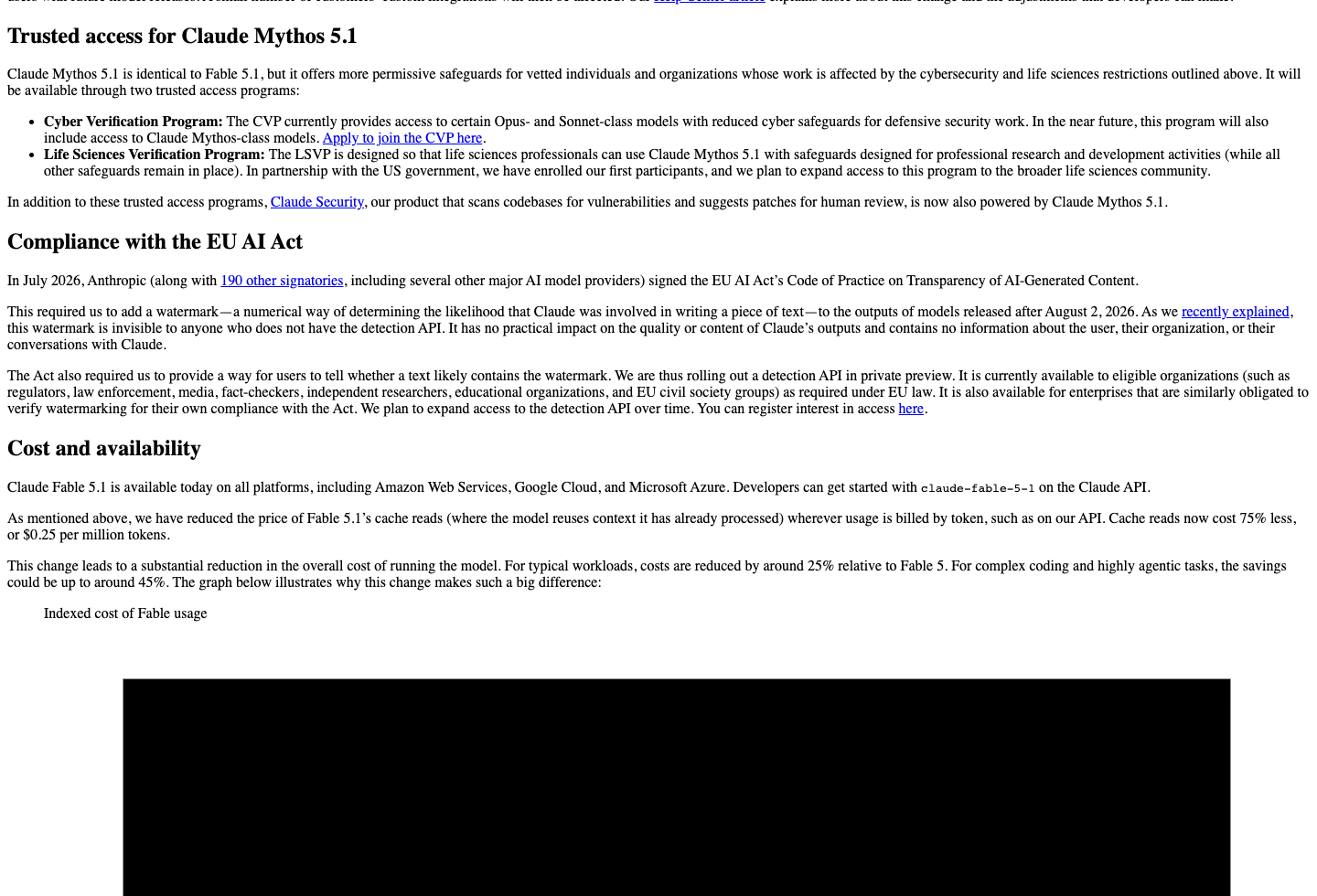
Anthropic lists Fable 5.1 at $10 per million input tokens and $50 per million output tokens, the same list rates as Fable 5. Cache reads are $0.25 per million tokens. Anthropic estimates about 25% lower cost for typical workloads and up to about 45% for complex, context-heavy agentic work; those are Anthropic estimates based on its stated workload assumptions, not a guaranteed discount.
The key variable is reuse. A one-off prompt will not benefit much from cache-read pricing, while a workflow that repeatedly sends a large brief, codebase summary, or policy pack can. For the older-generation context, see our Claude Fable 5 pricing guide. If the comparison you are making is between separate subscriptions rather than API token billing, GlobalGPT plans provide a separate multi-model subscription route; they are not a conversion of Anthropic API pricing.
Official API list prices
Move the slider for monthly input volume. Estimate assumes output equals 20% of input and 50% of input tokens are cache reads.
10M input tokens / monthClaude Fable 5.1 vs Fable 5: Is It a Meaningful Upgrade?
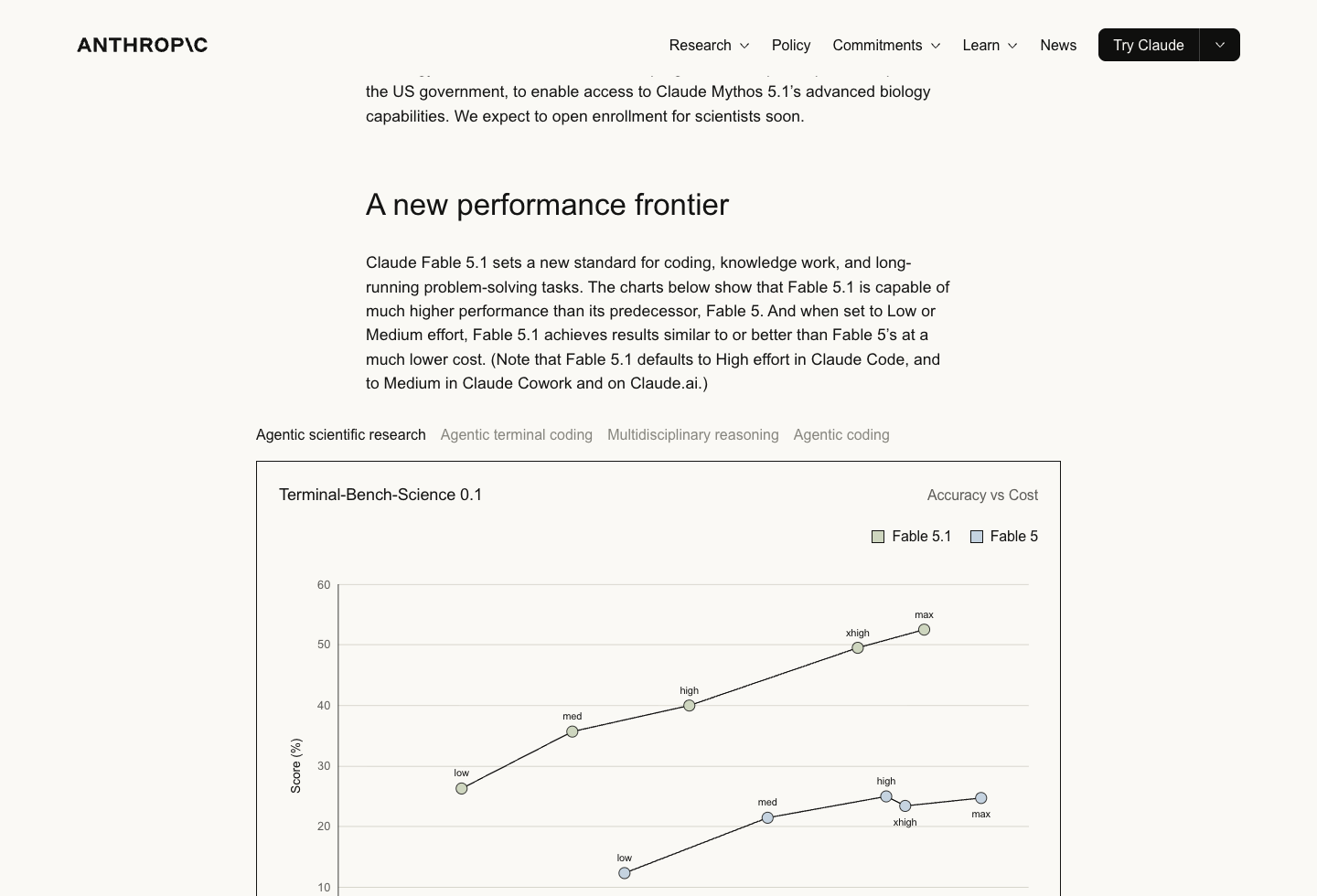
Anthropic reports higher Fable 5.1 scores than Fable 5 on several task-specific evaluations, including 52.6% versus 24.7% on Terminal-Bench-Science, 55.8% versus 42.0% on Terminal-Bench, 31.4% versus 17.1% on AutomationBench, and 73.4% versus 70.5% on CursorBench. Its GDPval-AA v2 result is 1853 versus 1723. These are Anthropic-reported figures with their own harnesses and conditions, so they are useful context rather than an independently reproduced overall ranking.
We did not run a direct Fable 5 baseline in the same venue. The honest upgrade conclusion is therefore conditional: the official evidence points to task-specific gains and lower cache-read cost, while an independent Fable 5.1-versus-Fable 5 judgment remains unfinished.
If your choice is broader than this one upgrade, our Claude Fable 5 vs GPT 5.5 comparison is a better next read than treating a single benchmark row as a universal ranking.
Anthropic-reported task results
Hands-On Tests: What We Actually Checked
We used the Anywhere API route /v1/chat/completions after verifying the returned model ID claude-fable-5-1 and a small structured-output probe. Every result below is the first valid output from a frozen, closed-input task. SVG input was rejected before T05 reached the model, so the identical fixture was converted to PNG and run once; no valid result was replaced.
First-output evidence
The response identified why zero values disappeared, proposed a minimal code change, and explicitly did not claim a test run.
{
  "root_cause": "scores.filter(Boolean) removes all falsy values, including the numeric score 0, so normalize([0, 4, null, undefined]) drops the 0 and returns [4] instead of [0, 4]. The predicate is too broad; it should only exclude null and undefined.",
  "unified_diff": "--- a/normalize.js\n+++ b/normalize.js\n@@ -1,3 +1,3 @@\n function normalize(scores) {\n-  return scores.filter(Boolean);\n+  return scores.filter((score) => score != null);\n }",
  "expected_test_results": "normalize([0, 4, null, undefined]) is expected to return [0, 4] because score != null is false only for null and undefined, so 0 is kept. normalize([7]) is expected to return [7], unchanged. These are expectations based on reading the code; no test run was performed.",
  "remaining_risk": "Other falsy values that were previously filtered out (NaN, empty string, false) will now be retained, which matches the stated requirement (remove only null/undefined) but may surface as a behavior change if any caller relied on the old filtering. If input can be non-array, the function still throws, as before."
}The response mapped supplied claims, found the $18,000/$20,000 conflict, and kept the cause unresolved rather than inventing one.
{
  "claims": [{"claim":"The pilot began on 3 March with 120 enrolled students.","source":"Document A","section":"A1","status":"stated"},{"claim":"Attendance was recorded weekly.","source":"Document A","section":"A2","status":"stated"},{"claim":"At the 31 March checkpoint, 96 of 120 enrolled students had attended at least three sessions.","source":"Document B","section":"B1","status":"stated"},{"claim":"The programme budget was $18,000.","source":"Document B","section":"B2","status":"contradicted"},{"claim":"The finance note lists an approved programme budget of $20,000.","source":"Document C","section":"C1","status":"contradicted"},{"claim":"The note does not state whether the budget difference reflects a revision or a recording error.","source":"Document C","section":"C2","status":"stated"}],
  "contradictions": [{"topic":"Programme budget","sources":[{"source":"Document B","section":"B2","value":"$18,000"},{"source":"Document C","section":"C1","value":"$20,000"}],"description":"Document B states the programme budget was $18,000, while Document C lists an approved programme budget of $20,000."}],
  "unresolved": [{"issue":"Whether the $2,000 difference between the $18,000 budget (Document B, B2) and the $20,000 approved budget (Document C, C1) reflects a revision or a recording error.","source":"Document C","section":"C2","reason":"Document C explicitly states the note does not clarify the cause of the difference, and no other supplied document addresses it."}]
}The verified chat endpoint did not expose file-writing or validator tools. The task was therefore not sent as a model-quality test, and no output or score is claimed.
The response calculated the observed difference and refused the unsupported causal conclusion.
{
  "mean_control": {"value": 10, "units": "points"},
  "mean_treatment": {"value": 14, "units": "points"},
  "difference": {"value": 4, "units": "points", "direction": "treatment minus control"},
  "supported_conclusion": "In this dataset, the treatment group had a mean score 4 points higher than the control group (14 vs. 10 points).",
  "unsupported_conclusion": "That the treatment caused the 4-point higher score; the groups were not randomly assigned and no baseline scores were collected, so the difference may reflect pre-existing differences between groups.",
  "limitations": ["Non-random group assignment, so selection bias cannot be ruled out", "No baseline scores, so pre-existing differences between groups cannot be assessed", "Very small sample size (n=4 per group)", "No inferential statistics computed; the difference has not been tested for statistical significance", "Observational design does not support causal claims"]
}The PNG run returned the labeled April values, distinguished visual estimates from labeled values, and avoided unsupported extrapolation.
{
  "april_alpha": 30,
  "april_beta": 25,
  "trend": "Both Alpha and Beta increase steadily each month from Jan to Apr, with Alpha consistently about 5 hours above Beta (estimated visually: Jan ~15/10, Feb ~20/15, Mar ~25/20, Apr 30/25 as labeled).",
  "unsupported": ["April values are explicitly labeled on the chart; Jan, Feb, and Mar values are visual estimates only", "No data beyond April or before January is shown, so no claims about other months can be made", "Units are labeled as study hours but no source, sample size, or definition of Alpha/Beta groups is given"]
}
Safety, Data, and Compatibility Limits
Fable 5.1 can be used to discover software vulnerabilities, but Anthropic says it is not intended for exploit development and may route some dual-use work to Opus. Life-science research and Mythos access have separate restrictions. Data retention is route-specific: AWS documentation, for example, should not be generalized to every Claude or third-party API path.
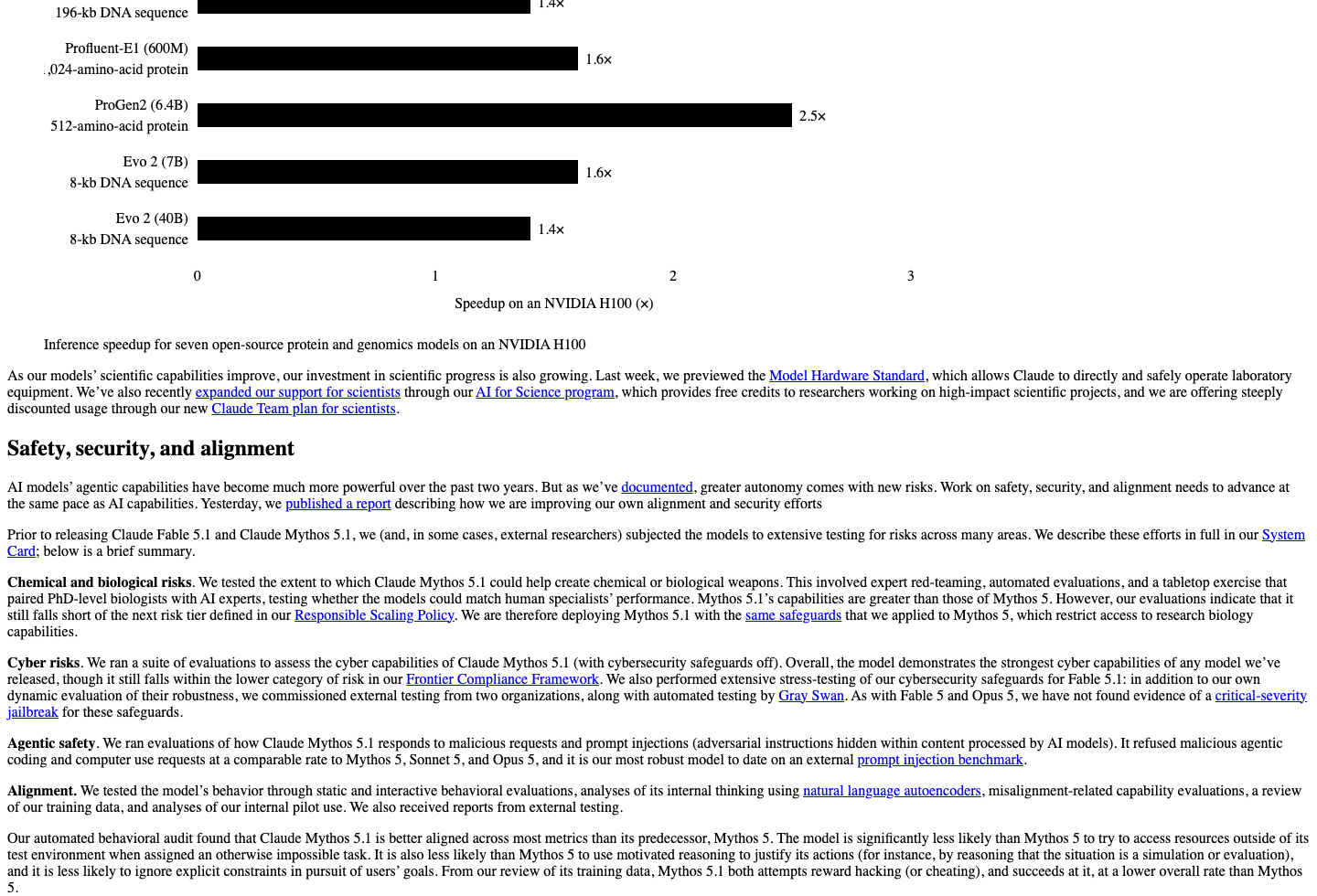
Anthropic also notes gaps in its own alignment coverage for very long-context, multi-agent, and impossible-task settings. That is a reason to validate a high-stakes deployment with your own bounded task, not a reason to ignore the model’s documented improvements.
Who Should Try Claude Fable 5.1?
Try it when your work benefits from careful coding support, source-bounded synthesis, document contradiction checks, or image-to-text extraction. Verify first when you need a specific regional deployment, zero-retention terms, a tool-using agent, or a direct Fable 5 comparison. If you are choosing a general Claude plan rather than API access, the separate Claude AI pricing guide explains the plan-versus-API distinction.
Claude Fable 5.1 FAQ
What is the practical difference between Claude Fable 5.1 and Mythos 5.1?
Anthropic describes them as the same underlying model with different safeguards and access rules. Fable 5.1 is the general-availability route discussed here. Mythos 5.1 is reserved for trusted-access programs in cybersecurity and life sciences, so Mythos capabilities are not a promise about a standard Fable account.
Can I use Claude Fable 5.1 in the Claude app, or is it API-only?
Do not infer consumer-app access from an API or cloud announcement. Anthropic names its own platforms and major cloud providers as access routes, but the plan, region, quota, and tool set depend on the route. Check the exact account surface you intend to use before changing a workflow around it.
What is the correct Claude Fable 5.1 model ID?
Anthropic lists claude-fable-5-1 for its API. Cloud providers can use route-specific identifiers, so copy the model ID from the provider documentation for the endpoint you are actually calling.
Does Claude Fable 5.1 have a 1M-token context window?
AWS documents a 1M-token context window and a 128K maximum output for its Bedrock route. That is useful for Bedrock planning, but it should not be generalized to every Claude API, consumer, or third-party route without checking its own documentation.
Does Fable 5.1 accept images and generate images?
AWS documents text and image input with text output for the Bedrock route. That means image understanding is documented there; it does not mean that the model is an image generator or that every route accepts the same formats. In our bounded API check, PNG input worked after SVG was rejected by the request layer.
When does the lower cache-read price make a difference?
It matters when the same large context is reused across requests: for example, a persistent codebase brief, a policy corpus, or a long research pack. For isolated short prompts, normal input and output volume dominate the bill. Use the calculator above as a planning estimate, then compare it with the actual caching behavior of your route.
Can Fable 5.1 run a tool-using agent on its own?
That depends on the environment around the model. A chat-completions endpoint can return a strong text answer without exposing file writing, validators, browsing, or a repository sandbox. Our test route did not expose those tools, so it was not used to claim autonomous-agent execution.
Is Claude Fable 5.1 definitely better than Fable 5?
Anthropic reports task-specific gains and lower cache-read pricing. That is a strong reason to evaluate the upgrade on work that resembles your own, but it is not an independent universal winner verdict. This article did not run a same-venue Fable 5 baseline.
Sources: Anthropic release announcement; AWS announcement; Amazon Bedrock model card.