
مراجعة Claude Opus 5.5: السعر، ونتائج الاختبارات القياسية، واختبارات واجهة برمجة التطبيقات (API) الفعلية
Claude Opus 5.5 combines a 1M-token context window with a $4 / $20 per-million-token API price. This review separates Anthropic’s published claims, independent benchmark snapshots, and five direct task runs through the Messages API route.
The measured result is specific. Three tasks returned clean, usable answers; the coding task returned a useful answer but hit the first 1,024-token ceiling; the Chinese-writing run produced garbled text on the tested route. The sample shows concrete behavior and route limits, not a universal success rate.
إجابة سريعة
- الأداء: Anthropic reports Fable 5.1-level performance on most work, while Artificial Analysis recorded a 58 Intelligence Index score at max effort. METR’s narrower judgment-skill evidence did not show a large improvement over Fable 5.1.
- السعر: the official API rate is $4 per million input tokens and $20 per million output tokens. Cache reads cost $0.20 per million; 5-minute cache writes cost $5 per million.
- Hands-on result: long-text extraction, strict JSON, and arithmetic reasoning passed in the recorded runs. Coding was useful but truncated at the initial ceiling. The Chinese result is recorded as a route/encoding issue, not a model-level language verdict.
- API warning: thinking cannot be disabled, forced tool use returns an error, thinking blocks are tied to the model and conversation, and the older
computer_20251124tool is not accepted on the Claude API and Google Cloud route.
What the official docs say
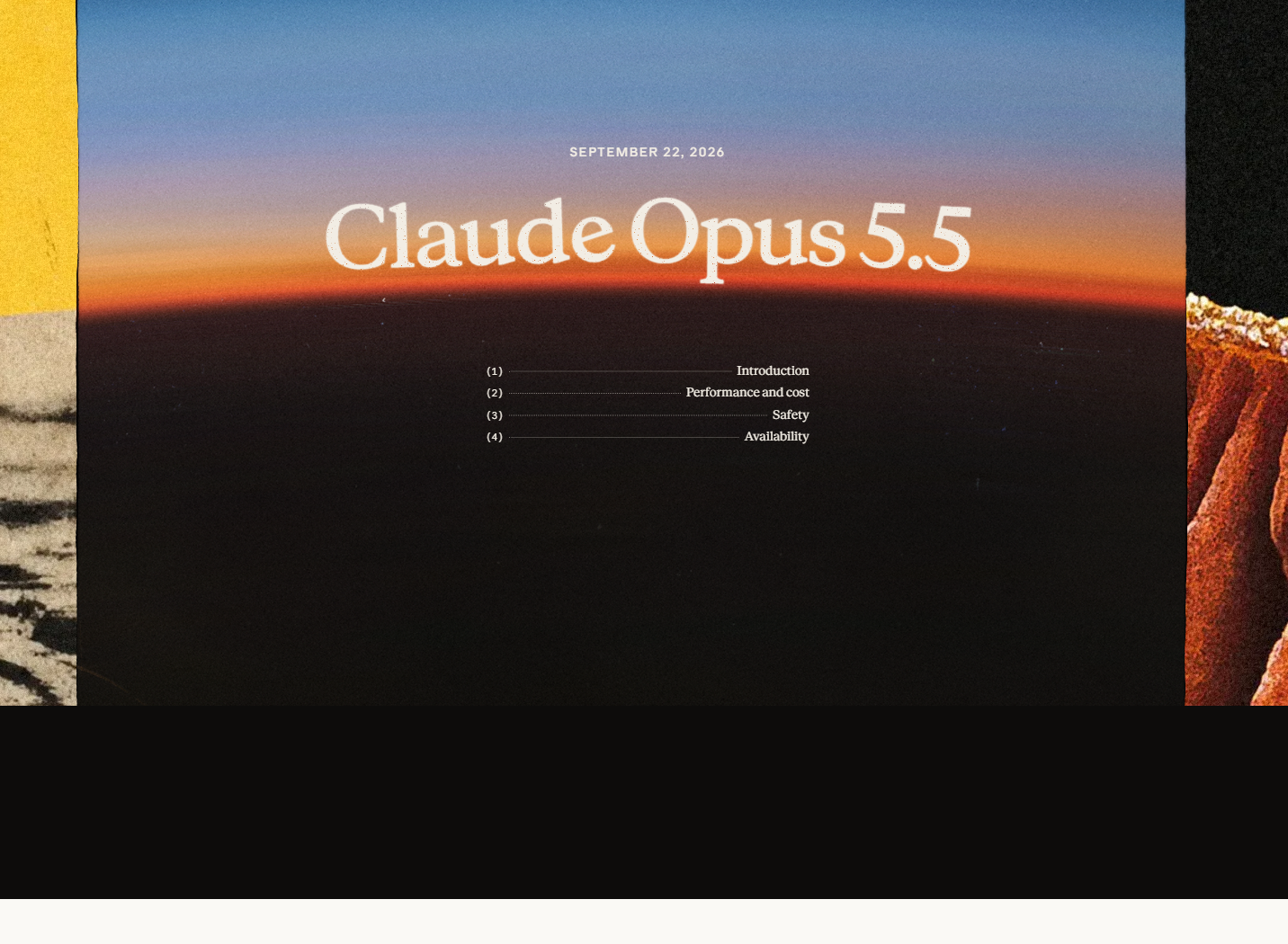
Anthropic’s release page dates Claude Opus 5.5 to September 22, 2026 and describes it as the first model in the Claude 5.5 family. The announcement claims performance at the level of Claude Fable 5.1 on most work, a 40% lower typical workload cost than Opus 5, and output more than 30% faster than Opus 5. Those are provider claims, so they are shown separately from the independent and hands-on evidence below.
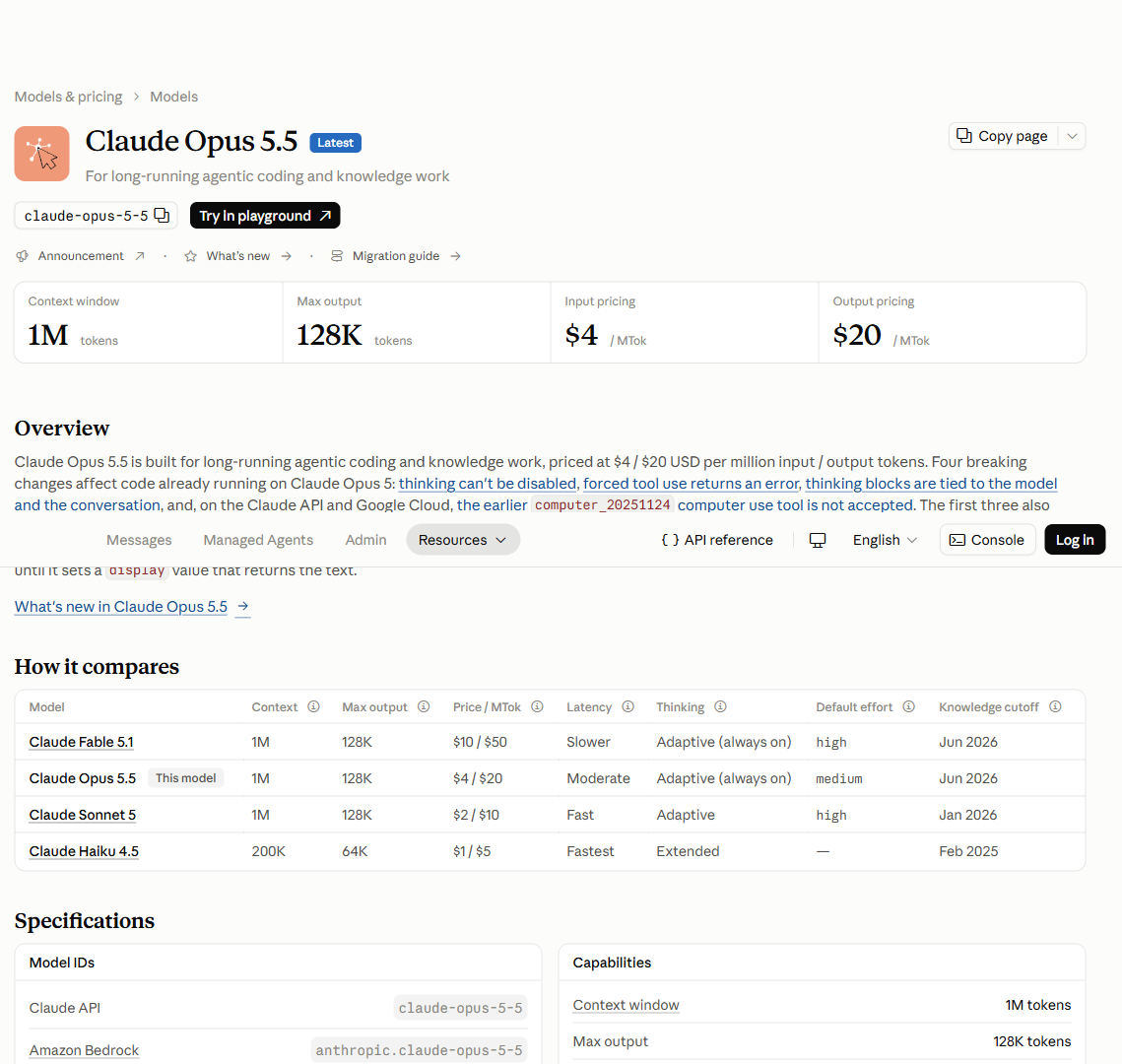
إن Claude Platform Docs list the API model ID as claude-opus-5-5, a 1M-token context window, a 128K maximum output, and adaptive thinking that is always on. The docs also list the changes that affect existing Opus 5 integrations, covered in the migration section below.
Performance evidence
There is no single “performance” number here. The three public sources measure different things, so each card keeps its metric and evidence boundary visible.
Anthropic announcement
Published signal: Anthropic says Opus 5.5 performs at the level of Claude Fable 5.1 on most work, costs 40% less than Opus 5 on typical workloads, and produces output more than 30% faster.
الحدود: provider-published positioning and tester examples, not an independent benchmark.
التحليل الاصطناعي
Published signal: the max-effort snapshot reports 59.6% on Terminal-Bench 4.0, 61.4% on Humanity’s Last Exam, and 66.9% on SciCode.
الحدود: scores depend on effort, harness, date, and metric definition. They do not predict every API prompt.
METR predeployment evaluation
Published signal: METR says its evidence did not show a large improvement over Fable 5.1 on the judgment skills it examined, while still expecting meaningful acceleration for some R&D work.
الحدود: this is a narrower evaluation of judgment and task acceleration, not a complete quality ranking.
Read together, the cards support a limited conclusion: Opus 5.5 is a leading model on several dated public evaluations, but the size of the advantage changes with the task, effort setting, and evaluation design. The cards do not establish a universal “best model” result.
Claude Opus 5.5 price and billing units
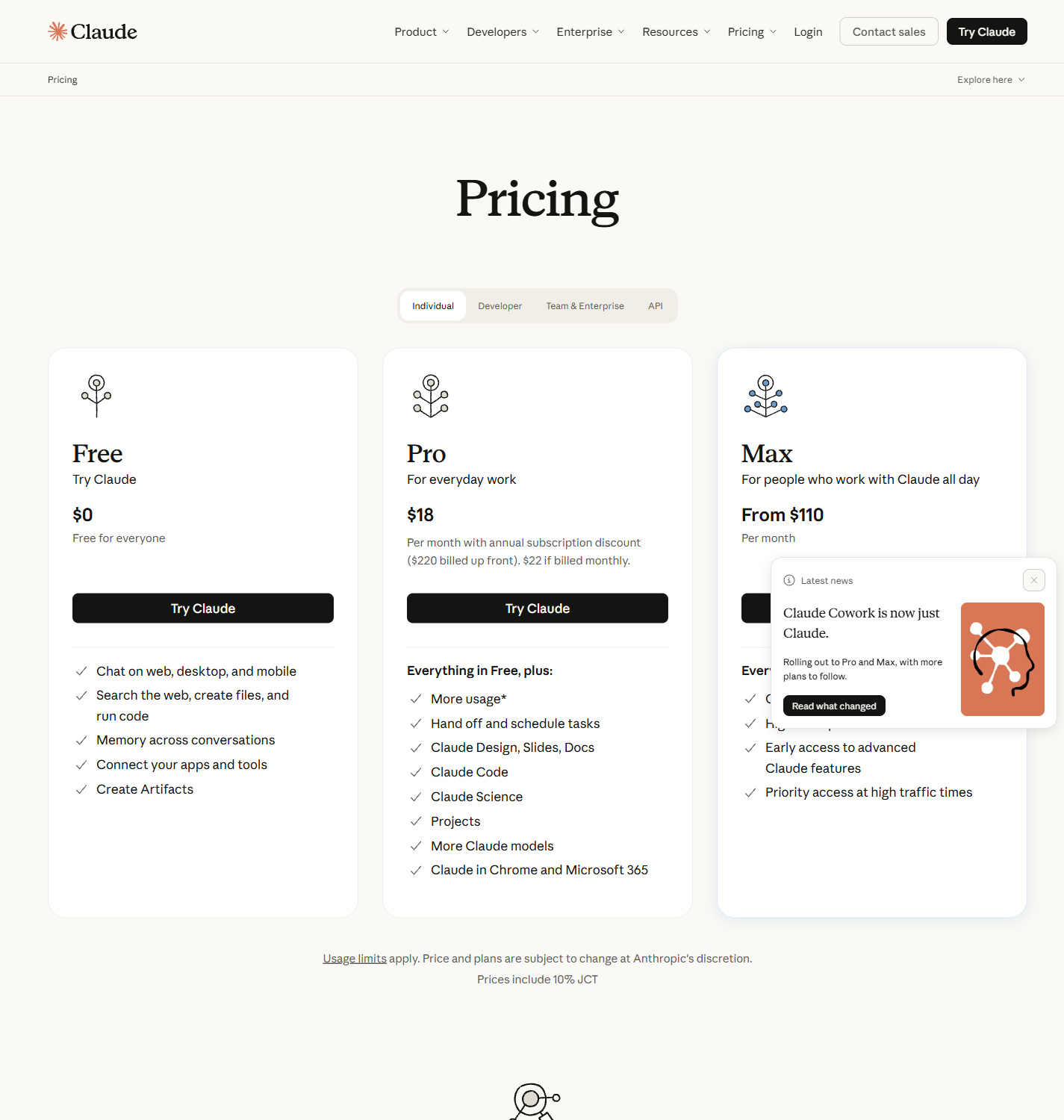
The API price and the consumer subscription price are different products. The API figures below are the unit prices used for token budgeting; the consumer figures are the plan cards visible in the captured browser region.
التسعير الرسمي لواجهة برمجة التطبيقات (API)
Simple estimate: 10,000 input tokens plus 2,000 output tokens is about $0.08 at standard rates, before cache, batch, tax, or platform markup.
Consumer plan screenshot
The captured page also shows a 10% JCT note. These are region-sensitive displayed values, not a global price promise.
For a separate explanation of token billing and context-window cost, see the دليل التسعير والسياق الخاص بـ GPT-5.5. The provider’s API rate, a subscription price, and any multi-model platform credit balance should remain separate in your budget.
Hands-on test: five task result cards
We sent five independent prompts through the same controlled Messages API route on September 23, 2026 with model ID claude-opus-5-5. The first pass used max_tokens: 1024. We recorded local elapsed time, input/output tokens, stop reason, correctness, and literal format compliance. The Chinese-writing task was rerun with a 4,096-token ceiling after the first pass exposed the route’s output issue. This is a five-task sample, not a reliability estimate.
Can it repair a mixed-type deduplication function?
إعداد المهمة
Find the bug in a Python dedupe function, handle non-string and unhashable values, preserve the first spelling, and provide tests.
The response identified the .lower() failure on non-string values, switched strings to casefold(), added an unhashable fallback, and returned corrected code plus test cases.
The answer stopped at the 1,024-token ceiling. The fix was useful, but the configuration was too small for a full code review.
Card verdict: technically useful answer returned; this run cannot support a latency or completeness claim because the token ceiling cut it off.
Can it preserve facts and test limitations?
إعداد المهمة
Extract five numbered findings from a short evaluation memo, including the method and what the next round did not measure.
Returned exactly five numbered bullets. It preserved the assistant comparisons, the 20-prompt method, and the gaps around long-term retention and customer conversion.
This was a short source pack, so it does not test the 1M context window.
Card verdict: clean extraction with the requested count and the source memo’s evidence boundary preserved.
Can it return machine-readable output without cleanup?
إعداد المهمة
Return a fixed JSON object with a title, audience, two pros, two cons, and a verdict. No Markdown fence was allowed.
Returned parseable JSON with the requested keys, two pros, two cons, and a concise recommendation. No Markdown wrapper was present.
One valid response does not prove schema reliability across larger or nested objects.
Card verdict: literal JSON compliance passed in this run.
Can it apply a repeated rounding rule correctly?
إعداد المهمة
Start with 12 items, multiply each next batch by 1.25, round down after each batch, and report the total across four batches.
Returned 12, 15, 18, and 22, then summed them to 67. The intermediate arithmetic was visible.
The task is deterministic and small; it does not represent broad reasoning performance.
Card verdict: correct result and transparent intermediate steps.
Did the tested route return usable Chinese text?
إعداد المهمة
Draft a Chinese review opening that separates official claims, price, benchmark evidence, and hands-on testing.
The response structure was present, but Chinese characters were returned garbled through the tested route in the saved result.
The evidence does not distinguish model language quality from route or encoding behavior. No Chinese-quality score is assigned.
Card verdict: unusable returned text on this route; rerun with a verified UTF-8 path before making a language-quality claim.
Across the four language-neutral or English runs, the local mean was 6.24 seconds. That number describes five sequential requests on one route and is not provider-side latency. The strongest observed behaviors were concise extraction, literal JSON compliance, and correct arithmetic; the two unresolved issues were output-budget pressure on coding and garbled Chinese output on the tested route.
API and migration caveats
The quick answer includes these because they can change an integration even when the model’s text quality looks good.
- Thinking is always on. Use the documented effort parameter to control depth, latency, and cost; there is no off switch.
- Forced tool use returns an error. Existing code that requires forced tool selection needs a separate migration test.
- Thinking blocks are bound to model and conversation. Do not assume a thinking block can be reused after changing models.
computer_20251124is not accepted on the Claude API and Google Cloud route listed in the docs.- Output ceilings matter. The coding card shows a useful response can still be cut off by a small
ماكس_توكينزvalue. - Batch and fast mode are separate billing paths. Keep their discounts or surcharges separate from standard token prices.
Evidence-based verdict
Claude Opus 5.5 has strong dated public benchmark evidence and a lower published standard API rate than the Opus 5 figures shown in Anthropic’s announcement. In the five recorded task runs, it produced clean extraction, strict JSON, and arithmetic; the coding answer was useful but truncated by the initial ceiling; and the Chinese output was not usable through the tested route.
The defensible conclusion is therefore narrow: the model demonstrated strong instruction following on several small tasks, while the route and configuration introduced visible limits. Any migration decision should repeat the same prompts with a suitable output budget, verify tool calls, and keep official token rates separate from subscription or platform credits.
If you want a second route for comparison, the DeepSeek V4 Pro vs Flash test format shows how task-level verdicts can stay separate from model-wide claims. The دليل حالات استخدام GPT-5.5 adds a task-oriented reference point, while Gemini Flash benchmark notes و AI model comparison guide provide nearby model context. For multi-model access, see all-in-one AI subscriptions و the multi-model platform comparison.
الأسئلة الشائعة
How much does Claude Opus 5.5 cost?
The official API rate is $4 per million input tokens and $20 per million output tokens. Cache reads are $0.20 per million tokens, and 5-minute cache writes are $5 per million tokens.
What is the Claude Opus 5.5 context window?
The Claude Platform Docs list a 1 million-token context window and a 128K-token maximum output. A separate documented beta path supports up to 300K output tokens for Message Batches.
Is Claude Opus 5.5 better than Opus 5?
Anthropic reports lower typical workload cost and faster output, while independent evaluations show strong results on several dated tasks. The size of any quality gain depends on the benchmark, effort setting, prompt, and route.
Can thinking be turned off?
No. The current model documentation says adaptive thinking is always on. Use the effort parameter to control thinking depth, latency, and cost.
Did the five API tasks prove reliability?
No. The cards show concrete behavior and configuration limits, but five tasks cannot estimate a general success rate. The coding ceiling issue and Chinese route issue are reported separately.
Did this review prove Chinese quality?
No. The tested route returned garbled Chinese text, so the result is recorded as an encoding or route issue pending a verified UTF-8 rerun.