GPT-5 and Gemini 2.5 Pro are both strong AI models, but they are not interchangeable. GPT-5 is best understood as OpenAI’s previous reasoning model for coding, agentic workflows, and structured professional tasks. Gemini 2.5 Pro is Google’s state-of-the-art 2.5-series thinking model, built for complex reasoning across code, math, STEM, large datasets, codebases, and long documents.
GPT-5 is no longer OpenAI’s latest model. OpenAI’s official GPT-5 documentation now describes GPT-5 as its previous model and recommends using GPT-5.5 for the latest frontier work. Gemini 2.5 Pro remains an officially documented stable model, but Google’s current model family has also moved forward.
That means the best way to read this comparison is practical:
- Use it if you specifically need to compare GPT-5 vs Gemini 2.5 Pro.
- If you want the newest frontier-model comparison, also compare newer options such as GPT-5.5 and current Gemini 3 models.
- If you are choosing a model for real work, test the same prompt across several models instead of relying only on brand-level claims.
GlobalGPT can help with that last step. It gives users access to multiple AI models in one workspace, so you can compare ChatGPT, Gemini, Claude, and other models on the same writing, coding, research, or image task before deciding which model fits your workflow.

All-in-one AI platform for writing, image&video generation with GPT-5, Nano Banana, and more
Overview of GPT-5
GPT-5, developed by OpenAI, builds upon the impressive capabilities of GPT-4 and GPT-4 Turbo. It offers improved reasoning, faster response times, and more accurate context retention over long conversations. In testing, GPT-5 demonstrated remarkable skill in:
- Complex reasoning tasks: Better at multi-step logic than its predecessors.
- Creative writing: Produces more coherent, engaging, and original long-form content.
- Code generation: Handles complex programming requests with fewer syntax errors.
- Multimodal abilities: Enhanced image and audio understanding, though still text-dominant.

For businesses, GPT-5 offers superior integration with existing workflows and APIs, making it ideal for chatbots, content creation, and advanced knowledge retrieval.
Overview of Gemini 2.5 Pro
Gehttps://ai.google.dev/gemini-api/docs/models/gemini-2.5-promini 2.5 Pro, developed by Google DeepMind, represents a leap forward from the Gemini 1 and 1.5 series. Known for its multimodal first architecture, Gemini 2.5 Pro shines in:
- Image-text integration: Processes and generates combined visual + text outputs seamlessly.
- Real-time reasoning: Strong in fast decision-making scenarios like data analysis or real-time translations.
- Mathematics and science: Handles symbolic reasoning and STEM problems with high accuracy.
- Search integration: Leverages Google’s ecosystem for fresher, web-connected results.

Its biggest selling point is its deep integration with Google Workspace and potential for AI-powered search augmentation.
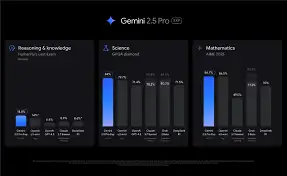
Quick Answer: GPT-5 vs Gemini 2.5 Pro
Choose GPT-5 if your work depends on coding help, structured reasoning, tool-based workflows, or OpenAI API compatibility.
Choose Gemini 2.5 Pro if your work involves long-context analysis, multimodal input such as audio, images, video, text, or PDF, and deep integration with Google’s AI ecosystem.
For most users, the difference is not simply “which model is smarter?” The better question is:
Which model performs better on my actual task, with my files, my prompt, my budget, and my workflow?
Performance Comparison: GPT-5 vs Gemini 2.5 Pro
The table below uses official model documentation checked on June 18, 2026.
| Category | GPT-5 | Gemini 2.5 Pro |
|---|---|---|
| Official model ID | gpt-5 | gemini-2.5-pro |
| Current status | OpenAI describes it as a previous model and recommends GPT-5.5 for the latest work | Google lists it as a stable Gemini 2.5 Pro model |
| Best described as | Reasoning model for coding, reasoning, and agentic tasks | Thinking model for code, math, STEM, large datasets, codebases, and documents |
| Input types | Text and image | Audio, images, video, text, and PDF |
| Native output | Text | Text |
| Context window | 400,000 tokens | 1,048,576 input tokens |
| Max output | 128,000 tokens | 65,536 output tokens |
| Knowledge cutoff | September 30, 2024 | January 2025 |
| API pricing shown in official docs | $1.25 per 1M input tokens and $10.00 per 1M output tokens | Check Gemini API pricing page for current route and tier |
| Function calling | Supported | Supported |
| Structured outputs | Supported | Supported |
| Code execution | Not listed as a GPT-5 model feature on the model page | Supported |
| Search grounding | Available through supported OpenAI tools/routes, depending on product setup | Supported |
| Image generation | Not native to GPT-5 model output | Not supported for Gemini 2.5 Pro |
Important correction: Do not describe Gemini 2.5 Pro as an image-generation model. Google’s official Gemini 2.5 Pro page lists multimodal inputs, text output, and says image generation is not supported for this specific model.
In hands-on testing, GPT-5 excelled at storytelling, nuanced conversation, and creative ideation, while Gemini 2.5 Pro was unbeatable in visual-text workflows, quick factual lookups, and tight Google integration.
Pricing and Access
Pricing changes often, so article updates should avoid unsupported permanent claims like “cheaper,” “best value,” or “lowest price” unless the exact route and date are shown.
OpenAI’s GPT-5 model page currently lists:
- $1.25 per 1M input tokens;
- $0.125 per 1M cached input tokens;
- $10.00 per 1M output tokens.
Google’s Gemini API pricing depends on the exact model, tier, and route. The pricing page distinguishes free, paid, and enterprise access, with different limits and data-use rules. For any production article, link to the official Gemini pricing page rather than hard-coding a claim that may become outdated.
If the article promotes GlobalGPT, the safer value proposition is not “this model is always cheaper.” A better line is:
GlobalGPT lets you try multiple AI models in one workspace, so you can compare output quality and workflow fit before committing to a single provider.
Which AI Model Should You Choose?
- Choose GPT-5 if your work demands high-quality writing, deep reasoning, and versatile integration across platforms.
- Choose Gemini 2.5 Pro if you rely heavily on visual data, real-time search, or work within Google’s productivity suite.
Free GPT-5 and Gemini 2.5 Pro available on GlobalGPT, an all-in-one AI platform.
Final Verdict
GPT-5 and Gemini 2.5 Pro are both capable AI models, but they are built for different workflows.
GPT-5 is the better first test for coding, structured reasoning, agentic tasks, OpenAI API workflows, and polished business writing. It has a 400,000-token context window, a 128,000-token maximum output, text and image input, and text output.
Gemini 2.5 Pro is the better first test for long-context and multimodal-input work. It supports audio, images, video, text, and PDF input, with a 1,048,576-token input limit and 65,536-token output limit.
For everyday users, the smartest answer is not to pick a permanent winner. Use GPT-5 when the task is OpenAI-centered, structured, or code-heavy. Use Gemini 2.5 Pro when the task includes long files, PDFs, mixed media, or Google ecosystem workflows. If the task matters, test both.
GlobalGPT makes that comparison easier by putting multiple AI models in one workspace. Instead of guessing which model is best, you can run the same prompt across GPT, Gemini, Claude, and other models, then choose the answer that works best for your task.
FAQ
Is GPT-5 better than Gemini 2.5 Pro?
Not always. GPT-5 is often the better first choice for coding, structured reasoning, and OpenAI API workflows. Gemini 2.5 Pro is often the better first choice for long-context, multimodal-input, and Google ecosystem workflows.
Is GPT-5 still the latest OpenAI model?
No. OpenAI’s current GPT-5 documentation describes GPT-5 as a previous model and recommends GPT-5.5 for the latest work.
Is Gemini 2.5 Pro still available?
Google’s official documentation still lists gemini-2.5-pro as a stable model. However, users comparing the newest models should also check Google’s current Gemini model lineup.
Which model has the larger context window?
Gemini 2.5 Pro has the larger documented input limit at 1,048,576 tokens. GPT-5 has a 400,000-token context window and a larger documented maximum output of 128,000 tokens.
Can Gemini 2.5 Pro generate images?
No, not according to the official Gemini 2.5 Pro model page. It supports multimodal input, but its output is text and image generation is listed as not supported for this model.
Can GPT-5 understand images?
Yes. OpenAI’s GPT-5 model page lists text and image as input types, with text output.
Which model is better for coding?
GPT-5 is a strong first test for coding and agentic development workflows. Gemini 2.5 Pro is also useful for coding, especially when the task involves long codebases, files, PDFs, or other large-context material.