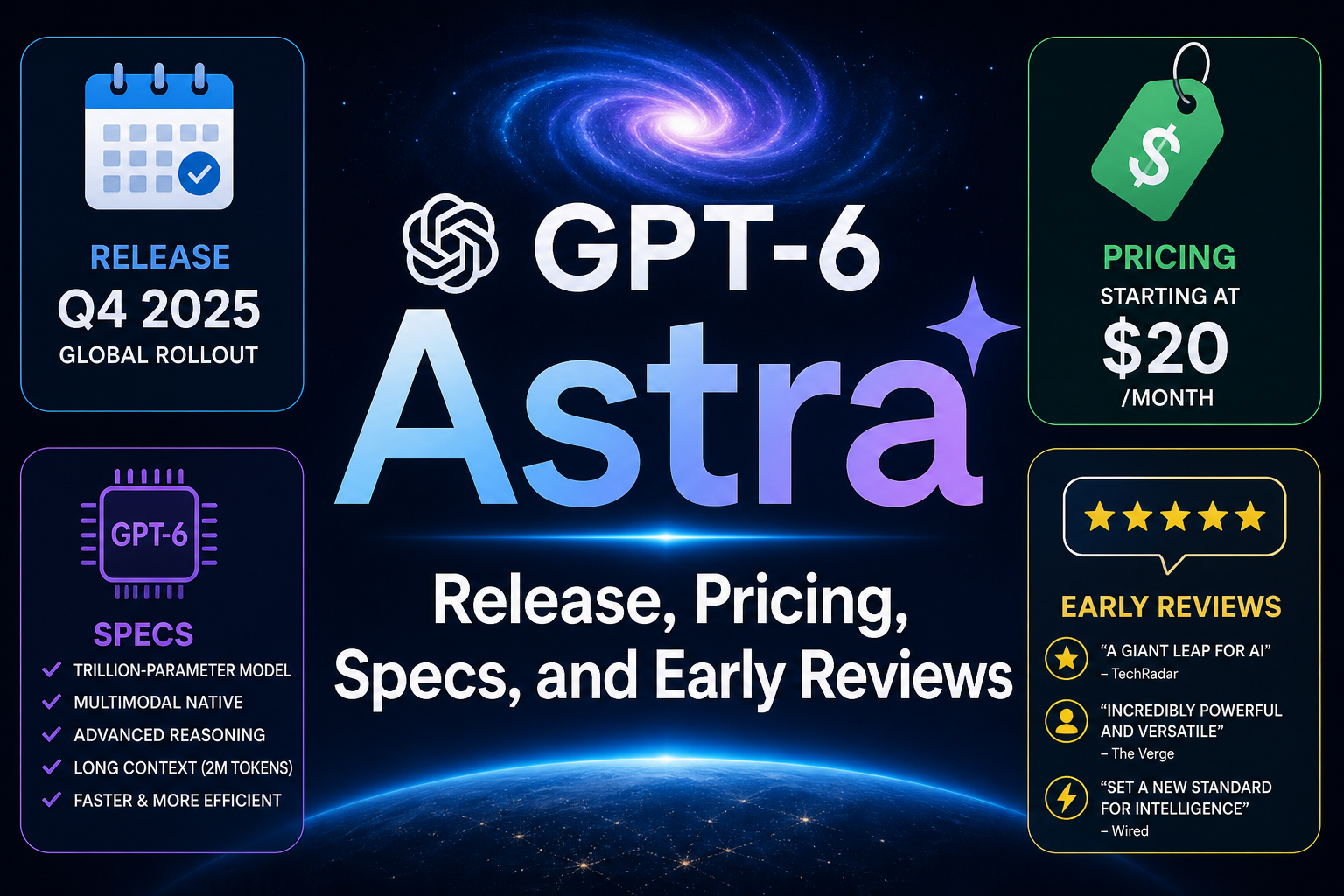
Risposta rapida: GPT-6 Astra is real and has begun rolling out to enterprises in OpenAI’s Trusted Access Program. OpenAI says API, Plus, Pro, Business, and Enterprise access will follow over the next few days. The model combines a Finestra contestuale da 1.050.000 gettoni with stronger long-running agent work, computer use, and mid-task steering. Standard API pricing starts at $10 per 1 million input tokens e $50 per 1 million output tokens. This article uses OpenAI’s published documentation and an attributed early review; GlobalGPT has not independently tested Astra, and Astra was not listed in GlobalGPT when checked on September 4, 2026.
GPT-6 Astra is arriving with an unusually specific promise: not just a smarter answer, but an AI system that can keep working across long, tool-heavy tasks without losing the thread. That makes its release especially relevant to developers, researchers, and teams building agents.
This guide separates what OpenAI has officially documented from what an early reviewer experienced. You will find the rollout status, model specifications, API pricing, practical use cases, early praise, reported limitations, and the questions worth testing before adopting it.
Astra is not currently listed in GlobalGPT’s model picker. While access expands, you can use GPT-5.6 Sol su GlobalGPT or compare other available models in one place. Treat that as a current alternative, not an Astra access claim.
Is GPT-6 Astra Available?
Status ufficiale
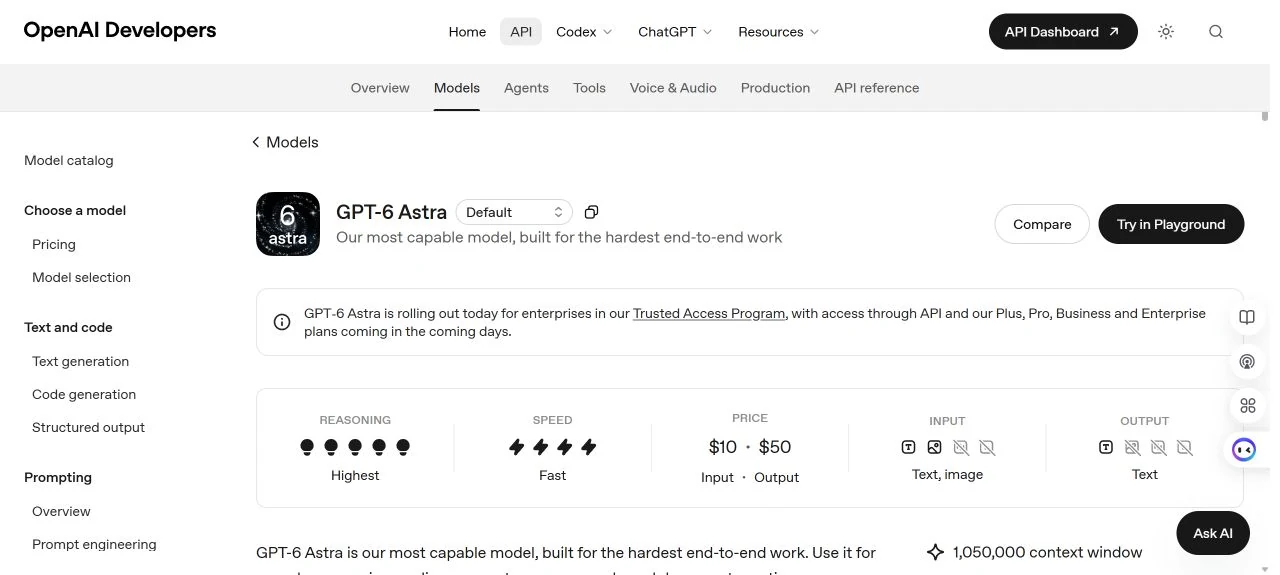
Yes, but the rollout is staged. The official GPT-6 Astra model page says the model has started rolling out to companies in OpenAI’s Trusted Access Program. OpenAI says API access and availability for ChatGPT Plus, Pro, Business, and Enterprise will follow over the next few days.
That wording matters. A published model page does not mean every account can select Astra immediately. Availability may depend on the product, plan, organization, and rollout timing. Check your own model picker or API account instead of relying on a screenshot from another user.
GPT-6 Astra Specifications
Astra accepts text and image inputs and produces text output. Its 1.05M-token context window matches the scale needed for large repositories, document collections, or long agent histories, while the 128K output ceiling gives it room for substantial code or reports.
Capacity is not the same as quality. A million-token window does not guarantee that every detail will be recalled equally well, and sending the maximum amount of context can increase both cost and noise. For practical long-context work, retrieve the most relevant files first and keep the task instructions explicit.
If you want a baseline for how the previous generation handled large prompts, see the GPT-5.5 pricing and context guide. For a broader task-oriented view, the Guida ai casi d'uso di GPT-5.5 helps identify workloads that may justify a flagship model.
GPT-6 Astra API Pricing
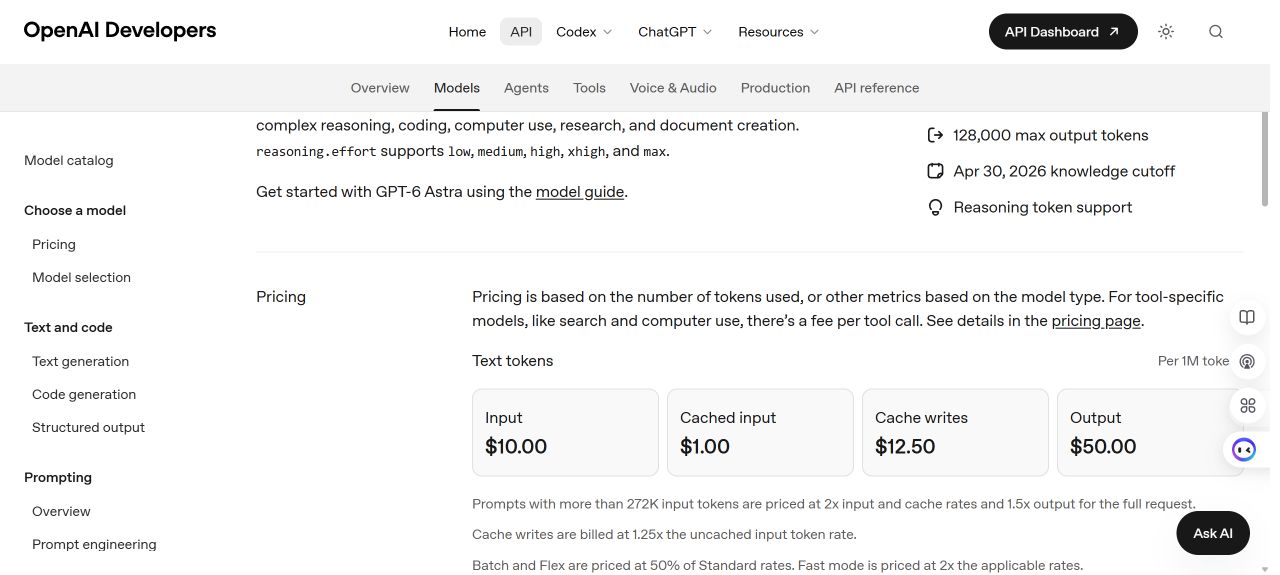
OpenAI lists the following Standard processing rates for prompts up to 272,000 input tokens:
| Token category | Prezzo per 1 milione di token | Cosa significa |
|---|---|---|
| Ingresso | $10.00 | New prompt content, history, retrieved material, and other billable input. |
| Input memorizzato nella cache | $1.00 | Eligible repeated input served through prompt caching. |
| Scrittura nella cache | $12.50 | Input written into the cache under the applicable cache-write pricing. |
| Uscita | $50.00 | Generated answer and billable reasoning output. |
Once a request exceeds 272,000 input tokens, OpenAI applies a 2x multiplier to input and cached-input rates e un 1.5x multiplier to output rates for the session. At the listed Standard rates, that means $20 per million input tokens and $75 per million output tokens.
For comparison with the current generation, see Prezzi GPT-5.6 e Prezzi GPT-5.4. Compare the full workload, not only the input rate: output length, cache behavior, tool use, and failure or retry rates can matter more than the headline price.
What Is Actually New in GPT-6 Astra?
OpenAI latest-model guide emphasizes a set of features aimed at long-running, interactive agent work.
Asynchronous tool calling
Astra can keep making progress while slower tools are still running instead of treating every tool call as a hard stop. That can help with research, coding, and operational tasks that combine several external systems with different response times.
Mid-task instructions
Users can add direction while a task is in progress. This is valuable when an agent is generally on track but needs a new constraint, a priority change, or a narrower scope. It should reduce the need to cancel a long run and start over.
Dynamic reasoning effort
Astra can adjust how much reasoning it applies during a task. In principle, that lets it spend more effort on difficult steps and less on routine ones. Teams should still test whether the quality gain is worth the added output-token cost for their own workload.
Computer use and long-task continuity
OpenAI positions Astra for computer interaction and work that unfolds over many steps. The practical question is not whether it can click through a demo, but whether it can recover from unexpected states, preserve the user’s intent, and explain what it changed. Those are the areas early adopters should evaluate.
Readers interested in the evolution from deliberative chat to tool-using systems can also review GPT-5.4 Pensare and this guide to using ChatGPT Agent.
Why Astra Changes the Buying Decision
The important shift is from evaluating an AI by the quality of one answer to evaluating whether it can complete an entire job. A useful agent may need to inspect files, operate software, wait for tools, recover from errors, apply a change, run checks, and explain the result. The final answer is only one part of that sequence.
That also changes the cost question. Astra’s token rates are high, but token price alone cannot tell you whether it is economical. A better comparison is cost per successfully completed task: model and tool charges, retries, elapsed time, human supervision, and cleanup all count. A cheaper model can cost more overall if it needs repeated correction; an expensive run is still wasteful if it wanders or produces work that must be redone.
More autonomy also raises the standard for controls. OpenAI’s latest-model guidance says Astra is subject to asynchronous misalignment monitoring. Teams should still give an agent the minimum permissions it needs, require confirmation before consequential actions, keep an action record, and create checkpoints that make changes reversible. Strong computer use is valuable only when the surrounding system limits what can go wrong.
What Early Reviewers Are Saying
Attributed early experience
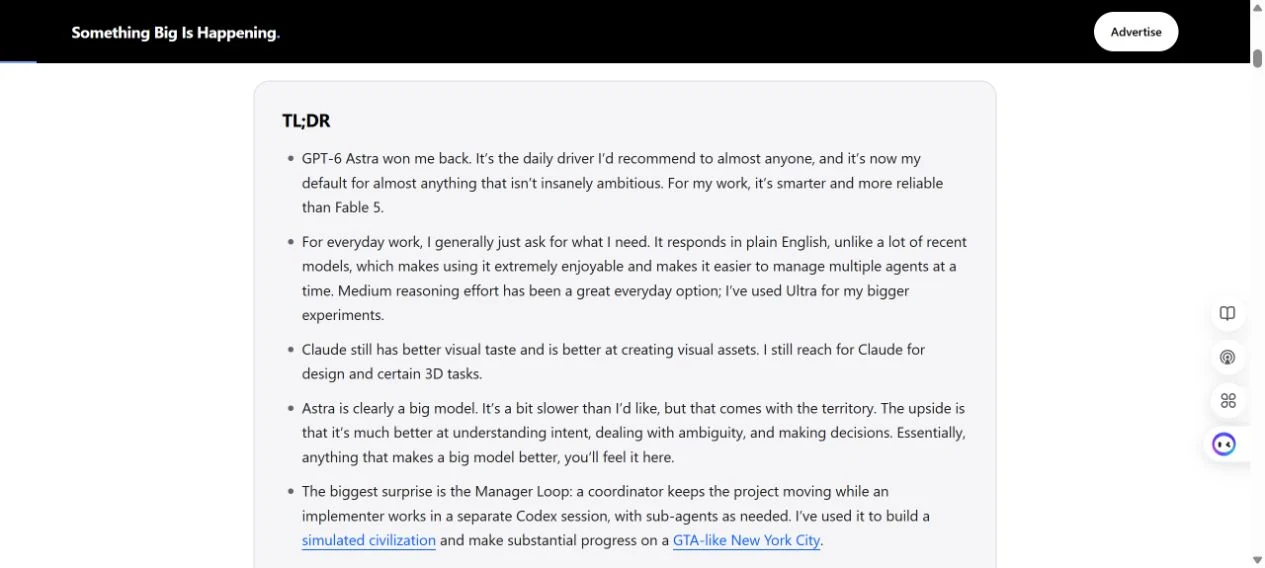
Matt Shumer’s early Astra review is one of the more detailed public accounts available at launch. He describes the model as strong at backend engineering, computer use, understanding underspecified requests, reporting its work clearly, and maintaining continuity across long conversations.
Backend engineering
The review highlights useful performance on complex implementation work, especially where the model must understand a system rather than produce a small isolated snippet.
Utilizzo del computer
Astra reportedly handles browser and desktop-style tasks with more awareness of the broader objective, though that does not eliminate the need for permissions and verification.
Ambiguous intent
The model is described as better at inferring what a user is trying to accomplish from incomplete instructions.
Continuity and reporting
The review credits Astra with preserving context over long sessions and giving clearer accounts of what it has done.
These observations line up with OpenAI’s positioning, but they remain qualitative. Launch access is limited, test environments vary, and one person’s tasks cannot establish general reliability. The fairest reading is that Astra shows promising agent behavior that still needs broader, repeatable testing.
Early Limitations and Open Questions
The same review also raises important concerns. Astra can be slow, consume large amounts of tokens, and still get absorbed in details during long autonomous work. Shumer also reports that its visual design output may trail Claude, even when its backend work is strong.
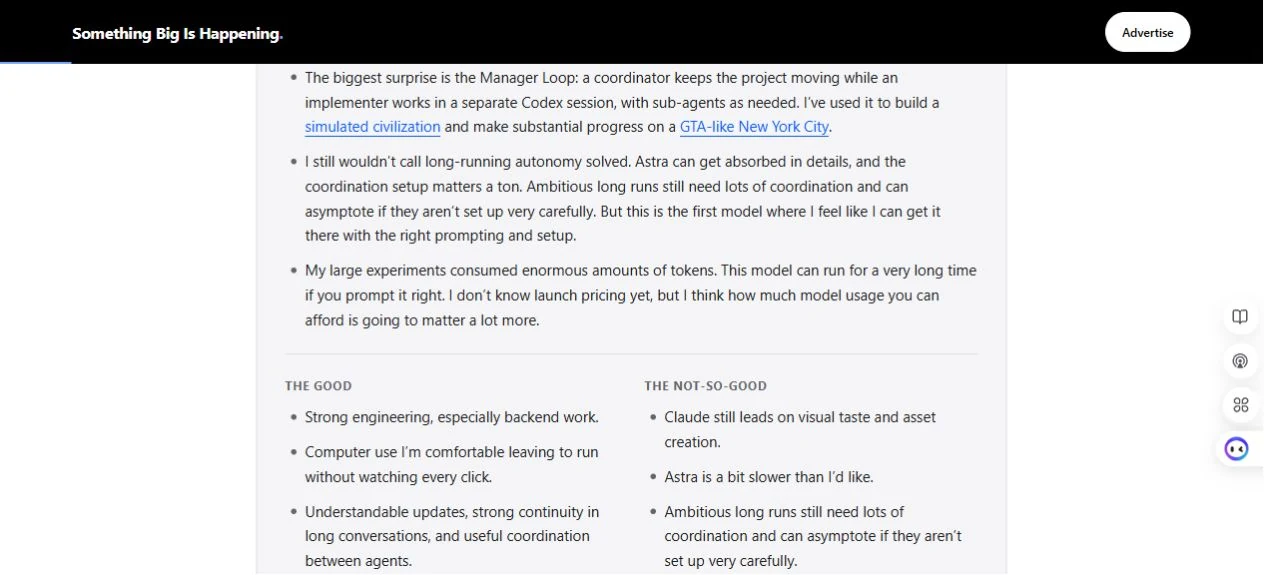
- Velocità: A model that reasons, uses tools, and checks its work may take longer than a lightweight chat model.
- Autonomy: Long-running does not mean unsupervised. The reviewer still found moments where the model needed coordination or redirection.
- Token use: Large context and extended reasoning can become expensive quickly, especially above the 272K threshold.
- Visual design: Strong coding performance does not automatically produce the best interface aesthetics.
- Evidence depth: There are not yet enough independent, matched tests to make broad claims about reliability or superiority.
The key adoption test is therefore efficiency, not maximum capability. Measure how often Astra completes the whole task correctly, how much supervision it needs, how many tokens it uses, and how much cleanup remains. A slower expensive run can still be worthwhile if it replaces hours of expert work, but not if it repeatedly wanders.
Who Should Use GPT-6 Astra?
| Potential fit | Why Astra may help | What to verify first |
|---|---|---|
| Large codebase work | Long context, tool use, and continuity across multi-file changes | Regression rate, test discipline, review time, and token cost |
| Research and synthesis | Can coordinate retrieval, analysis, and long-form output | Citation accuracy, source coverage, and unsupported inference |
| Computer-use agents | Designed for multi-step interaction with software | Permission boundaries, recovery from UI changes, and action logs |
| Large document analysis | 1.05M context can hold substantial source material | Recall across the full context and whether retrieval is cheaper |
| Long-running operations | Mid-task steering and asynchronous tools can reduce restarts | Escalation behavior, checkpoints, and safe rollback |
Astra is less likely to be the right default for short rewrites, routine classification, simple extraction, or high-volume work where a smaller model already meets the quality bar. The GPT-5.4 and Nano review shows why model routing by task can be more economical than sending everything to the flagship model.
A practical evaluation checklist
- Choose three real tasks with clear success criteria.
- Run the same inputs and constraints on Astra and your current model.
- Record total elapsed time, input and output tokens, retries, and human corrections.
- Score final task completion separately from writing style or presentation.
- Test interruption, mid-task steering, and recovery from one deliberate tool failure.
- Adopt Astra only where the improvement is repeatable and worth the extra cost.
What to Use While Astra Access Rolls Out
If Astra is not visible in your account yet, waiting is the only honest route to Astra itself. There is no reason to trust an unofficial page that asks for credentials or claims guaranteed early access.
For work that cannot wait, choose a currently available model based on the task. GPT-5.6 Sol is a relevant OpenAI-family option for difficult coding and professional work, while other models may be faster or cheaper for routine jobs. The Guida ai migliori modelli di IA provides a broader task-based comparison.
Need to keep working before Astra reaches your account? Aperto GPT-5.6 Sol su GlobalGPT o utilizzare GlobalGPT’s model library to compare the models that are available now. Astra access is not being promised here.
Domande frequenti
Is GPT-6 Astra officially released?
GPT-6 Astra has begun rolling out to companies in OpenAI’s Trusted Access Program. OpenAI says API, Plus, Pro, Business, and Enterprise availability will follow over the next few days, so access may not appear in every account immediately.
What is the GPT-6 Astra context window?
OpenAI lists a 1,050,000-token context window, a 922,000-token maximum input, and a 128,000-token maximum output for GPT-6 Astra.
How much does the GPT-6 Astra API cost?
For Standard processing up to 272,000 input tokens, OpenAI lists $10 per million input tokens, $1 per million cached input tokens, $12.50 per million cache-write tokens, and $50 per million output tokens. Other processing tiers and tool charges may differ.
Does GPT-6 Astra cost more for long context?
Yes. When input exceeds 272,000 tokens, OpenAI applies a 2x multiplier to input and cached-input prices and a 1.5x multiplier to output prices for the session.
What is new in GPT-6 Astra?
OpenAI highlights asynchronous tool calling, mid-task instructions, dynamic reasoning effort, computer use, and stronger continuity across long-running tasks.
Is GPT-6 Astra available on GlobalGPT?
GPT-6 Astra was not listed in GlobalGPT’s model picker when checked on September 4, 2026. GlobalGPT has not independently tested Astra, and this article does not claim that Astra is currently available there.
Should I switch to GPT-6 Astra?
Test Astra on representative tasks before switching. Compare end-to-end completion, accuracy, elapsed time, supervision, retries, and total token cost against the model you use today.