
Índice
Tabla comparativa entre Seedance 2,5 y MiniMax H3
La tabla que figura a continuación se basa en las especificaciones publicadas por los proveedores. La disponibilidad de las funciones puede variar entre una aplicación alojada, una API y un punto de control implementado localmente, por lo que el contexto de implementación es tan importante como el nombre del modelo.
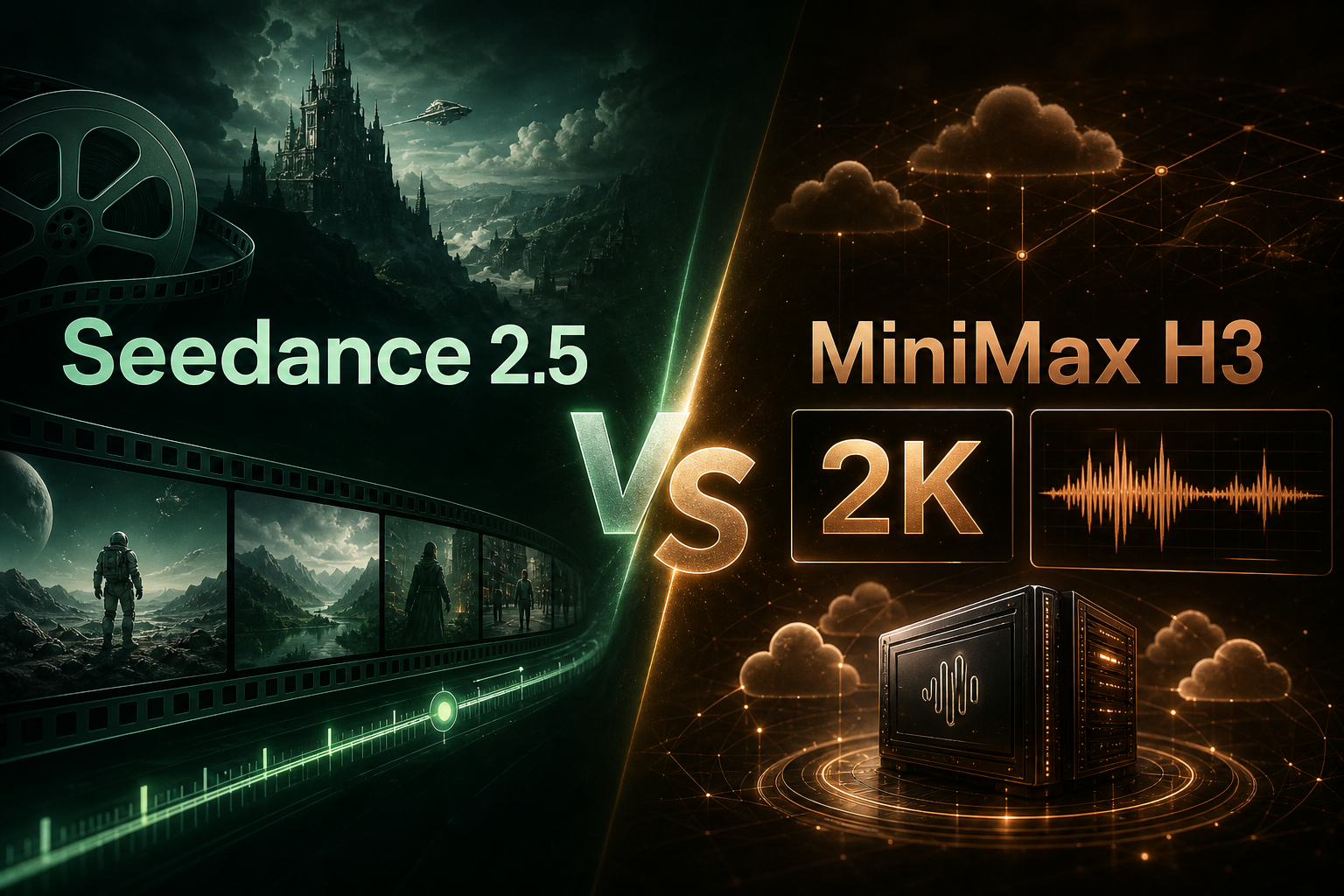
Las principales diferencias entre el Seedance 2.5 y el MiniMax H3
1. El modelo Seedance 2.5 da prioridad a la construcción de narrativas más largas
ByteDance Seed describe el Seedance 2.5 como un modelo diseñado para contar historias de 30 segundos. Su atractivo práctico no radica simplemente en una mayor duración. Los materiales de presentación destacan la organización de múltiples planos conectados lógicamente, el mantenimiento del lenguaje visual y sonoro a lo largo de una secuencia más extensa y la ampliación de un resultado ya existente mediante rondas adicionales.
Esto hace que el formato Seedance 2.5 resulte especialmente adecuado para anuncios narrativos breves, secuencias musicales, historias de marca y escenas con un principio, un desarrollo y un final. Los lectores que deseen obtener más información sobre la generación anterior pueden comparar esta evolución con nuestro Revisión de Seedance 2.0 y su nueve características clave y casos de uso.
2. MiniMax H3 da prioridad a la resolución y a la elección de la implementación
El formato MiniMax H3 tiene un límite máximo de duración publicado más corto, de 15 segundos, pero sus especificaciones oficiales del sistema son más explícitas en cuanto a la entrega: 24 FPS, audio estéreo a 32 kHz, una resolución base de 768p y la posibilidad de alcanzar 2K mediante H3-Regenerate-2K. Para un equipo de producción que necesita unas especificaciones de salida definidas, estos datos facilitan la planificación.
H3 también ofrece una vía de implementación que Seedance 2.5 no iguala actualmente. Los desarrolladores pueden descargar los puntos de control de H3-Base y trabajar con marcos locales o autohospedados. La contrapartida es que el flujo de trabajo oficial completo de 2K sigue dependiendo de componentes MiniMax alojados. En otras palabras, H3 es lo suficientemente abierto como para permitir una experimentación e integración locales significativas, pero hablar de un “flujo de trabajo oficial de 2K totalmente local” sería exagerar lo que se ha lanzado hasta ahora.
3. Seedance admite un conjunto de referencia mucho mayor
Seedance 2.5 admite hasta 30 imágenes, 10 vídeos y 10 clips de audio en una sola solicitud. MiniMax H3 admite hasta 9 imágenes, 3 vídeos y 3 clips de audio, con un límite máximo de 12 archivos entre todos los tipos de entrada. Estos límites no demuestran que un modelo comprenda mejor todas las referencias, pero sí que influyen en el tipo de proyecto que cada flujo de trabajo puede organizar con facilidad.
Seedance es la opción más obvia para un proyecto con un reparto numeroso, múltiples tableros de localización, referencias de atrezo, referencias de cámara y señales de audio independientes. Si tu flujo de trabajo se basa en un conjunto más reducido y cuidadosamente seleccionado de entradas multimodales, H3 sigue cubriendo las referencias de imagen, vídeo y audio en un solo sistema. Para obtener más información sobre las indicaciones basadas en referencias, consulta el Guía de referencia completa del Seedance.
4. Las filosofías de edición son diferentes
Seedance 2.5 presenta la edición como una continuación del proceso de creación orientada a los creadores. Sus materiales oficiales describen instrucciones de marcas de tiempo, cambios específicos en los personajes, las acciones, el sonido y la trama, además de ediciones con pantalla verde, de punto de vista, de movimiento de cámara y de referencia. El objetivo es revisar una parte seleccionada conservando la continuidad a su alrededor.
H3 aborda la edición a través de un contexto multimodal generalizado. Esta misma familia de modelos está diseñada para interpretar las relaciones entre indicaciones, imágenes, vídeos y audio, en lugar de dividir cada flujo de trabajo en un modelo especializado independiente. Esto resulta atractivo para los desarrolladores que crean procesos reutilizables, pero la capacidad exacta depende de si utilizan el sistema alojado, H3-Base-FL2VA o H3-Base-Ref2VA.
Seedance 2,5 frente a MiniMax H3: Ganadores por categorías
Su límite de una sola generación publicado es de 30 segundos, frente a los 15 segundos del H3.
H3 ofrece una resolución base documentada de 768p y una ruta de regeneración a 2K.
Admite un número considerablemente mayor de archivos de referencia de imagen, vídeo y audio.
Los pesos de la base H3 y las directrices sobre el marco local están a disposición del público.
El control de las marcas de tiempo y la revisión selectiva son elementos fundamentales del flujo de trabajo oficial.
Las rutas de la API oficial y del modelo base autohospedado ofrecen más opciones de implementación.
El MiniMax ofrece explícitamente una salida estéreo a 32 kHz.
Los límites de referencia más altos son adecuados para tableros complejos con muchos elementos.
Por eso, una puntuación global única resultaría engañosa. Los ganadores de cada categoría se dividen claramente en función del flujo de trabajo. El Seedance 2.5 se impone en las categorías narrativas y de control, más orientadas a los creadores; el H3, en las categorías relacionadas con las especificaciones de salida y la implementación.
Vídeos oficiales de presentación
Estos vídeos son ejemplos seleccionados por los proveedores de los dos ecosistemas de productos. Resultan útiles para comprender el lenguaje visual previsto y los flujos de trabajo compatibles, pero deben considerarse como demostraciones oficiales y no como muestras generales de rendimiento.
Seedance 2.5: vídeo promocional oficial de 30 segundos
Presentación oficial «text-to-video» de MiniMax H3
En qué aspectos destaca el Seedance 2.5
- El doble de la duración máxima publicada para un clip: 30 segundos frente a 15 segundos.
- Un presupuesto de referencia multimodal más amplio: hasta 50 recursos de referencia, entre imágenes, vídeos y archivos de audio.
- Edición basada en la sincronización: Resulta útil cuando un evento, un corte, una acción o un sonido concretos deben cambiar en un momento determinado.
- Flujo de trabajo creativo gestionado: una opción más adecuada para los creadores que no desean gestionar una infraestructura de inferencia local.
Esta ventaja se aprecia con mayor claridad en los trabajos en los que prima la historia. Un creador que esté preparando un anuncio, una narración musical o una secuencia cinematográfica puede aportar más material de referencia y describir cuándo deben tener lugar los acontecimientos. Nuestro Guía publicitaria de Seedance y Flujo de trabajo Seedance para creadores tratar esos casos de uso con más detalle.
También hay que tener en cuenta una limitación importante. ByteDance afirma que los movimientos físicos complejos y las escenas con un gran número de sujetos que interactúan entre sí aún tienen margen de mejora. Esa advertencia oficial coincide con el tipo de problemas de continuidad que describen algunos usuarios de la comunidad, pero no debería interpretarse como una tasa de fallos sin disponer de pruebas más amplias.
En qué aspectos destaca el MiniMax H3
- Ruta 2K documentada: Resulta útil cuando la resolución es un requisito fijo de entrega.
- Audio estéreo nativo: publicado en estéreo a 32 kHz.
- Ponderaciones de Open H3-Base: Los desarrolladores pueden revisar, implementar e integrar los puntos de control básicos.
- Apoyo al ecosistema local: MiniMax documenta las rutas de SGLang, vLLM, Diffusers y ComfyUI.
- API alojada: Los equipos pueden utilizar H3 sin necesidad de mantener hardware local.
Por lo tanto, H3 es la opción de ingeniería más adaptable. Un pequeño estudio puede empezar a trabajar a través de la API, mientras que un equipo técnico puede integrar el modelo base en su propio flujo de trabajo. La limitación es igualmente importante: H3-Context-IR no forma parte de la versión de código abierto, y H3-Regenerate-2K aún no se ha publicado como código abierto. La salida local de H3-Base y el flujo de trabajo completo de H3 alojado no deben considerarse productos idénticos.
Lo que dicen los creadores en Reddit y X
Las publicaciones de la comunidad son útiles para descubrir dudas sobre los flujos de trabajo, pero tienen carácter anecdótico. Los siguientes comentarios se atribuyen a cuentas individuales y no deben interpretarse como representativos de todos los creadores o proyectos.
Seedance 2.5: elogios por las escenas más largas, con algunas salvedades en cuanto al flujo de trabajo
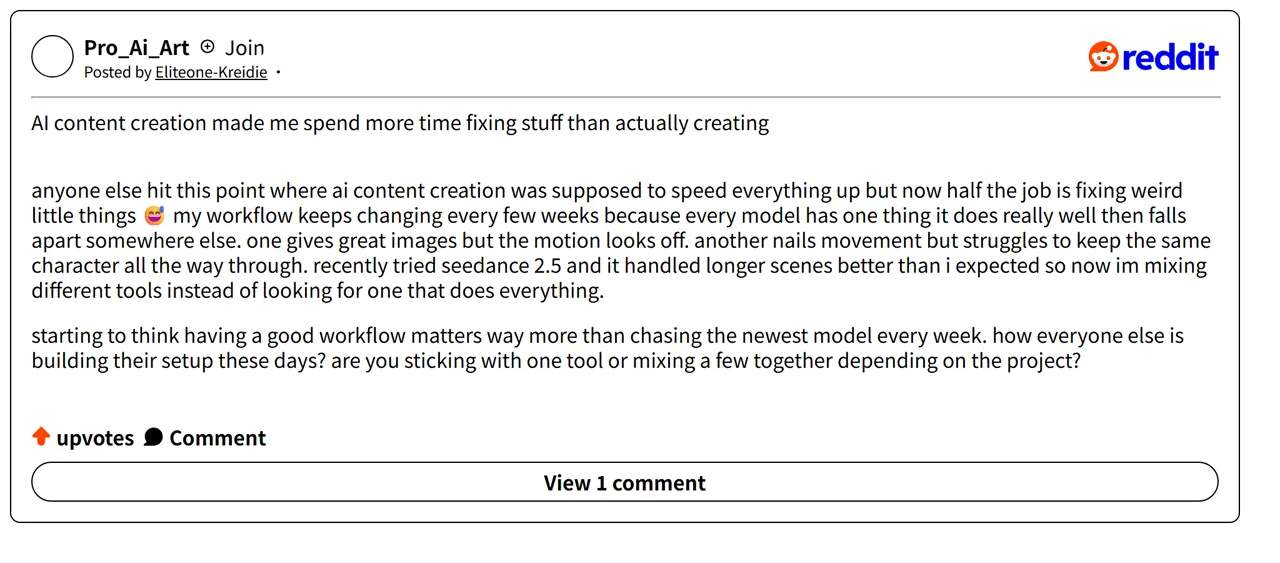
Usuario de Reddit Eliteone-Kreidie escribió que Seedance 2.5 gestionaba las escenas más largas mejor de lo esperado, al tiempo que explicaba que su flujo de trabajo general sigue combinando diferentes herramientas, ya que cada modelo destaca en distintos ámbitos. Esa es una forma útil de enfocar Seedance: su mayor capacidad narrativa puede reducir un tipo de fricción sin eliminar la necesidad de un conjunto de herramientas de producción.
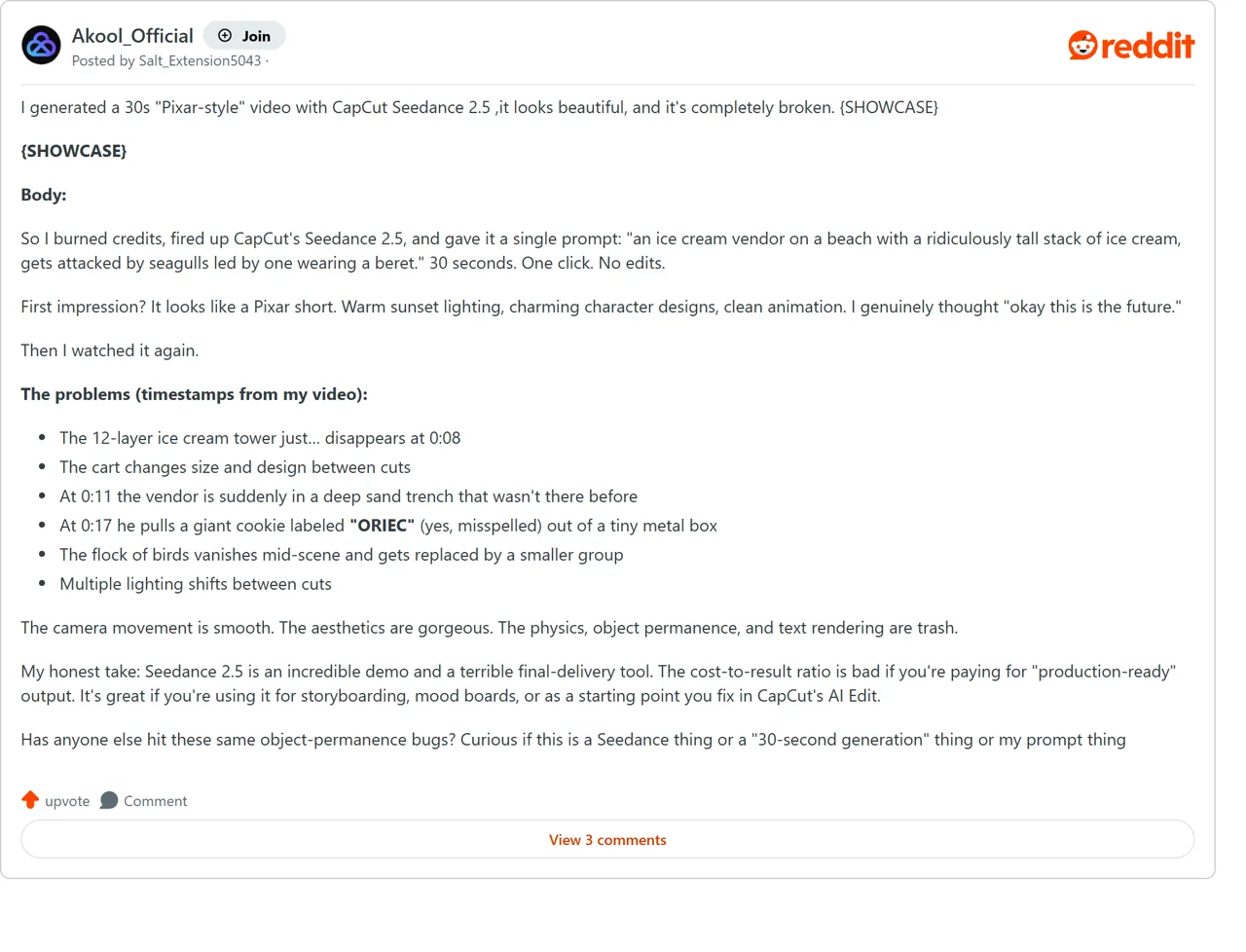
Una segunda publicación en Reddit de Salt_Extension5043 ofreció una visión mucho más crítica de una secuencia de 30 segundos, señalando la desaparición de objetos, cambios de diseño entre planos, errores en el texto, variaciones en la iluminación y problemas de continuidad de los objetos. En la misma publicación también se elogiaban los movimientos de cámara y la estética visual. Se trata del relato de un usuario a partir de una solicitud concreta y del flujo de trabajo de una plataforma específica, no de una conclusión general sobre el rendimiento, pero pone de relieve la diferencia entre una primera impresión atractiva y una continuidad lista para su entrega.
El día X, STARJUPI describió el Seedance 2.5 como “ridículamente bueno”, al tiempo que se quejaba del consumo de créditos. Esa reacción tiene que ver tanto con la calidad percibida como con el coste de la plataforma; no establece una comparación de precios universal, ya que los sistemas de créditos pueden variar según los servicios y las tarifas.
MiniMax H3: el entusiasmo gira en torno a la transparencia y la presión sobre los costes
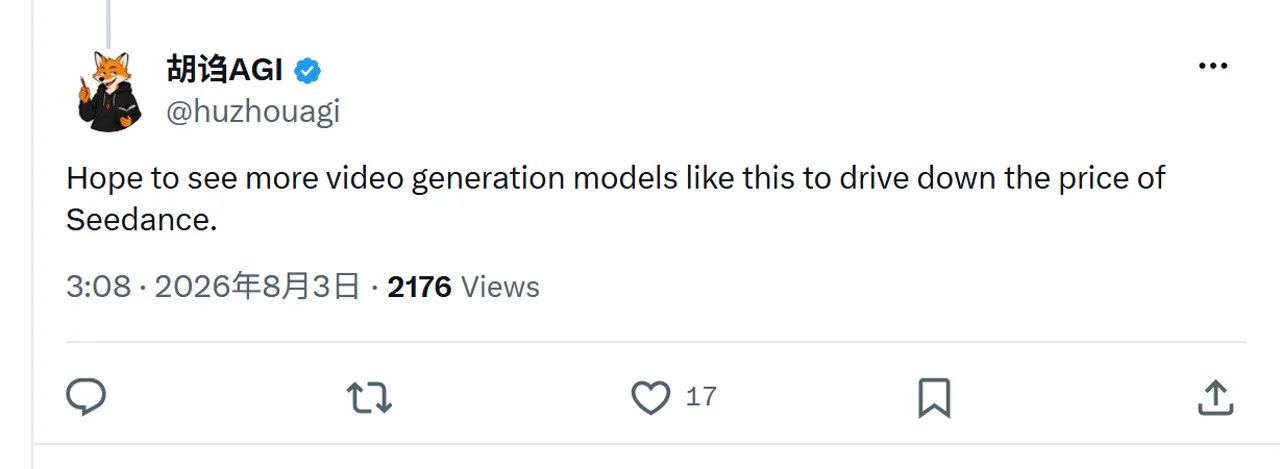
El día X, @huzhouagi reaccionó positivamente al lanzamiento de los pesos de H3 y animó a otros a probarlos. En otra respuesta al anuncio de MiniMax, la misma cuenta afirmó que esperaba que más modelos de vídeo como el H3 hicieran bajar el precio del Seedance. Esta reacción personal del mercado pone de manifiesto por qué la publicación abierta del H3 es importante más allá de las especificaciones del modelo: añade otra vía de implementación y competencia.
El anuncio de ComfyUI también confirmó los flujos de trabajo H3 desde el primer día para la conversión de texto a vídeo, de imagen a vídeo, el control del primer y último fotograma, la conversión de referencia a vídeo y la edición in situ. ComfyUI es una fuente del ecosistema, más que una reseña neutral de usuarios, por lo que su publicación resulta más útil para documentar la disponibilidad de los flujos de trabajo que para afirmar una calidad de salida superior.
Conclusión para la comunidad: El debate sobre Seedance se centra en la calidad de las escenas largas, la continuidad y el uso de créditos. El debate inicial sobre H3 se centra más en los pesos descargables, los flujos de trabajo locales y el efecto competitivo de un modelo abierto.
¿Cuál deberías elegir?
Elige Seedance 2.5 para anuncios narrativos y producciones dirigidas por creadores
Elige Seedance 2.5 cuando una historia de entre 20 y 30 segundos tenga más valor que una especificación de 2K o una implementación local. También es la mejor opción cuando el guion incluye muchos personajes, localizaciones, atrezo, referencias de movimiento y señales de audio independientes. Si la elaboración de las indicaciones es el principal reto, el Guía rápida de Seedance ofrece una base útil para estructurar los planos y el ritmo.
Elige MiniMax H3 para 2K, API y tuberías locales
Elige H3 cuando tu flujo de trabajo comience con un requisito técnico: una ruta 2K documentada, estéreo nativo, integración con la API o un modelo base descargable. Es la opción más natural para desarrolladores, usuarios de ComfyUI y equipos que deseen tener un mayor control sobre la pila de inferencia. Ten en cuenta la diferencia de presupuesto entre el H3-Base local a 768p y los componentes alojados necesarios para reproducir el flujo de trabajo oficial completo a 2K.
Utilízalas ambas cuando el proyecto cuente con fases separadas de ideación y ejecución.
Un flujo de trabajo híbrido también puede ser una buena opción. El Seedance 2.5 puede gestionar un borrador narrativo más extenso y con muchas referencias, mientras que el H3 puede utilizarse en un flujo de trabajo independiente para tomas locales o controladas por API, en el que la resolución y el control del proceso son fundamentales. No se trata de una mejora automática de la calidad, sino de una decisión de producción que sacrifica la simplicidad a cambio de flexibilidad.
Si estás comparando una gama más amplia de modelos de vídeo alojado, nuestro Comparación entre Seedance y Kling ofrece otro marco de decisión. Los promotores que evalúen las vías de acceso también pueden examinar las existentes Guía de la API Seedance.
Lista de verificación para la toma de decisiones
Preguntas frecuentes
¿Es el MiniMax H3 mejor que el Seedance 2,5?
MiniMax H3 es más adecuado para una salida de 2K, especificaciones estéreo nativas, integración con la API y la implementación local del estándar abierto H3-Base. Seedance 2.5 resulta más adecuado para narraciones de 30 segundos, conjuntos de referencia más amplios, control de marcas de tiempo y edición creativa gestionada. El modelo más adecuado depende del flujo de trabajo de producción, más que de una única puntuación de calidad.
¿Es MiniMax H3 totalmente de código abierto?
N.º MiniMax ha publicado los puntos de control de H3-Base bajo su licencia comunitaria, pero el sistema de preprocesamiento H3-Context-IR alojado no está incluido en la versión de código abierto. H3-Regenerate-2K tampoco es aún de código abierto. Por lo tanto, un flujo de trabajo local con el modelo base no reproduce todos los componentes del sistema 2K oficial alojado.
¿Puede Seedance 2.5 generar vídeos de 30 segundos?
Sí. ByteDance Seed afirma que Seedance 2.5 puede generar vídeos de hasta 30 segundos en una sola generación y admite rondas de ampliación adicionales. El proveedor también señala que ha mejorado las transiciones entre planos y la continuidad en los vídeos de larga duración, aunque reconoce que aún se puede mejorar en lo que respecta a los movimientos físicos complejos y las interacciones con gran cantidad de personas.
¿El MiniMax H3 es compatible con vídeo 2K?
Sí, a través del componente H3-Regenerate-2K. La versión descargable de H3-Base genera una salida de 768p, mientras que el sistema de regeneración combina ese resultado con el contexto original para crear una salida de 2K. MiniMax afirma que H3-Regenerate-2K aún no forma parte de la versión de código abierto.
¿Qué modelo admite más archivos de referencia?
El modelo Seedance 2.5 admite más archivos de referencia: hasta 30 imágenes, 10 vídeos y 10 clips de audio. El modelo MiniMax H3 admite hasta 9 imágenes, 3 vídeos y 3 clips de audio, con un máximo de 12 archivos entre todos los tipos de entrada. Unos límites más altos aportan capacidad, pero no son garantía de una mayor fidelidad de las referencias.
¿Se puede ejecutar MiniMax H3 de forma local?
Sí, H3-Base puede ejecutarse en un entorno local o autohospedado, siempre que se cumplan los requisitos de hardware y se respete la licencia comunitaria MiniMax de H3. MiniMax documenta las rutas para SGLang, vLLM, Diffusers y ComfyUI. El flujo de trabajo completo de Context-IR y regeneración 2K sigue utilizando componentes MiniMax alojados.
Veredicto final
Lo más útil Seedance 2,5 frente a MiniMax H3 La conclusión es que se trata de una división del flujo de trabajo. Seedance 2.5 es la opción que da prioridad a la narrativa: clips más largos, más referencias y una edición organizada en torno al tiempo y la continuidad. MiniMax H3 es la opción que da prioridad a la implementación: regeneración en 2K, salida estéreo, acceso a la API, pesos H3-Base abiertos y compatibilidad con el ecosistema local.
Elige Seedance 2.5 cuando el briefing creativo sea extenso y la historia necesite espacio para desarrollarse. Elige MiniMax H3 cuando la resolución, la integración y el control sobre la pila técnica sean más importantes. Si ambas necesidades tienen la misma importancia, pon a prueba los límites del flujo de trabajo con un proyecto pequeño antes de comprometer recursos de producción, no para declarar un ganador universal, sino para confirmar qué sistema se adapta mejor a tu proceso de entrega real.