Respuesta rápida: FLUX 3 es el modelo base multimodal de Black Forest Labs para imágenes, vídeo, audio y predicción de acciones. A fecha de 11 de agosto de 2026, BFL ofrece FLUX 3 Video en acceso anticipado con clips de hasta 20 segundos, audio nativo opcional y precios públicos por segundo. GlobalGPT también cuenta con una ruta verificada de FLUX 3 Video. En nuestra prueba de tres ejecuciones, se completaron todas las tareas y se devolvió un archivo MP4 de 5,04 segundos con una secuencia de audio, pero el control exacto de la duración, el espaciado tipográfico y la coherencia de los objetos no fueron perfectos.
Esa condición aún debe redactarse con cuidado. El publicación oficial de lanzamiento y página oficial del modelo FLUX 3 Video se describe como «Acceso anticipado», mientras que la página de precios de BFL ya publica las tarifas de los vídeos. GlobalGPT ofrece una ruta de acceso independiente a la plataforma basada en el modelo. El acceso a través de esa ruta no implica que todas las API de BFL, la opción de pesos privados, el modelo de imagen, el modelo de acción o la versión para desarrolladores de FLUX 3 estén disponibles de forma generalizada.
Esta actualización incluye una pequeña comprobación práctica: tres generaciones el 11 de agosto utilizando el entorno de pruebas de flux-3-video ID del modelo, incluida una repetición exacta de la indicación. Es suficiente para documentar el comportamiento real y los puntos de fallo visibles, pero tres resultados no constituyen una referencia exhaustiva.
Tres pruebas de rendimiento de FLUX 3 Video realizadas por el propio desarrollador; no se trata de una prueba de rendimiento generalizada.
| Carreras | Duración devuelta | Resolución | Audio |
|---|---|---|---|
| 3 de 3 correctas | 5,04 s por clip | 1280 × 704 | Datos descodificados en todos los archivos |
¿Qué es FLUX 3?
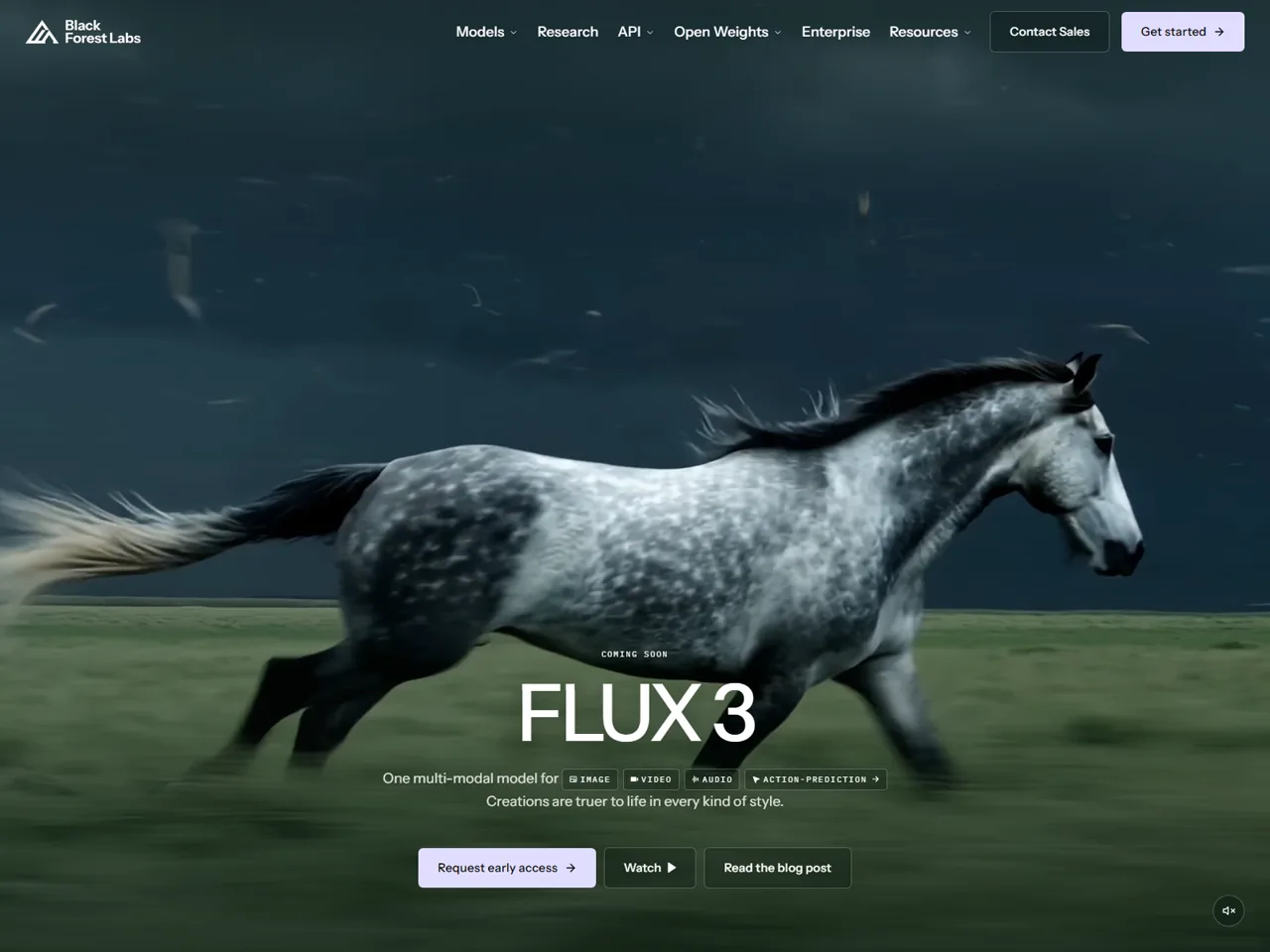
FLUX 3 es un modelo base multimodal desarrollado por Black Forest Labs. A diferencia de los sistemas entrenados únicamente para convertir texto en imágenes, BFL afirma que este modelo aprende de forma conjunta a partir de imágenes, vídeo y audio en una única arquitectura. El objetivo es crear representaciones que conecten la estructura espacial, el movimiento, el sonido, la causa y la acción, en lugar de tratar cada medio como una característica aislada.
Puede que el nombre parezca una simple continuación de FLUX.1 y FLUX.2, pero su alcance es mucho más amplio. FLUX.2 sigue siendo una familia de programas para la generación y edición de imágenes; el Guía de FLUX 2 Pro abarca el flujo de trabajo de imágenes de esa generación, el contexto de precios y las indicaciones. FLUX 3 se está posicionando como una infraestructura común para la creación de contenidos y la predicción de acciones.
BFL utiliza la expresión “modelo del mundo” para describir esta línea de trabajo. En este contexto, eso no significa que la empresa haya anunciado una inteligencia general. Significa que el modelo está diseñado para aprender cómo se relacionan entre sí, a lo largo del tiempo, los objetos visibles, el movimiento, el audio y las acciones. Esa distinción es importante porque lo más interesante de FLUX 3 no es simplemente que ofrezca “mejores imágenes”, sino que se trata de un único modelo subyacente que da servicio a varios tipos de generación y control.
Por qué FLUX 3 es más que un generador de imágenes
La mayoría de los productos de IA creativa siguen utilizándose como herramientas independientes: un modelo genera imágenes, otro produce vídeos y un tercero añade voz o efectos de sonido. FLUX 3 se ha diseñado partiendo de una premisa diferente. Si una misma arquitectura aprende estas modalidades de forma conjunta, una indicación, una imagen de referencia, una secuencia de movimiento y una banda sonora podrían compartir la misma comprensión interna.
- Las imágenes aportan espacio: objetos, composición, textura, tipografía y relaciones visuales.
- El vídeo añade tiempo: el movimiento, la persistencia, el contacto y la relación de causa y efecto entre fotogramas.
- El audio añade otra señal sincronizada: el habla, el ambiente y los sonidos relacionados con acontecimientos visibles.
- La predicción de la acción vincula la percepción con el control: La representación del modelo puede adaptarse para predecir cuál debería ser la siguiente acción del robot.
Para los creadores, la ventaja práctica radica en que hay menos traspasos entre las distintas fases de producción. El audio nativo es especialmente importante, ya que permite reducir la brecha entre la creación de un clip y la producción por separado de los diálogos, los efectos y la sincronización. Si el sonido es tu principal preocupación, la situación actual Veo 3.1: guía de sonido muestra cómo otra importante familia de plataformas de vídeo aborda hoy en día el audio nativo.
Resumen de las funciones de FLUX 3
| Capacidad | Lo que ha anunciado BFL | Situación a 11 de agosto de 2026 |
|---|---|---|
| Vídeo de FLUX 3 | Creación y edición de vídeos con audio nativo opcional, incluyendo voz, efectos, estilos, tipografía y flujos de trabajo con múltiples tomas | Acceso anticipado a BFL; precios oficiales publicados; ruta GlobalGPT confirmada |
| Imagen de FLUX 3 | Generación y edición de imágenes mediante API y acceso a los pesos privados | Se ha anunciado el acceso anticipado; en este artículo no se ha probado |
| FLUX 3 Acción | Predicción de acciones nativa más modelos especializados creados a partir de la estructura central del vídeo | Empezando por socios seleccionados |
| FLUX 3 Dev | Infraestructura multimodal de peso abierto prevista para vídeo, audio, imágenes y predicción de acciones | Anunciado; fecha y licencia aún no publicadas |
FLUX 3 Video es el producto más claro a corto plazo. BFL afirma que admite la conversión de texto a vídeo y la edición, el audio sincronizado, los diálogos multilingües, diversas relaciones de aspecto, la tipografía y los clips encadenados. Estas características lo sitúan en un mercado cada vez más saturado; el Comparativa de los mejores generadores de vídeo con IA ofrece información útil sobre las funciones que los creadores ya pueden utilizar mientras el acceso a FLUX 3 sigue siendo limitado.
La publicación de presentación también describe, en sus evaluaciones preliminares, clips de vídeo de 10 segundos y 720p generados a partir de texto, con audio. BFL señala explícitamente que tanto el modelo como el conjunto de pruebas de evaluación aún se encuentran en fase de desarrollo. Esto hace que las cifras sean útiles como primeros datos facilitados por la empresa, pero no sustituyen a unas pruebas independientes y repetibles una vez que se amplíe el acceso público.
La página actual del modelo va más allá: indica que FLUX 3 Video puede generar hasta 20 segundos de vídeo en una sola ejecución, con audio opcional y voz, efectos y ambientación multilingües generados junto con los fotogramas. Esos son los límites oficiales de capacidad; la prueba práctica que se muestra a continuación recoge lo que la ruta de la plataforma conectada devolvió realmente a partir de nuestras indicaciones.
¿Ya está disponible FLUX 3?
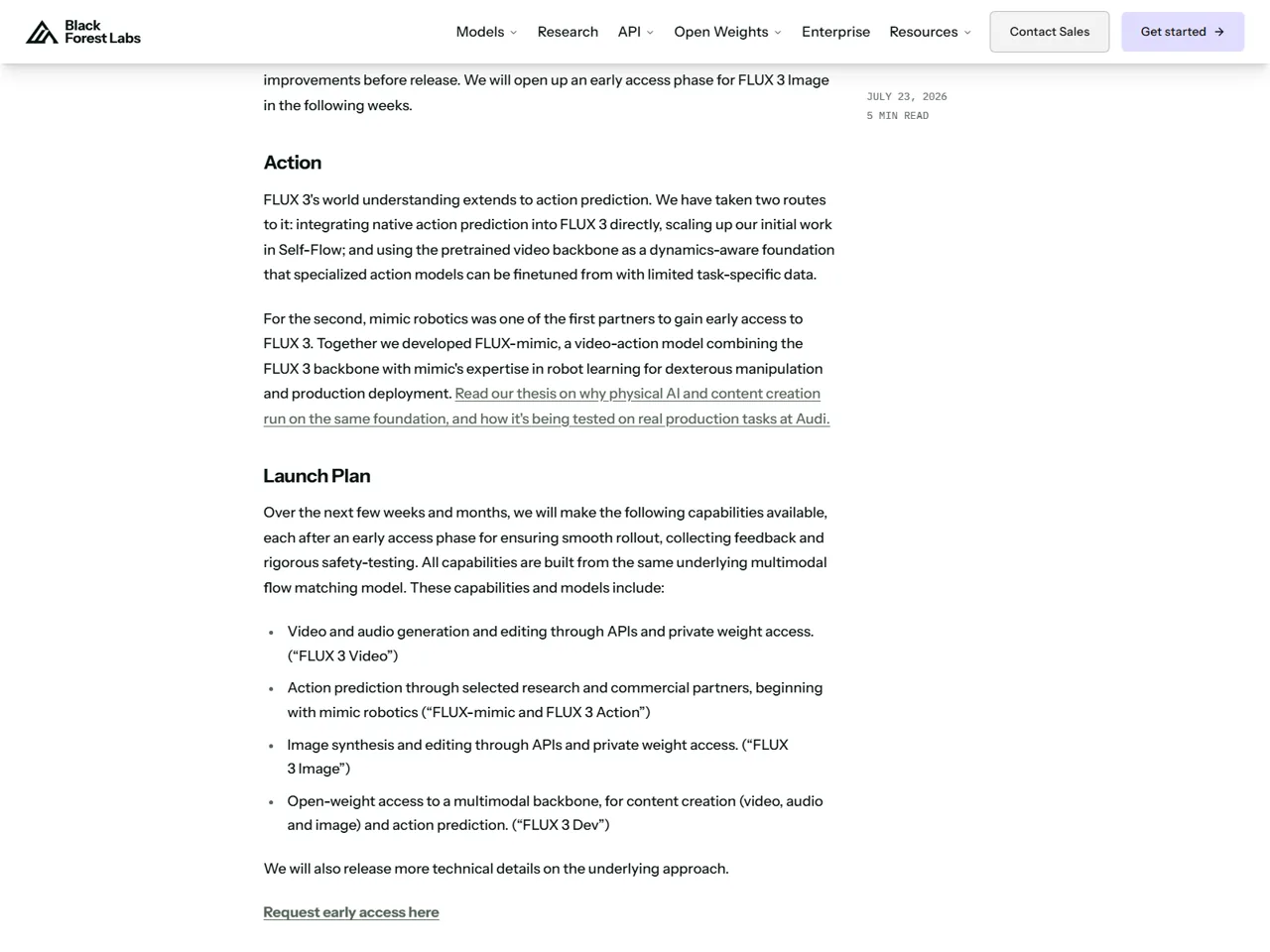
Sí, pero solo a través de un «Acceso anticipado» por fases. BFL ha abierto una vía de solicitud en lugar de lanzar una plataforma de autoservicio generalizada. De este modo, la empresa puede trabajar con usuarios y socios seleccionados mientras los modelos, las API, las opciones de peso privado y el proceso de evaluación siguen en fase de desarrollo.
| Pregunta | Conocido | Aún limitado o desconocido |
|---|---|---|
| ¿Se puede solicitar la admisión en BFL? | Sí, a través del formulario de solicitud oficial | Criterios de aceptación y tiempo de respuesta |
| ¿Pueden los usuarios probar FLUX 3 Video en GlobalGPT? | Sí; el enlace a la ruta del producto verificado aparece a continuación | Los límites y las cuotas de las rutas dependen de la cuenta de la plataforma |
| ¿A qué precio se cotiza públicamente BFL? | Tarifas de «texto/imagen a vídeo», «continuación», «borrador», «HD» y «FHD» | Condiciones para particulares y empresas |
| ¿Habrá categorías de peso libre? | El FLUX 3 Dev está previsto que sea de peso libre | Fecha de lanzamiento, licencia y requisitos de hardware |
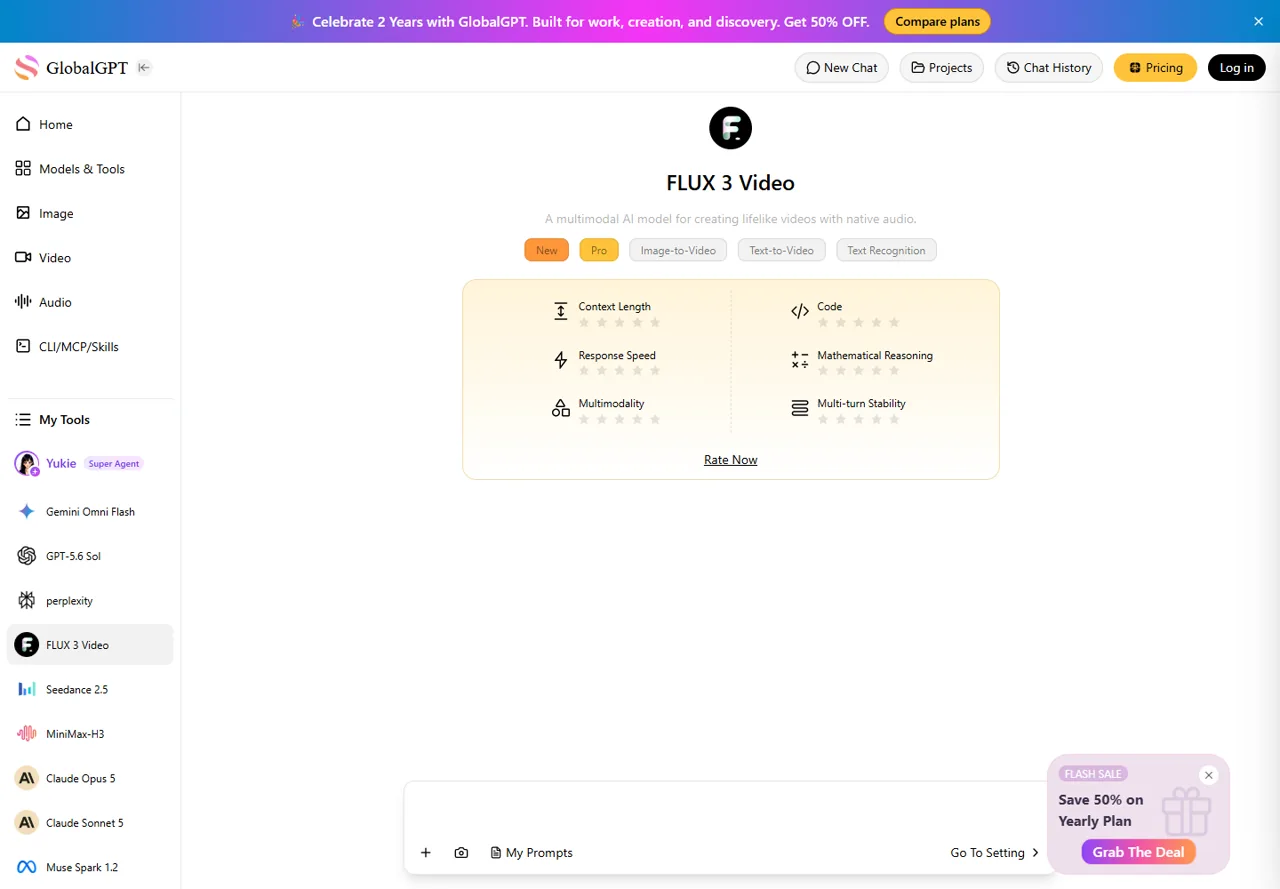
La interpretación más segura es sencilla: FLUX 3 es real y su implementación está en marcha, pero “Acceso anticipado” no debe interpretarse como “disponible para todo el mundo”. Si necesitas una fecha límite de producción, espera a recibir la confirmación por escrito del acceso y las condiciones antes de diseñar un flujo de trabajo en torno a ello.
Hemos probado FLUX 3 (vídeo): tres ejecuciones, resultados reales
Configuración de la prueba: Realizamos las pruebas el 11 de agosto de 2026 a través del entorno de pruebas de tareas de Broly conectado a la plataforma, utilizando el ID de modelo exacto flux-3-video. Cada solicitud contenía únicamente el ID del modelo y la indicación. Enviamos tres tareas: una indicación sobre un anuncio de producto, una indicación sobre consistencia temporal y una repetición exacta de la primera indicación. La API de tareas indicó unos tiempos de procesamiento reales de 88, 190 y 77 segundos, respectivamente. Dado que las ejecuciones se realizaron de forma simultánea y que la ruta sigue en fase de desarrollo, estos tiempos no deben considerarse un punto de referencia de latencia.
Prueba 1: tipografía, transformación y audio nativo
ID de la tarea: task_tl5xE4BIOv2ojEb0VOMFnVT56YtvzhZ8. Las instrucciones pedían un anuncio de perfume de ocho segundos con dos planos, el texto exacto de la etiqueta, una transformación del frasco en una ciudad, el sonido de un cristal al romperse, un silbido y una frase hablada.
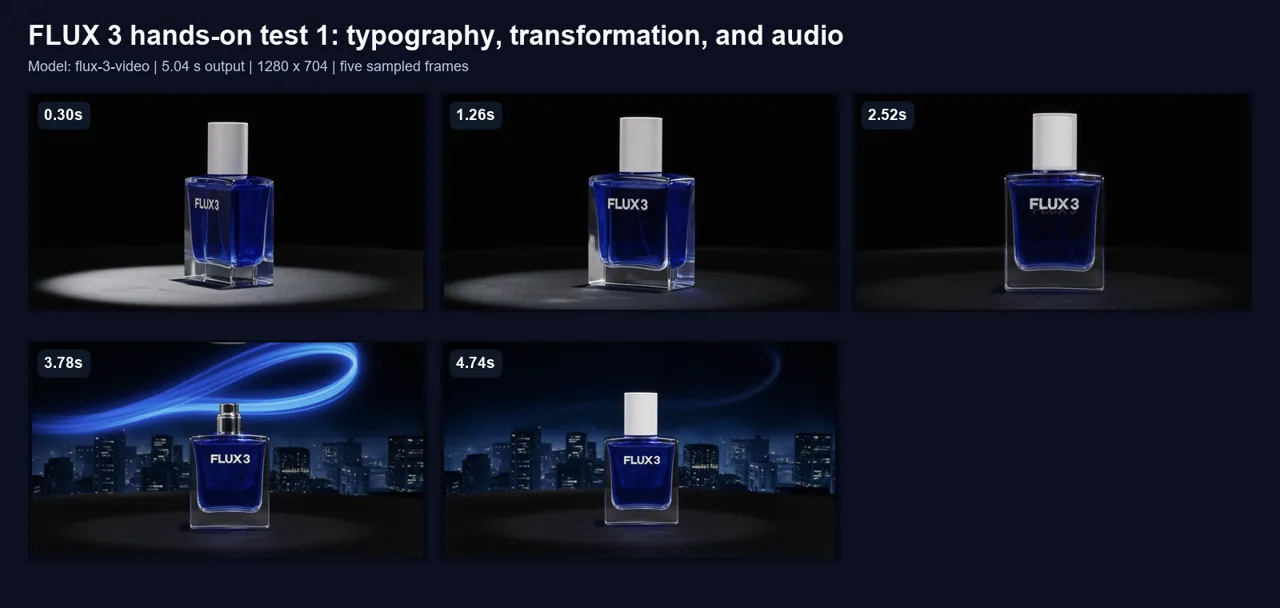
Lo que pasó: El resultado final completó el arco visual solicitado y mantuvo la legibilidad del concepto del perfume azul en ambas escenas. La etiqueta siguió siendo legible, pero visualmente redujo el espacio solicitado y se asemejaba más a “FLUX3” que al “FLUX 3” exacto. El frasco también cambió la forma del tapón y del cuerpo durante la transformación. El archivo MP4 contenía datos de audio descodificados, pero nuestra inspección automatizada no transcribió la línea hablada, por lo que no estamos puntuando el diálogo palabra por palabra. Y lo más importante: el clip devuelto duraba 5,04 segundos en lugar de los ocho segundos solicitados.
Prueba 2: movimiento en una sola toma y consistencia de los objetos
ID de la tarea: task_izFhE8RhTeA5Tb1EaESJqbb7sP6wCwoE. Esta indicación eliminaba los cambios de escena y pedía que un robot de cuerda cruzara tres marcadores en un orden fijo, conservando al mismo tiempo sus características distintivas.
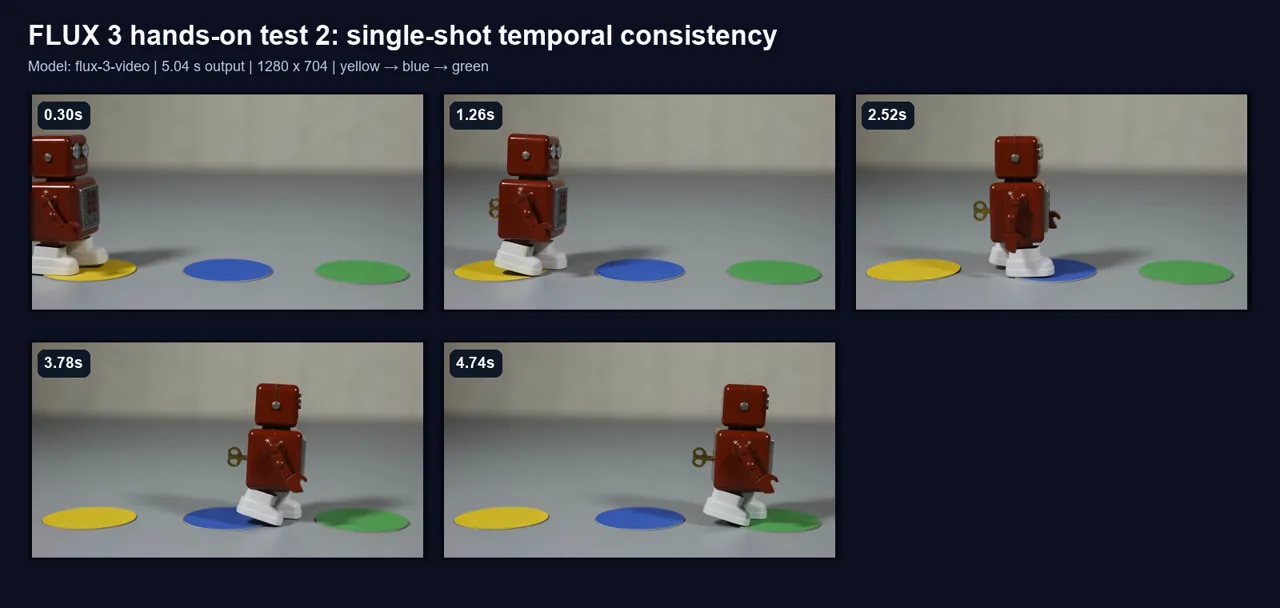
Lo que pasó: Este fue el resultado más limpio. El robot se desplazó en la dirección solicitada y cruzó los marcadores amarillos, azules y verdes en orden. Sus principales rasgos identificativos permanecieron visibles durante toda la toma, sin ningún elemento adicional ni cortes evidentes de cámara. El movimiento parecía más sencillo que cinematográfico, pero esa sencillez facilitó la evaluación de la coherencia. El resultado volvió a durar 5,04 segundos y contenía datos de audio descodificados.
Prueba 3: repetición exacta de la primera indicación
ID de la tarea: task_JsnPFkB0Yqf55EwaoPU8BShBRkGLJT44. Volvimos a enviar la primera indicación sin cambiar ni una sola palabra.
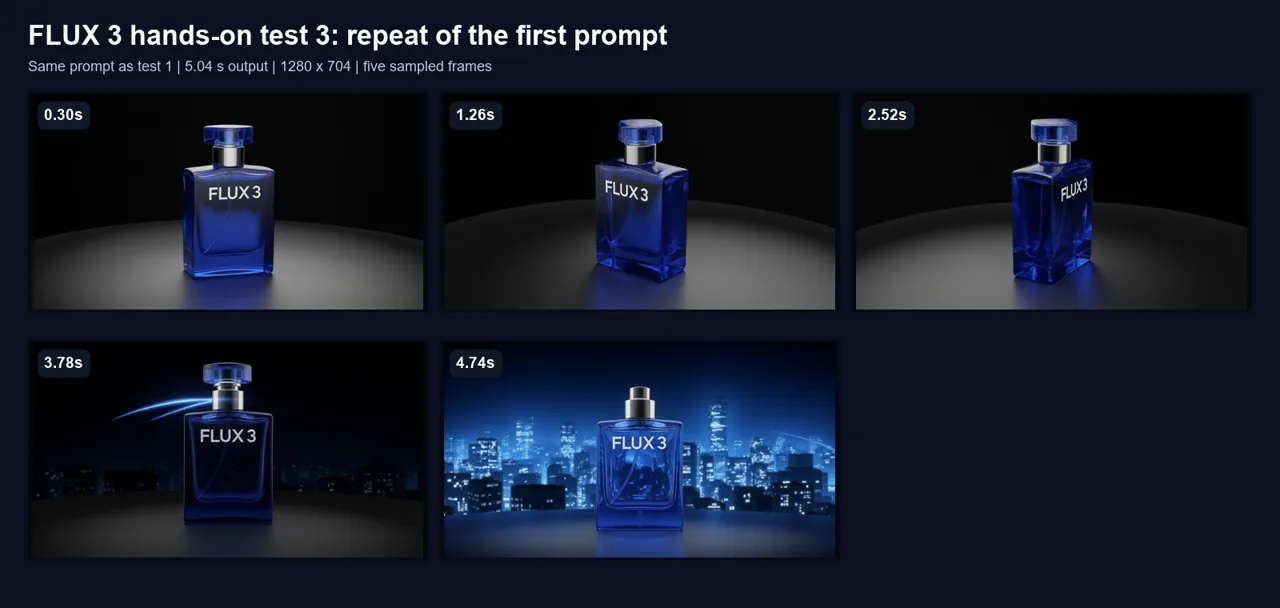
Lo que pasó: La repetición conservó el concepto, más que el resultado exacto. Volvió a representar una botella azul, la inscripción “FLUX3” legible, una cinta de luz y un horizonte nocturno, pero la geometría de la botella, el tapón, el encuadre y la transición eran diferentes. Esto es normal en una generación sin datos de referencia, pero cobra importancia cuando el equipo de una marca espera que los detalles del producto sean repetibles.
| Dimensión de prueba | Resultado observado | Conclusión práctica |
|---|---|---|
| Finalización de la tarea | Se han completado con éxito 3 de las 3 tareas | La ruta conectada estuvo operativa durante esta prueba |
| Control de la duración | Las tres solicitudes pedían 8 segundos; todas devolvieron 5,04 segundos. | Comprueba los controles de duración a nivel de ruta antes de pasar a producción |
| Tipografía | La etiqueta se lee bien, pero no se ha conservado el espaciado exacto de “FLUX 3”. | Prever repeticiones o trabajos posteriores a la producción en los textos de la marca |
| Coherencia temporal | El robot sencillo conservó sus características distintivas y el orden de los marcadores | Las indicaciones de un solo intento con restricciones pueden dar buenos resultados |
| Repetibilidad | La misma historia, pero con una geometría del producto y unas opciones de cámara diferentes | Una repetición exacta de la indicación no es una repetición visual exacta |
| Audio | Todos los archivos MP4 contenían datos de audio descodificados; los diálogos no se transcribían automáticamente. | Escucha y revisa la sincronización manualmente antes de dar tu aprobación |
Nuestro veredicto: El vídeo de FLUX 3 se ajustó mejor a la lógica general de la escena que a las restricciones exactas de producción. La fluida transformación del producto y el movimiento ordenado del robot resultaron alentadores. El retorno fijo de 5,04 segundos, el espaciado imperfecto del texto y la desviación en la forma de la botella son motivos para probar tu propio flujo de trabajo antes de dar el paso. Se trata de una indicación práctica útil, no de una puntuación válida para todo el modelo.
FLUX 3 frente a FLUX.2: ¿Qué ha cambiado realmente?
| Área | FLUX.2 | FLUX 3 |
|---|---|---|
| Identidad pública principal | Familia de herramientas para la generación y edición de imágenes | Modelo base multimodal |
| Modalidades | Imágenes y flujos de trabajo de edición de imágenes | Imágenes, vídeo, audio y predicción de acciones |
| Acceso actual | Modelos de API publicados y tarifas | Acceso anticipado a los vídeos de BFL, precios oficiales de los vídeos y una ruta GlobalGPT verificada |
| Dirección del modelo abierto | Varias variantes de FLUX.2 y criterios de valoración documentados | Se han anunciado los pesos de la versión de desarrollo de FLUX 3; los detalles están pendientes |
| Un veredicto justo sobre el rendimiento | Se puede probar hoy mismo como modelo de imagen | El vídeo se puede analizar; aún es prematuro emitir un veredicto general para toda la familia |
El cambio más importante es el alcance, no una mejora porcentual contrastada. FLUX 3 no es simplemente FLUX.2 con una nueva puntuación de calidad de imagen; su objetivo es unificar la generación creativa y la acción física en una sola familia. Para una decisión actual basada únicamente en la imagen, el Comparación entre FLUX 2 y Nano Banana Pro es más viable, ya que hoy en día ambas opciones pueden considerarse herramientas de imagen.
Para realizar una comparación exhaustiva entre FLUX 3 y FLUX.2, aún es necesario tener en cuenta los prompts de imagen equivalentes, las ediciones de referencia, la tipografía, el cumplimiento de los prompts, la latencia y el coste. La comprobación con tres ejecuciones de vídeo que se muestra más arriba reduce la falta de datos, y BFL publica ahora las tarifas de FLUX 3 para vídeo, pero no compara el modelo de imagen ni las variantes de peso abierto.
Lo que revelan las demostraciones oficiales y los resultados de robótica
Los materiales de lanzamiento de BFL muestran vídeos generados, audio sincronizado, estilos visuales, texto animado y comportamientos iniciales de edición. Muestran la orientación del producto y el tipo de resultados que la empresa pretende obtener. Al tratarse de ejemplos oficiales seleccionados, no nos indican con qué frecuencia un usuario normal podrá reproducir la misma calidad, cuánto tiempo tarda la generación ni cuánto costará cada resultado.
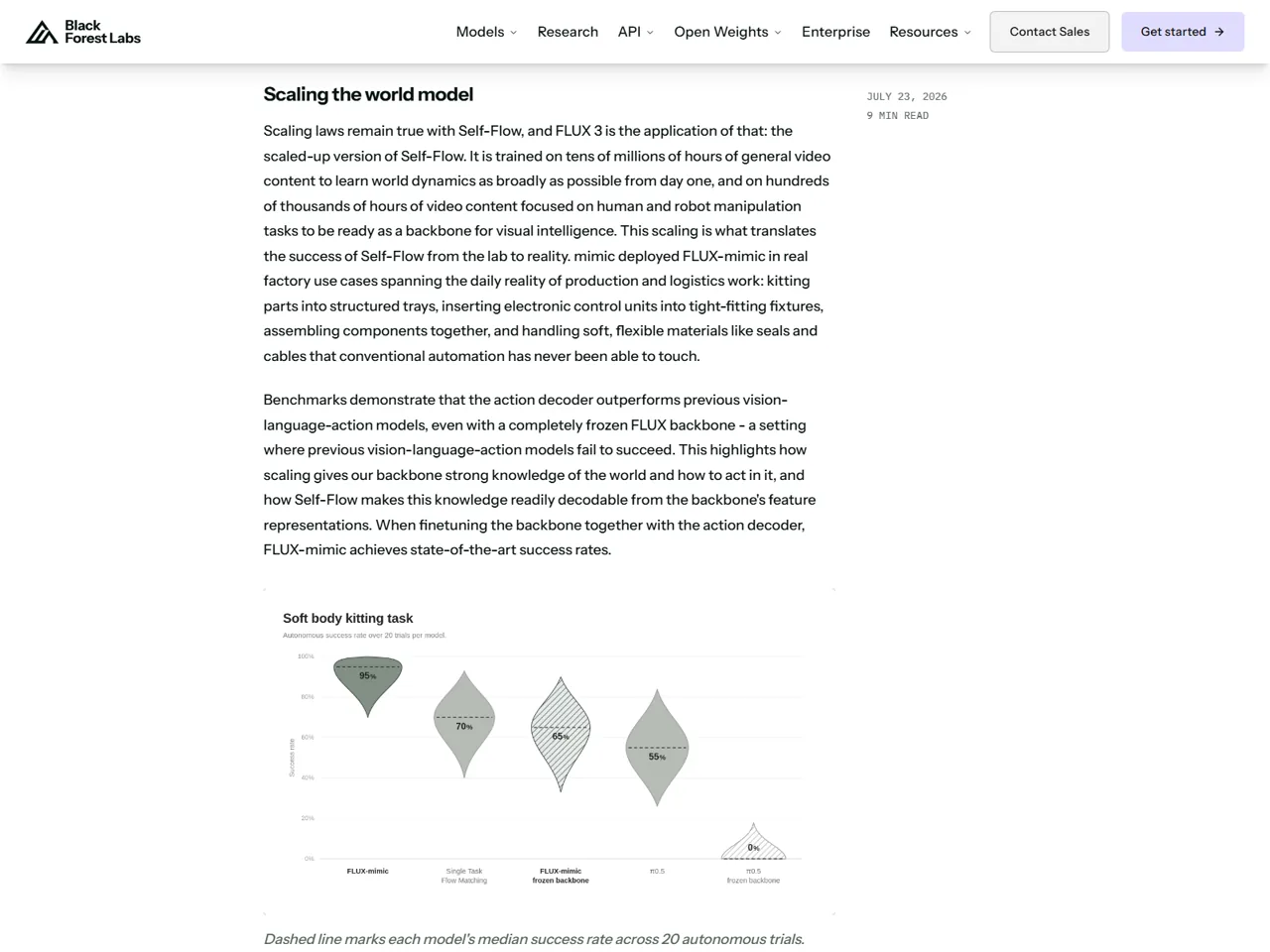
El trabajo en robótica es más específico. En el FLUX 3: informe de imitación, BFL y Mimic Robotics describen la adaptación de la estructura de vídeo FLUX 3 para la predicción de acciones robóticas. El gráfico de kitting de cuerpos blandos que se muestra indica una tasa de éxito mediana de 95% para FLUX-mimic, y cada mediana representada con una línea discontinua se basa en 20 ensayos autónomos.
Se trata de un resultado en el ámbito de la robótica, no de una prueba de rendimiento sobre la calidad de imágenes o vídeos. Su relevancia es conceptual: BFL sostiene que una red troncal entrenada para modelar el movimiento, el contacto, el peso y la causa puede revelar representaciones útiles para tareas físicas. Para determinar si este mismo enfoque es aplicable de forma generalizada a distintos robots, fábricas y tareas, se necesitarán pruebas independientes más amplias.
Primeras reacciones de la comunidad en X y Reddit
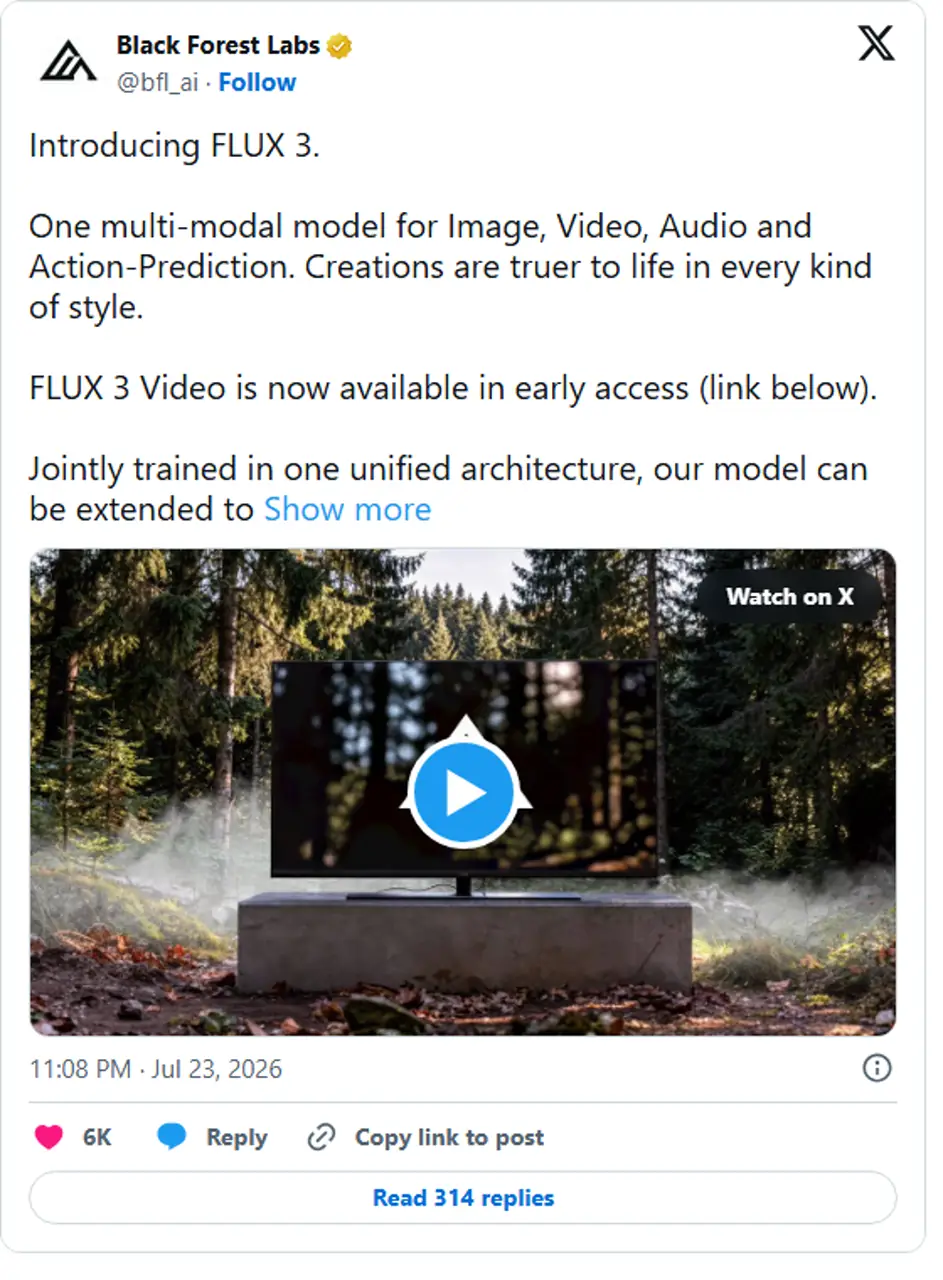
FLUX 3 llamó la atención de inmediato. En la instantánea de verificación del 27 de julio, el Comunicado oficial de BFL en X registró 6.088 «Me gusta», 862 compartidos, 365 citas y 314 respuestas. Estas cifras reflejan el interés suscitado por el lanzamiento, no la fiabilidad del modelo, y seguirán variando.
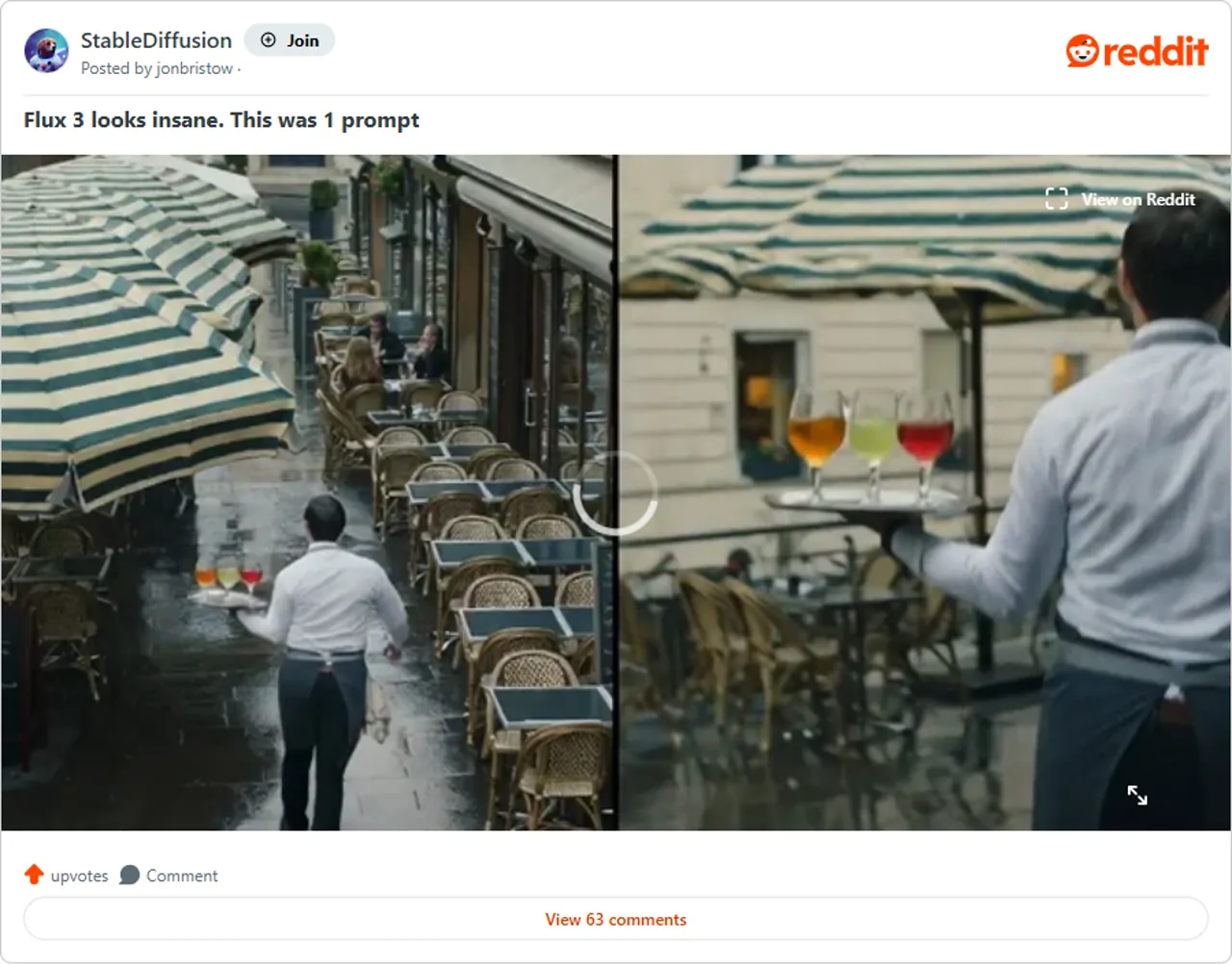
A Publicación en Reddit, en el subreddit r/StableDiffusion La publicación titulada “Flux 3 parece una locura. Esta fue la primera indicación” mostraba 370 votos positivos y 63 comentarios en la misma ventana de verificación. La muestra en pantalla dividida de la publicación utiliza una indicación exigente, pero sigue siendo un ejemplo compartido y no una prueba de rendimiento controlada.
La conclusión correcta es que los creadores sienten curiosidad por la complejidad de las instrucciones, el movimiento, el sonido nativo y la coherencia visual. Una vez que se amplíe el acceso, la reproducibilidad de las instrucciones debería convertirse en una prueba fundamental. Mientras tanto, el Fórmula de la pregunta Kling 3.0 es una referencia útil para estructurar escenas, el comportamiento de la cámara, el movimiento y las restricciones en las herramientas de vídeo disponibles actualmente.
API de FLUX 3, precios y pesos abiertos
A fecha de 11 de agosto, BFL’s documentación sobre precios publicada Incluye FLUX 3 Video. Un crédito equivale a $0,01. La conversión de texto a vídeo y de imagen a vídeo cuesta $0,17 por segundo en HD o $0,29 por segundo en FHD, mientras que los borradores en HD cuestan $0,06 por segundo. La continuación de vídeo cuesta $0,43 por segundo en HD o $0,54 por segundo en FHD, y los borradores, $0,12 por segundo.
| Artículo | Publicado o verificado | Aún limitado o desconocido |
|---|---|---|
| Precios de FLUX 3 Video | T2V/I2V: $0,17/s HD, $0,29/s FHD; borrador: $0,06/s. Continuación: $0,43/s HD, $0,54/s FHD; borrador: $0,12/s | Condiciones para particulares y empresas |
| Acceso a BFL | El vídeo sobre el acceso anticipado, la descripción general de los modelos y los precios ya son públicos | Aceptación general de la API, cuotas y límites específicos de cada cuenta |
| Acceso GlobalGPT | Se ha verificado el recorrido del producto FLUX 3 Video y se ha superado con éxito la prueba de tres ejecuciones | Los límites de cuenta y los controles a nivel de ruta pueden diferir de la oferta directa de BFL |
| FLUX 3 Dev | Concebida como una red troncal multimodal de peso abierto | Fecha de lanzamiento, licencia, tamaño de los parámetros y requisitos de hardware |
No se debe equiparar el término “peso abierto” con “código abierto”. Los pesos, el código, los datos de entrenamiento y la licencia pueden tener condiciones de acceso diferentes entre sí. Para emitir un veredicto significativo sobre el «peso abierto», habrá que esperar a que BFL publique la versión FLUX 3 Dev definitiva y su licencia.
Cómo solicitar el acceso anticipado a FLUX 3
- Abra el página oficial del modelo FLUX 3 y revisar las etiquetas de capacidad actuales.
- Haz clic en el botón «Solicitar» para ir a la Formulario oficial de acceso anticipado a FLUX 3.
- Describe la funcionalidad que necesitas —vídeo, imagen, acción, pesos privados o acceso para desarrolladores— y el flujo de trabajo que deseas crear.
- Incluye un caso de uso realista, el volumen previsto, los datos de la organización y por qué el acceso anticipado es importante para el proyecto.
- Espera a recibir una confirmación por escrito antes de dar por hecho el acceso, los precios, los límites o la fecha de entrega.
Una solicitud concreta tiene más peso que un simple “quiero probarlo” sin más. Por ejemplo, un estudio podría explicar que necesita diálogos multilingües y efectos sincronizados para vídeos cortos de marca, mientras que un equipo de robótica podría describir su tarea de manipulación, la plataforma robótica, los datos y el entorno de implementación.
Si el objetivo es el diálogo, planifica todo el proceso en su totalidad, en lugar de limitarte únicamente a la indicación de generación. El Veo 3.1: Flujo de trabajo de diálogos y sincronización labial destaca los aspectos prácticos —la sincronización de los interlocutores, la coherencia de la voz, el diseño de las tomas y la regeneración— que también serán importantes a la hora de evaluar FLUX 3 Video.
¿A quién va dirigido FLUX 3?
- Creadores de vídeos con IA Se debe prestar atención al audio original, los diálogos multilingües, el montaje, la concatenación de tomas, la coherencia, la velocidad y el precio final.
- Creadores de imágenes Deberíamos esperar a disponer de comparativas repetibles que abarquen el cumplimiento de las instrucciones, la edición de referencia, la tipografía y el coste. Hasta entonces, el Los mejores generadores de imágenes con IA probados en 2026 son la lista de finalistas más práctica.
- Desarrolladores Debería supervisar los identificadores de los modelos públicos, los límites de rate, la compatibilidad con el SDK, las condiciones relativas a los pesos privados y la futura licencia de FLUX 3 Dev.
- Equipos de robótica e inteligencia artificial física Debería analizarse si el enfoque FLUX-mimic es transferible más allá de la tarea publicada y en qué medida requiere una adaptación de los datos específica para cada tarea.
Antes de dar el visto bueno a un flujo de trabajo de producción, realiza una comprobación de idoneidad de FLUX 3 en cuatro fases. Una demostración de lanzamiento puede superar la fase de capacidad sin que ello implique que se hayan superado las fases de acceso, viabilidad económica o evidencia.
| Puerta | Lo que debe ser cierto | Pruebas que hay que recabar |
|---|---|---|
| Acceda a | Tu equipo cuenta con la autorización por escrito que acredita que dispone de la capacidad necesaria | Invitación a la cuenta, condiciones, región, cuotas y datos de contacto del servicio de asistencia |
| Capacidad | El modelo lleva a cabo tu tarea real, no es solo un ejemplo de solicitud. | Indicaciones coincidentes, entradas de referencia, casos de fallo y ejecuciones repetidas |
| Economía | El coste y los plazos de entrega se ajustan al plan de producción | Precio, tiempo de generación, frecuencia de reintentos, límites de volumen e infraestructura |
| Pruebas | Los resultados siguen siendo fiables más allá de los ejemplos de lanzamiento seleccionados | Pruebas independientes, configuraciones reproducibles y resultados con indicación de versión |
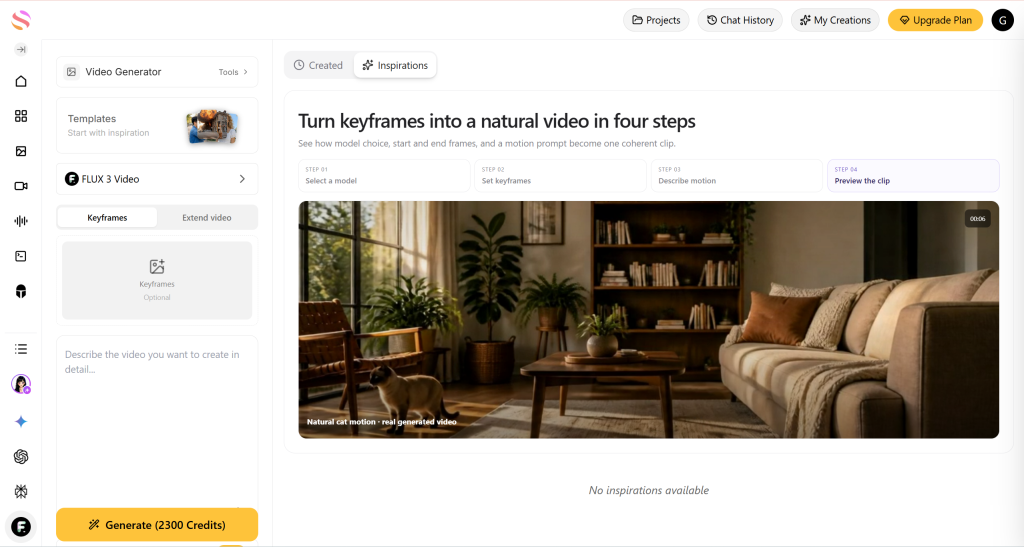
¿Quieres probar el modelo que hemos utilizado en nuestra prueba? Abrir Vídeo de FLUX 3 sobre GlobalGPT. La ruta del producto estaba activa y el entorno de tareas asociado completó las tres ejecuciones el 11 de agosto de 2026. Comprueba los controles y la cuota que aparecen en tu propia cuenta antes de iniciar un lote de producción.
Preguntas frecuentes sobre FLUX 3
¿Cuándo se anunció FLUX 3?
Black Forest Labs anunció FLUX 3 el 23 de julio de 2026. En la publicación de lanzamiento se presentó un modelo base multimodal que abarca imágenes, vídeo, audio y predicción de acciones, cuyas funcionalidades se irán implementando a través de un programa de acceso anticipado por fases, en lugar de un único lanzamiento público general.
¿Está FLUX 3 disponible para el público?
BFL ofrece FLUX 3 Video a través del programa de acceso anticipado y ya ha publicado los precios de este servicio. GlobalGPT también cuenta con una ruta de producto verificada para FLUX 3 Video. Esto no significa que FLUX 3 Image, Action, los pesos privados o FLUX 3 Dev estén disponibles de forma generalizada en régimen de autoservicio; cada función sigue teniendo su propio proceso de implementación y sus propias condiciones.
¿Puede FLUX 3 generar vídeos con audio nativo?
Sí. Según BFL, FLUX 3 Video puede generar voz, efectos y sonido ambiental en varios idiomas junto con los fotogramas. Los tres archivos MP4 de nuestra prueba del 11 de agosto contenían datos de audio descodificados. No transcribimos automáticamente las pistas, por lo que la prueba confirma la presencia de audio, pero no que el diálogo sea palabra por palabra.
¿FLUX 3 también es un modelo de imagen?
Sí. La generación y edición de imágenes forman parte de la familia FLUX 3, pero BFL ha indicado que el acceso anticipado a FLUX 3 Image se abriría en las semanas posteriores al anuncio inicial. En el momento de esta actualización, aún no se habían publicado los nombres de los puntos de conexión públicos, la disponibilidad definitiva ni los precios.
¿FLUX 3 es de código abierto o de peso abierto?
BFL ha anunciado que FLUX 3 Dev permitirá en el futuro el acceso de peso abierto. Aún no ha publicado la fecha de lanzamiento, la licencia, el tamaño de los parámetros, el alcance del código ni los requisitos de hardware. Hasta que se conozcan esos detalles, es más preciso hablar de “peso abierto previsto” que de “código abierto”.”
¿En qué se diferencia FLUX 3 de FLUX.2?
FLUX.2 es, ante todo, una familia de modelos de generación y edición de imágenes con parámetros y precios publicados. FLUX 3 es una base multimodal más amplia destinada a conectar imágenes, vídeo, audio y predicción de acciones. Para realizar una comparación justa en cuanto a calidad o coste, habrá que esperar a que se amplíe el acceso a FLUX 3.
¿Qué reveló la prueba práctica del FLUX 3?
Se han completado con éxito las tres tareas con el flux-3-video ID del modelo. Los resultados se ajustaron a las escenas generales solicitadas, y la prueba del robot mantuvo el orden de sus movimientos y sus características principales. Los tres clips duraron 5,04 segundos a pesar de que las instrucciones indicaban ocho segundos; el espaciado exacto entre las etiquetas y la geometría repetida del producto no fueron perfectos.
¿Puedo utilizar FLUX 3 en GlobalGPT?
Sí. La ruta verificada es Vídeo de FLUX 3 sobre GlobalGPT. Además, el 11 de agosto de 2026 completamos tres generaciones a través del entorno de tareas conectado. El acceso a la plataforma es independiente del acceso directo a la API de BFL o al peso privado.
Conclusión final
FLUX 3 ya no es solo una promesa de la página de lanzamiento. BFL ha publicado las capacidades de vídeo y los precios, GlobalGPT cuenta con una ruta verificada y nuestras tres ejecuciones han generado archivos MP4 utilizables con flujos de audio. El modelo gestionó bien la lógica de las escenas y los movimientos restringidos, pero no respetó la duración solicitada y suavizó la exactitud del texto y la coherencia del producto. Prueba tu prompt real antes de ampliarlo y sigue atento a FLUX 3 Image, Action, los pesos privados y la licencia FLUX 3 Dev a medida que esas partes de la familia maduran.