

If you are asking, “How much does GPT-Live 1 cost?”, the official API answer is $0.05 per voice minute. OpenAI bills the voice session by the second, so a 90-second session costs $0.075 instead of being rounded up to $0.10. The voice rate is only one layer of the bill: the backend model and tool usage are charged separately.
That distinction matters when you are planning a real voice agent. Explore AI workflows with GlobalGPT if your work moves between model research, writing, audio, images, video, and API tasks; use the official GPT-Live pages as the source of truth for the Live transport and its rate.

What is GPT-Live 1?
GPT-Live 1 is OpenAI’s full-duplex voice model. It can listen and speak at the same time, which is the behavior people expect from a natural live conversation rather than a turn-by-turn audio file pipeline. The model page lists gpt-live-1 as the model ID, with audio and text as both input and output modalities.
The important architecture detail is delegation. GPT-Live 1 handles the spoken interaction while a backend agent can reason, look up information, call tools, or complete a task. The application still owns permissions, confirmation steps, access to business systems, and the record of what actually happened. A spoken answer is not by itself proof that an order, refund, or account change was completed.
For developers, the Live route is separate from the normal chat and response routes. OpenAI’s model page lists the Live session endpoint as v1/live/sessions; always recheck the current documentation before implementing a production connection.
GPT-Live 1 pricing at a glance
Краткий ответ
- Модель: GPT-Live 1 (
gpt-live-1) - Voice session: $0.05 per minute
- Meter: actual session seconds; no whole-minute round-up
- Separate charges: backend model usage and tool usage
The official rate card gives one clear number for the Live voice layer. It does not give one universal “voice agent” total because the backend model, functions, databases, telephony provider, and other infrastructure depend on your application.
| Billed voice time | Voice-layer math | Voice cost | Included in this illustration |
|---|---|---|---|
| 90 секунд | 90 ÷ 60 × $0.05 | $0.075 | Voice session only |
| 100 minutes | 100 × $0.05 | $5.00 | Voice session only |
| 1,000 minutes | 1,000 × $0.05 | $50.00 | Voice session only |
| 10,000 minutes | 10,000 × $0.05 | $500.00 | Voice session only |
Price snapshot: the figures above reflect the OpenAI documentation read on September 28, 2026. They are arithmetic examples, not a promise of a monthly bill. Your loaded cost adds the backend and tool layers.
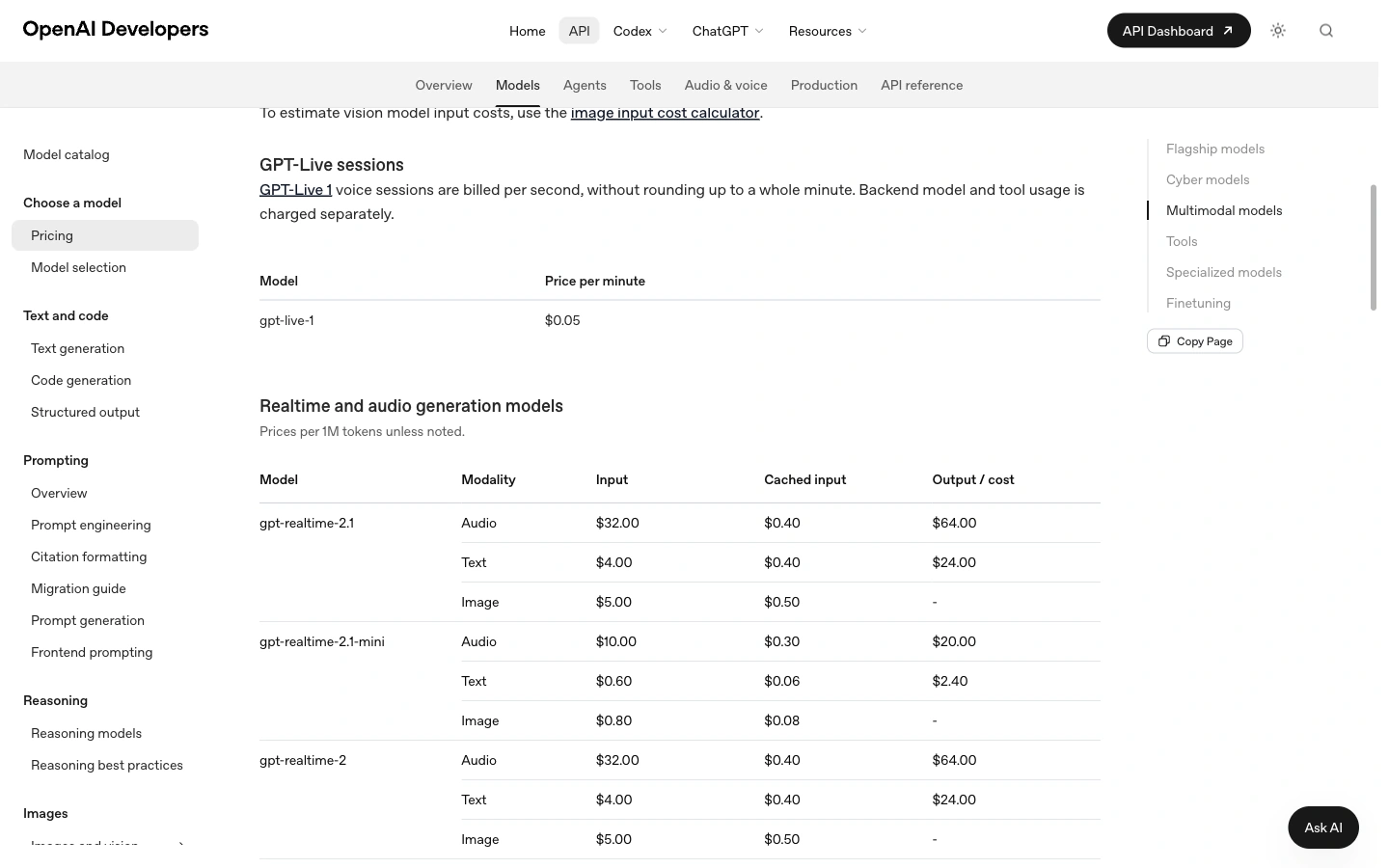
What the $0.05 rate covers—and what it leaves out
Think of a GPT-Live deployment as a chain with separate meters. The $0.05 number pays for the live voice layer. The work that makes the conversation useful can create additional usage.
Separate the meters before you forecast
- Voice session: GPT-Live 1 listens and speaks. Forecast it from actual billed seconds at $0.05 per minute.
- Backend reasoning: a client-owned agent or an OpenAI-hosted backend can reason over the request. Its model usage follows that model’s own rate card.
- Tools and systems: search, databases, function calls, storage, observability, and any phone or carrier service add their own costs.
The application is responsible for permission checks, user confirmation, and recording whether a tool returned a completed action. Keep those controls in your workflow even when the voice response sounds confident.
This layered view prevents a common budgeting mistake: multiplying $0.05 by talk time and calling the result the cost of a finished customer-support call. The model rate is easy to calculate; the rest of the workflow needs measured usage.
GPT-Live 1 cost calculator
Use the calculator for a first budget pass. Enter either seconds or minutes for the voice session, then add your own effective backend estimate and any monthly tools or infrastructure budget. The backend field is your estimate, not an OpenAI GPT-Live price.
Estimate your loaded GPT-Live 1 cost
The calculator stays in your browser. It sends no request and uses no account data.
Worked scenarios: voice layer versus loaded budget
| Сценарий | Voice layer | Backend estimate | Инструменты | Loaded total |
|---|---|---|---|---|
| 100 minutes, voice only | $5 | $0 | $0 | $5 |
| 1,000 minutes + $0.04/min backend | $50 | $40 | $0 | $90 |
| 10,000 minutes + $0.04/min backend + $25 tools | $500 | $400 | $25 | $925 |
Only the first column of these calculations comes from the official GPT-Live rate. The $0.04 backend figure is a reader-supplied planning assumption used to show how the layers add up; it is not an OpenAI backend quote.
GPT-Live 1 vs. Realtime API vs. TTS
These names sit close together in search results, but they describe different building blocks. Keeping the billing unit attached to the right route avoids a misleading comparison.
| Маршрут | Для чего это нужно | How to read the bill | Хорошая посадка |
|---|---|---|---|
| GPT-Live 1 | Full-duplex voice conversation with backend delegation | $0.05 per voice minute, billed by actual seconds; backend and tools separate | Live spoken interaction where the user can interrupt and keep talking |
| Realtime API | A separate real-time audio/text session route | Use the current Realtime token rate card for the exact model and modality; do not substitute the GPT-Live session rate | Applications already designed around the Realtime API contract |
| Преобразование текста в речь | Turns text into generated audio | Use the selected speech model’s current endpoint unit; it is not a full-duplex conversation charge | Narration, playback, voiceovers, and generated audio files |
| Phone or carrier layer | Connects a conversation to a phone network | Carrier, SIP, minutes, recording, and compliance costs are separate from the model session | Production telephony after the application workflow is ready |
If you need the conceptual difference between generated speech and transcription, see how text-to-speech differs from transcription. That reading helps with the audio workflow, but it is not the source of the GPT-Live price.
How to budget a real voice workflow
- Measure seconds, not calls. Export session duration and keep short interruptions in the same accounting method as long calls.
- Choose the backend deliberately. A lightweight backend can answer simple lookups; a heavier reasoning model may spend more per minute. Record the actual input and output usage returned by that model.
- List every tool boundary. Include search, databases, function calls, storage, monitoring, telephony, and any human handoff process that your application pays for.
- Track value separately from duration. A ten-minute conversation costs more voice time than a two-minute one, even if both end with the same business outcome.
For a text-model budgeting example, you can compare text-model API cost components. Keep that model’s token formula separate from the GPT-Live voice-session formula; the two prices should never be substituted for each other.
Место GlobalGPT в рабочем процессе
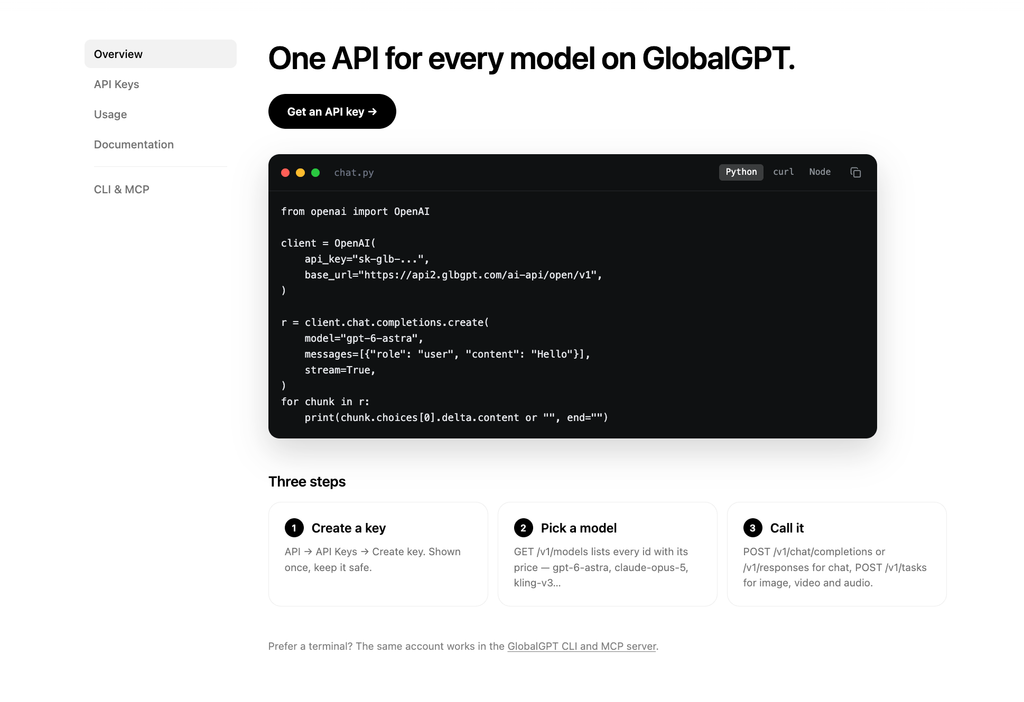
GlobalGPT is useful when the work around a voice project spans more than one model or modality. Its public documentation describes one API entry point for chat and asynchronous media tasks, while the broader workspace brings text, audio, image, and video work into one dashboard. That can shorten the path from researching a voice workflow to drafting prompts, preparing supporting audio, and comparing other models.
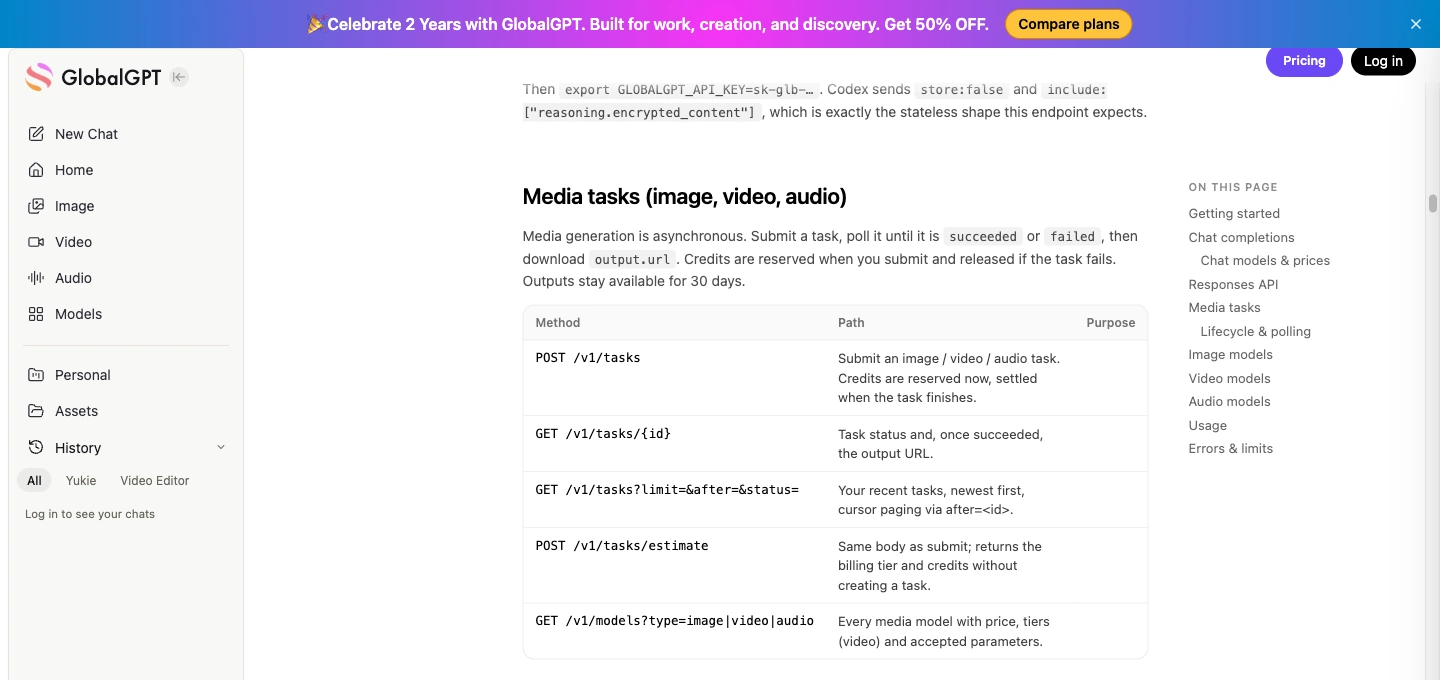
GPT-Live 1 itself has a specific Live session contract and a specific official rate. Treat OpenAI’s model and pricing pages as the authority for that transport. Use GlobalGPT as the surrounding multi-model workspace and API workflow, and confirm the exact model route shown in the current product documentation before promising a direct GPT-Live connection.
Explore AI workflows with GlobalGPT when you want one place to move from model research to a wider content or audio workflow.
GPT-Live 1 pricing FAQ
What is the official GPT-Live 1 API price?
OpenAI lists GPT-Live 1 voice sessions at $0.05 per minute. The session is billed by actual seconds, and backend model and tool usage are separate.
Does GPT-Live 1 round a short call up to a full minute?
No. The official pricing page says the duration is billed per second without rounding up to a whole minute. Ninety seconds therefore equals 1.5 billable minutes, or $0.075 for the voice layer.
Does the $0.05 rate include the reasoning model?
No. The voice session and the backend model are separate layers. Add the backend model’s actual usage to the voice-layer estimate, then add tool and infrastructure costs.
Is GPT-Live 1 the same as the Realtime API?
No. They are separate routes in OpenAI’s audio documentation. GPT-Live 1 uses the published voice-session duration rate; a Realtime implementation must use the current Realtime model and modality pricing.
Is GPT-Live 1 the same as text to speech?
No. Text to speech produces audio from text. GPT-Live 1 is a full-duplex conversation layer that can listen and speak while delegated backend work runs.
How do I estimate a monthly GPT-Live 1 budget?
Start with actual seconds ÷ 60 × $0.05. Add a measured backend estimate per minute and a separate monthly line for tools, telephony, storage, monitoring, and other infrastructure. The calculator above keeps those layers visible.
Can I treat GlobalGPT as a drop-in GPT-Live transport?
Do not assume that from a general multi-model workspace description. Check the current GlobalGPT model and API documentation for the exact route you need, and use OpenAI’s GPT-Live documentation for the Live session contract.
Практические выводы
GPT-Live 1 pricing starts at $0.05 per voice minute, measured by actual seconds. That is a clear voice-layer cost, not a complete voice-agent bill. Forecast the backend, tools, and phone or business infrastructure as separate lines, then use real session and usage data to replace the planning assumptions.
Official references: GPT-Live 1 model page, Цены на API OpenAI, и Getting started with GPT-Live.