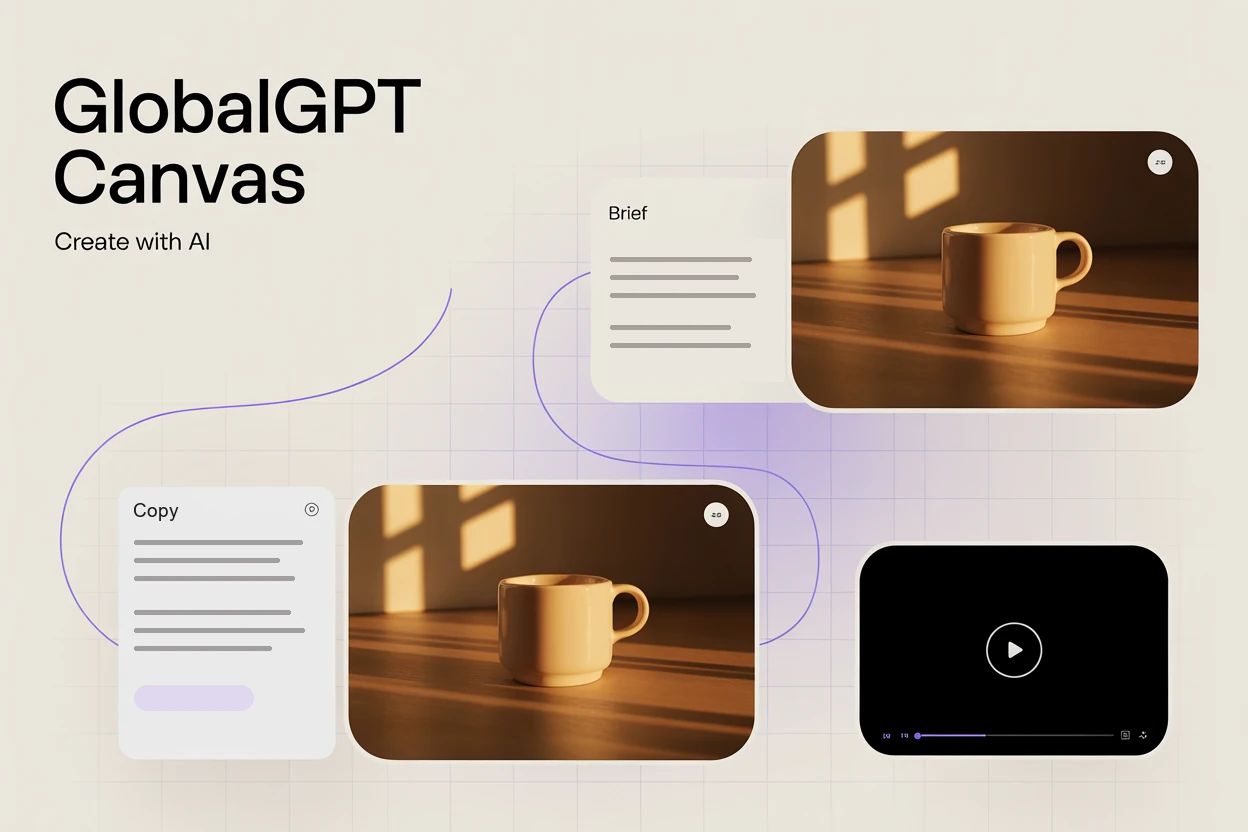
Your first AI image is rarely the end of a project. You still need to change the scene, adapt the message, and decide what to make next. GlobalGPT Canvas gives those decisions a shared workspace: describe the job to an agent, review the nodes it builds, and keep developing the result.
We tried that process with a fictional coffee-cup campaign. In the same canvas, we built a product-image flow, created a student-focused variation from the first image, and drafted social, email, and blog copy. The useful part was being able to move between AI planning and direct editing without rebuilding the project in another app. Try GlobalGPT Canvas with a small brief of your own.
Escopo do teste: hands-on GlobalGPT Canvas testing on September 16, 2026. Two images, two versions of the copy, and one video were produced. This was a Canvas walkthrough, not a matched output-quality or speed test against Canva.
Canvas, Canva, and GPT Image Integrations
If you arrived while searching for “Canva integrations with GPT Image 1 Mini,” start with one distinction: GlobalGPT Canvas and Canva are different products. Connecting an assistant to Canva also does not establish which image model powers Canva’s native tools.
Canva’s official AI Connector documentation says assistants such as ChatGPT, Claude, and Cursor can create designs, autofill templates, find existing designs, and export files. Canva already supports AI-assisted work; the question is which workspace fits the deliverable you want.
There is also a date to know if you mean the OpenAI API model. The official deprecation schedule lists GPT Image 1 Mini for API removal on December 1, 2026, with GPT Image 2 as the recommended replacement. That schedule does not establish Canva’s underlying model or the availability of a model through a separate platform.
For this article, we focused on a different question: can you develop images and copy with AI while keeping the project together? GlobalGPT’s all-in-one AI subscription approach is the broader context; the examples below show what we actually did inside Canvas.
1. Turn a Brief into a Product Image
We started with an empty canvas and chose Ask the Agent. The task was deliberately small: a short campaign brief and one square product image for Morrow, a fictional reusable coffee-cup brand. Asking for one draft kept the first review focused.
The request
Build a small product-launch canvas for Morrow, a fictional reusable coffee cup brand. Create a short campaign brief and one image-generation node connected to it. Audience: busy commuters. Image: an unbranded cream-colored reusable coffee cup on a simple wooden breakfast table, soft morning light, warm editorial product photography, no text or logo. Use an available image model. Generate only ONE square hero image for this first draft, with no video or audio yet. I will review it before asking for changes.
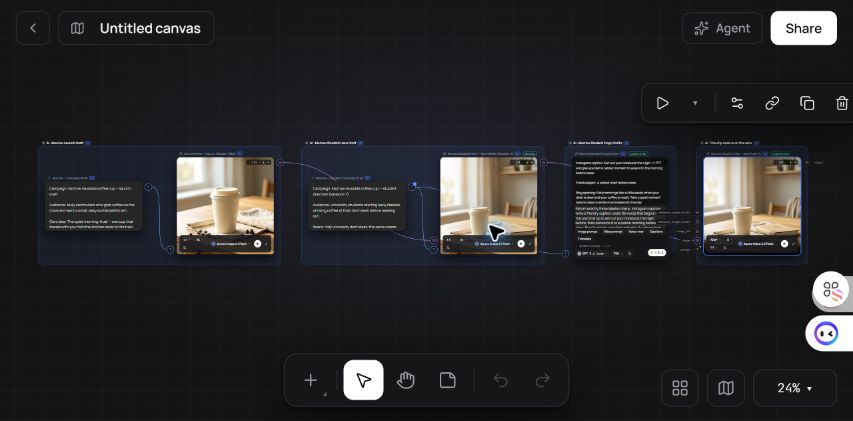
The agent created a text brief and an Image Generator node, connected them, and selected the model labeled Agnes Image 2.1 Flash. The node showed a square aspect ratio and a 1K setting. We then ran the image node; building the flow alone had not produced the image.
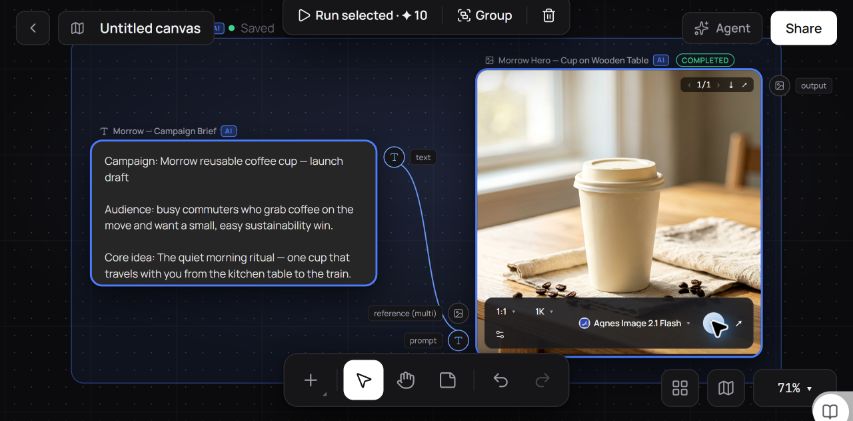
The result placed the cream-colored cup on a wooden table beside a window, with a linen napkin and scattered coffee beans. It matched the warm product-photography direction well enough to become the starting point for another scene.
The brief still needed an editorial check: the agent added sustainability-oriented language that we had not supplied. For a real product, that would need support or removal. A useful draft does not make every line an approved brand claim.
2. Develop a New Direction from the First Image
Next, we changed the audience from commuters to university students. Rather than discard the first result, we asked for a separate branch that used it as an image reference. This made the original and the new direction available in the same project.
The feedback
I like the first image. Keep the existing brief and completed hero image unchanged. Create a second image node for a student campaign, using the completed hero image as its image reference so the same cup is retained. Change the scene to a tidy university dorm desk with one closed notebook, warm morning light, and generous empty space in the upper third for a headline I will add later. No visible text or logos. Keep it square and use the same image model. Add a short text brief for this new direction. Build only this one variation; do not add video or audio.
The agent added a student campaign brief and a second image node. The new node visibly referenced the original hero image, while the original brief and image remained on the canvas. We ran the new node and reviewed the result.
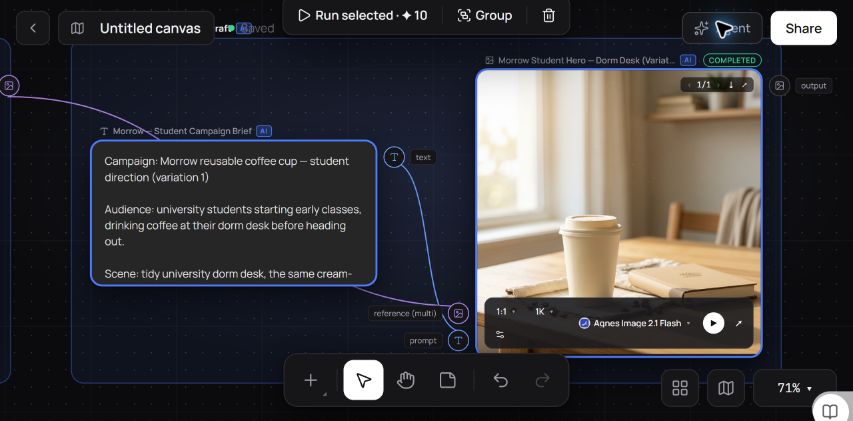
The new image retained the cream-cup look and added the requested notebook. It also left more space above the cup for a later headline. That is useful visual continuity in this example, not proof that every product detail will stay identical across future generations.
The reusable instruction pattern is keep this, change that, and use this as the reference. Name the scene, lighting, objects, and empty space you want to change. For other kinds of visual revisions, the GlobalGPT image-editing guide covers additional editing tasks.
3. Draft and Refine Campaign Copy
We then asked the agent to add one LLM Assistant node for three pieces of copy: an Instagram caption under 35 words, an email subject under eight words, and a two-sentence blog opening. It selected the model labeled GPT-5.6 Luna and created a connection from the student brief.
The request
Next task: turn the student campaign into concise copy. Keep all existing image and brief nodes unchanged. Add one LLM Assistant node connected to the student campaign brief, with instructions to draft three outputs: an Instagram caption under 35 words, an email subject under 8 words, and a 2-sentence blog opening. Use a friendly student voice and focus on a calmer morning routine, not environmental or performance claims. Do not invent prices, discounts, dates, or product specifications. Do not publish or send anything. Use an available text model and build only this one copy node.
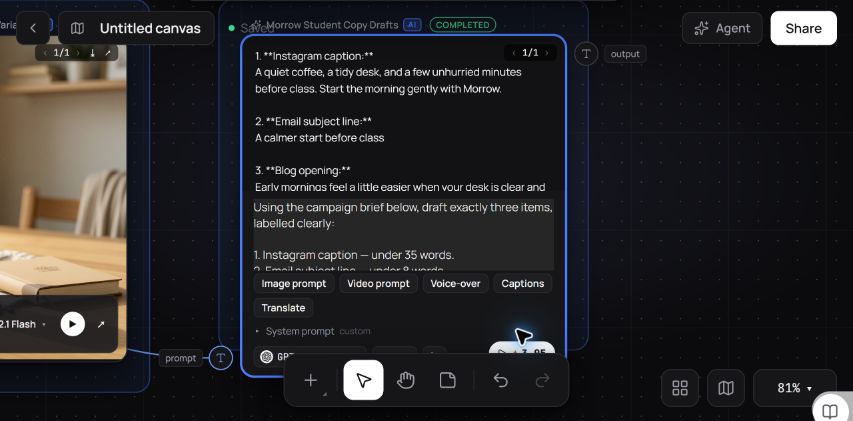
The first Instagram caption read: “A quiet coffee, a tidy desk, and a few unhurried minutes before class. Start the morning gently with Morrow.” It was usable but generic, so we asked for one practical tip instead: set out your notebook the night before.
This revision needed a manual step. The agent said it had updated the instructions, but the visible field and saved canvas still held the earlier instruction. We edited that field directly and reran the node. The second output was:
Set out your notebook the night before, and give yourself a calmer moment to ease into the morning before class.
The node then showed two result versions. The blog opening stayed the same, and the email subject followed the wording in our manual instruction, including its final period. We could keep the first draft available while reviewing the revised caption.
There is another useful control to understand: the node’s inspector says a typed instruction overrides the connected prompt. A connecting line alone is not a guarantee that every upstream sentence will be included. Check the instruction field before rerunning a node.
Add a Video Step When You Need One
We also asked the agent to connect the student image to a video node as its first frame. The requested motion was a slow camera push-in with the cup and notebook staying still. It configured Agnes Video 2.5 Flash at five seconds, 720P, and a square aspect ratio.
The video completed after one generation request. Before running it, we checked a cost discrepancy: the node and its cost table showed an estimate of 420 credits, while the agent’s prose said 0.42 credits. We approved the run against the higher, node-level estimate. These are displayed estimates, not a verified billing total.
The completed node showed one result, with the student scene visible in the video preview. The player reported a duration of 5.175 seconds and dimensions of 704 × 704 pixels, although the selected setting was labeled 720P. We verified completion and playback metadata; we did not perform a frame-by-frame motion or product-consistency review.
When the All-in-One Approach Makes Sense
GlobalGPT Canvas is a compelling starting point when your main job is developing AI-generated assets and refining the direction. In our test, we could keep the original image, create a reference-based variation, draft copy with a different model, and generate a video from the student image in one workspace. That is a concrete reason to try it beyond looking for a connection to one particular image model.
| Your main goal | A practical starting point | Por que |
|---|---|---|
| Develop a brief into image options and supporting copy | GlobalGPT Canvas | Our test kept the brief, image branches, and text-model output together. |
| Create, locate, autofill, or export Canva designs from an assistant | Canva AI Connector | These actions are documented in Canva’s official connector guide. |
| Improve one part while keeping the rest available | Try a small Canvas branch | The image branch worked in our test; the copy revision needed direct editing and a final check. |
| Choose a tool by finished-design quality, speed, or total cost | Run a matched test for your deliverable | This walkthrough did not measure a Canva comparison or verify a price advantage. |
Start with one brief and one image. Review the first result, then add a branch for the change you actually want. Open GlobalGPT Canvas and try the same process: ask the agent to build, inspect the result, and decide what should change next.
Perguntas frequentes
Is GlobalGPT Canvas the same as Canva?
No. GlobalGPT Canvas is the workspace tested here. Canva is a separate design platform with its own AI features and assistant connections.
Does Canva use GPT Image 1 Mini?
The sources reviewed for this article do not establish that Canva’s native image tools use GPT Image 1 Mini. Canva’s AI Connector is a separate capability from a particular image-model integration.
Can I work with both images and text in GlobalGPT Canvas?
Yes. In our September 16, 2026 test, Canvas produced two images through Agnes Image 2.1 Flash and campaign copy through the node labeled GPT-5.6 Luna.
Can the agent revise an existing project?
It created a new image branch from our feedback and preserved the original. A later copy-instruction update did not persist as expected, so we edited the node directly and checked the new result.
Did this test generate a video?
Yes. One Agnes Video 2.5 Flash request completed using the student image as its first frame. The selected settings were five seconds, 720P, and 1:1; the player reported 5.175 seconds and 704 × 704 pixels. Completion and metadata were checked, but motion accuracy was not systematically assessed.
Does building a canvas automatically run every node?
Not in this test. The agent built the nodes and showed estimates; we ran the image and copy nodes separately. Review the node settings and estimated credits before starting generation.