
GlobalGPT

GPT-5.5 Pricing Explained: Plans, Tokens, Context

GPT-5.5 Pricing Explained: Plans, Tokens, Context

GPT-5.5 pricing is split into two very different buckets, and that is where most confusion starts. In the API, GPT-5.5 costs $5 per 1M input tokens, $0.50 per 1M cached input tokens, and $30 per 1M output tokens. In ChatGPT, you do not buy GPT-5.5 as a standalone add-on. Instead, access depends on your plan: Plus includes expanded access to GPT-5.5 Thinking, Pro includes GPT-5.5 Pro, and Business includes unlimited GPT-5.5 messages with flexible access to Thinking and Pro.

The bigger reason GPT-5.5 pricing is getting so much attention is not just the token rate. It is the model’s 1,050,000-token context window, which makes it much more relevant for long-document analysis, coding repositories, tool-heavy workflows, and large retrieval tasks. That larger context can reduce repeated prompting and cut workflow overhead, but it can also raise total spend if you keep sending very large inputs without caching or prompt discipline. In other words, the real question is not only “How much does GPT-5.5 cost?” but also “When does its larger context actually save money?”

For most readers, the decision comes down to three paths. Choose ChatGPT Plus or Pro if you mainly want GPT-5.5 inside ChatGPT. Choose the API if you are building products, agents, or internal tools and need usage-based billing. Choose GPT-5.4 instead if your workloads are cost-sensitive and you do not need GPT-5.5’s higher-end reasoning profile, since GPT-5.4 is listed at $2.50 input and $15 output per 1M tokens. This article breaks down all three choices, compares GPT-5.5 with GPT-5.4 and GPT-5.5 Pro, and explains how token pricing and context size affect the total cost in real use.

For users who want access to GPT-5.5-style workflows without juggling multiple subscriptions, another practical option is using an all-in-one AI workspace such as GlobalGPT, which brings together 100+ leading models in one place for chat, image, and video workflows.

GPT-5.5 Price: Quick Answer

ItemDetails
GPT-5.5 API price$5.00 / 1M input tokens
GPT-5.5 cached input price$0.50 / 1M cached input tokens
GPT-5.5 output price$30.00 / 1M output tokens
GPT-5.5 Pro API price$30.00 / 1M input tokens
GPT-5.5 Pro output price$180.00 / 1M output tokens
Cached-input discount for GPT-5.5 ProNot available
ChatGPT access modelGPT-5.5 is not sold as a standalone subscription
Plus planIncludes access to GPT-5.5 Thinking
Pro planIncludes access to GPT-5.5 Pro
Business planIncludes unlimited GPT-5.5 messages, generous GPT-5.5 Thinking access, and access to GPT-5.5 Pro
Pricing model differenceChatGPT pricing is subscription-based; API pricing is token-based
Best for ChatGPT plansUsers who want GPT-5.5 for writing, research, and everyday work inside ChatGPT
Best for API billingDevelopers building apps, agents, coding workflows, or document pipelines

Which ChatGPT plans include GPT-5.5

PlanGPT-5.5GPT-5.5 ProBest For
FreeLimited / not full accessNoCasual users
GoLimitedNoBudget users
PlusYes, GPT-5.5 ThinkingNoIndividuals
ProYesYesPower users
BusinessYes, unlimited messagesYesTeams
EnterpriseYesYesLarge organizations
EduYes, depending on workspace setupPossibleSchools / institutions

ChatGPT pricing vs API pricing: the key difference

This distinction is where many users get confused. ChatGPT pricing is subscription-based and meant for people using the model inside the ChatGPT product. API pricing is usage-based and billed by tokens when developers build products, workflows, or internal tools on top of OpenAI’s platform. OpenAI explicitly states that API usage is separate and billed independently from ChatGPT Plus.

The practical takeaway is simple. If you want GPT-5.5 mainly for writing, research, and everyday work inside ChatGPT, look at plan pricing first. If you want GPT-5.5 for an app, agent, coding workflow, or document pipeline, the API token rate is the number that matters most.

Which ChatGPT Plans Include GPT-5.5?

Which ChatGPT Plans Include GPT-5.5?

Free and Go: what you do not get

For readers looking for the lowest-cost path, the first question is whether GPT-5.5 is available on cheaper or free tiers. OpenAI’s public pricing page positions Business, Plus, and Pro as the main GPT-5.5 access tiers. The same pricing page emphasizes GPT-5.5 access in paid plans, rather than presenting Free as a full GPT-5.5 entry point. That means users searching for consistent GPT-5.5 access should assume a paid plan is the reliable route.

Plus: GPT-5.5 Thinking for individual users

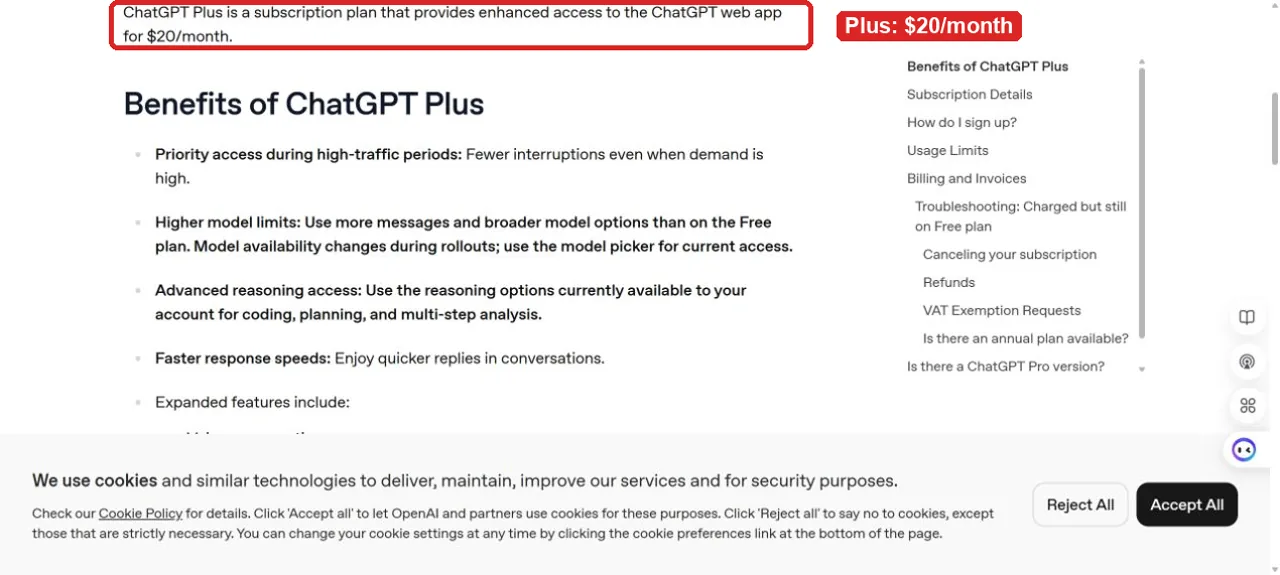
ChatGPT Plus costs $20 per month and remains the main individual plan for users who want better model access without jumping to enterprise-style pricing. OpenAI’s Help Center says Plus includes expanded access to higher-end models and explicitly notes that API usage is not included. OpenAI’s pricing page also associates Plus with access to GPT-5.5 Thinking, which makes Plus the most obvious entry-level option for individual users who want GPT-5.5 inside ChatGPT.

For many solo professionals, Plus is likely the best balance between cost and capability. If you are mainly asking complex questions, analyzing uploaded files, writing content, or using GPT-5.5 occasionally for higher-stakes work, Plus is often enough. It is much cheaper than Pro and avoids the complexity of usage-based API billing. That matters because most non-developers do not need per-token cost control as much as they need predictable monthly spend.

Pro: GPT-5.5 Pro for power users

OpenAI’s pricing page places GPT-5.5 Pro in the Pro tier, making Pro the plan for users who want the most capable ChatGPT experience rather than the cheapest one. GPT-5.5 Pro is also positioned in OpenAI’s API docs as the smarter and more precise variant, which supports the idea that Pro is intended for demanding workflows, heavier reasoning, and higher-quality output.

For someone who works all day in ChatGPT, Pro can make sense even before the API does. The deciding factor is not just raw intelligence. It is also the convenience of using the best ChatGPT model without worrying about token math, request orchestration, or infrastructure. That said, users who do not consistently push the model hard may find that Pro’s premium access is more capability than they truly need.

Business and Enterprise: flexible access for teams

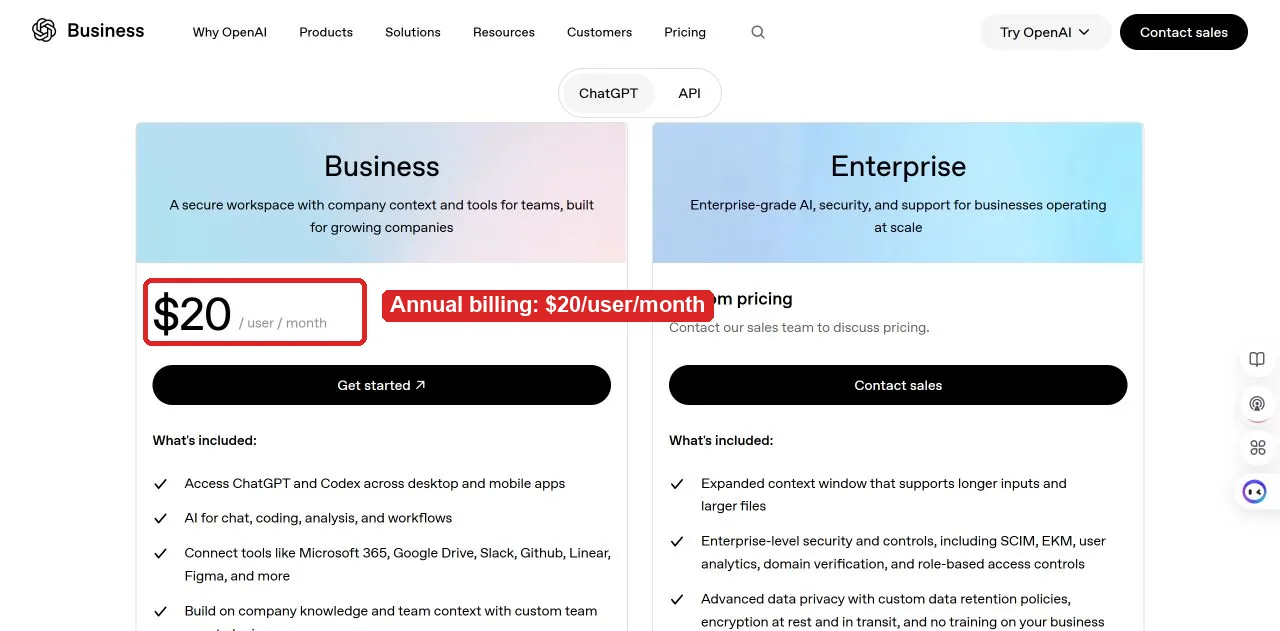
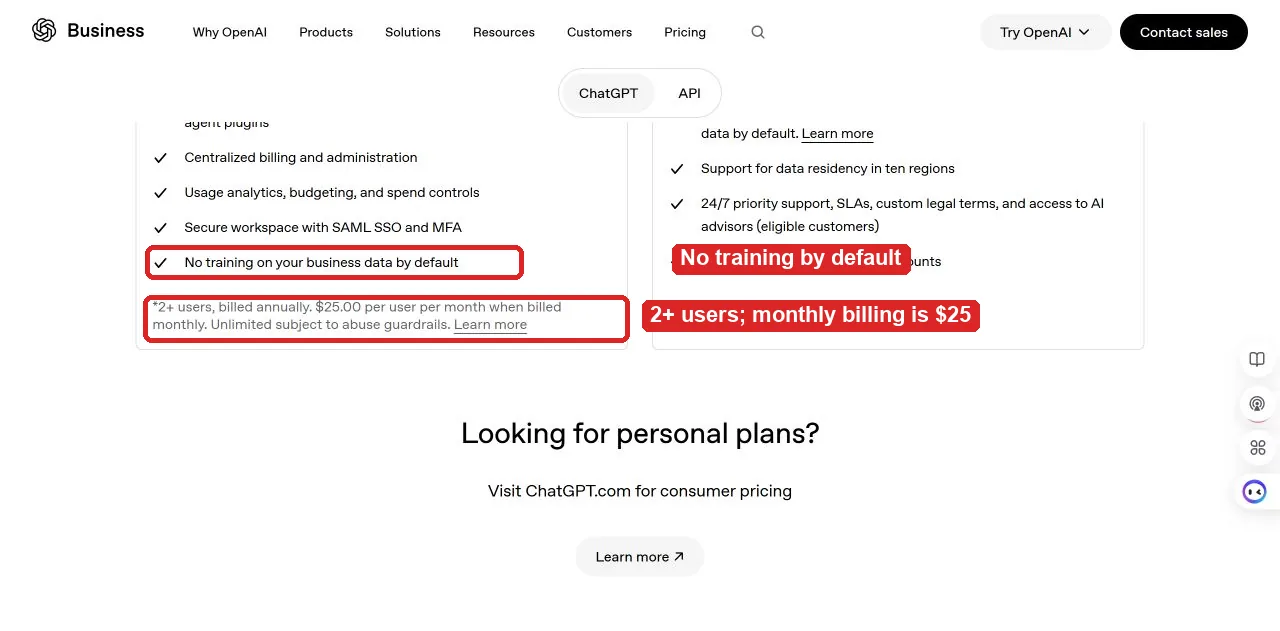
OpenAI’s pricing page says Business includes unlimited GPT-5.5 messages, generous access to GPT-5.5 Thinking, and access to GPT-5.5 Pro. OpenAI’s Help Center also notes that Business pricing changed on April 2, 2026, lowering the price of standard seats by $5 per month and adding flexible seat structures. Business workspaces can now mix standard ChatGPT seats and usage-based Codex seats, which makes the plan more adaptable for teams with different roles.

For Enterprise and Edu, OpenAI does not publish a simple universal public sticker price in the same way it does for Plus. Instead, model access and limits are documented in Help Center materials, and some organizations may use flexible pricing and credits for advanced usage patterns. That means Enterprise buyers usually need to think in terms of organization-level procurement, seats, governance, and usage controls rather than just monthly individual subscriptions.

Which plan is the cheapest way to use GPT-5.5 in ChatGPT?

For most individual users, Plus at $20 per month is the cheapest clear entry point to GPT-5.5 inside ChatGPT. For teams, Business may be more economical than giving every heavy user a premium individual setup, especially when unlimited GPT-5.5 messaging matters. For organizations with compliance or admin needs, Enterprise may be necessary even if the sticker price is not publicly listed on a self-serve page.

The right plan depends on how you work. A freelance writer or analyst may do perfectly well on Plus. A legal, finance, or engineering team that relies on GPT-5.5 every day may get more value from Business. A user who needs the strongest ChatGPT experience as an individual may consider Pro, but only if the extra capability shows up in real output quality for their workload.

For users who want access to GPT-5.5-style workflows without juggling multiple subscriptions, another practical option is using an all-in-one AI workspace such as GlobalGPT, which brings together 100+ leading models in one place for chat, image, and video workflows.

For users who want access to GPT-5.5-style workflows without juggling multiple subscriptions, another practical option is using an all-in-one AI workspace such as GlobalGPT, which brings together 100+ leading models in one place for chat, image, and video workflows.

GPT-5.5 API Pricing Explained

se a stacked pricing breakdown chart that separates standard, batch, priority, and long-context pricing for GPT-5.5. A second mini-chart can show how crossing the 272K-token threshold changes effective rates.

Input, output, and cached input costs

OpenAI’s API pricing distinguishes among input tokens, output tokens, and cached input tokens. Input tokens are the text you send to the model. Output tokens are the text the model generates back. Cached input pricing applies when reused prompt material can be billed at a lower rate. For GPT-5.5, OpenAI lists standard short-context prices of $5 input, $0.50 cached input, and $30 output per 1 million tokens.

OpenAI’s API pricing distinguishes among input tokens, output tokens, and cached input tokens. Input tokens are the text you send to the model. Output tokens are the text the model generates back. Cached input pricing applies when reused prompt material can be billed at a lower rate. For GPT-5.5, OpenAI lists standard short-context prices of $5 input, $0.50 cached input, and $30 output per 1 million tokens.

That structure matters because output is much more expensive than input. In other words, a workflow that asks GPT-5.5 to generate long, polished responses can become expensive faster than a workflow that sends large but mostly repeated context with shorter replies. This is why developers who optimize for cost often focus on controlling answer length, prompt reuse, and retrieval design rather than only worrying about the base input rate. The price ratio itself comes straight from OpenAI’s official table.

Short-context vs long-context pricing

One of the most important GPT-5.5 pricing details is that OpenAI separates short-context and long-context rates. The GPT-5.5 model page states that for prompts with more than 272K input tokens, pricing is raised to 2x input and 1.5x output for the full session in standard, batch, and flex modes. The pricing documentation reflects this with GPT-5.5 long-context standard pricing of $10 input, $1 cached input, and $45 output per 1 million tokens.

One of the most important GPT-5.5 pricing details is that OpenAI separates short-context and long-context rates. The GPT-5.5 model page states that for prompts with more than 272K input tokens, pricing is raised to 2x input and 1.5x output for the full session in standard, batch, and flex modes. The pricing documentation reflects this with GPT-5.5 long-context standard pricing of $10 input, $1 cached input, and $45 output per 1 million tokens.

This is where many shallow pricing articles stop too early. A user may see “$5 per million input tokens” and assume that number applies everywhere. It does not. If your workflow routinely pushes GPT-5.5 into long-context territory, your effective rates rise. That does not automatically make GPT-5.5 bad value, but it means that large context is not free.

Batch pricing vs standard pricing

OpenAI’s Batch API documentation says Batch jobs are processed asynchronously with 50% lower costs and higher rate limits, typically with a 24-hour turnaround time. In the API pricing docs, this appears as lower GPT-5.5 Batch pricing than standard pricing. For many offline or non-real-time workloads, Batch can materially improve economics.

This matters most for back-office work: document labeling, nightly summarization, support analysis, evaluation pipelines, and other jobs where speed matters less than cost. If a workload does not need instant replies, Batch can be one of the easiest ways to reduce GPT-5.5 spend without changing the model itself.

Priority processing and when it is worth paying more

OpenAI’s GPT-5.5 launch page says Priority processing is available at 2.5x the standard API rate. The pricing docs also list higher Priority rates for supported models. Priority exists for users who care about performance and availability more than the lowest cost.

Priority pricing makes sense when API latency directly affects revenue, user experience, or internal productivity. A customer-facing assistant that loses users when responses slow down may justify the premium. A nightly reporting job probably does not. The key is to match the pricing tier to the business importance of speed.

Regional processing uplift and hidden cost variables

OpenAI’s pricing docs note that regional processing endpoints carry a 10% uplift for GPT-5.5 and several related models. This is easy to miss, but it can affect total cost for organizations with residency or processing requirements.

The broader lesson is that total GPT-5.5 cost is never just one line from a pricing table. Context length, caching, batch usage, priority routing, and residency requirements all change the final bill. A careful cost analysis should look at the entire workflow, not only the headline token price.

GPT-5.5 Context Window: Why It Matters for Price

GPT-5.5 Context Window: Workflow & Pricing Impact

What the 1M context window actually means

OpenAI’s model documentation lists GPT-5.5 with a 1M context window and a 128K max output. In practical terms, that means GPT-5.5 can consider vastly more input in a single session than many earlier-generation workflows were designed for.

A context window is not just a technical bragging point. It changes how you structure work. Instead of splitting a large corpus into many smaller prompts, some teams can fit much more of a codebase, document set, or retrieval context into fewer sessions. That can improve consistency, reduce orchestration complexity, and simplify prompt engineering. OpenAI’s “Using GPT-5.5” guide explicitly frames the model as a strong fit for coding, tool-heavy agents, grounded assistants, and long-context retrieval.

Why a bigger context window is one of GPT-5.5’s biggest release highlights

OpenAI’s GPT-5.5 launch materials directly connect GPT-5.5 pricing with the 1M context window and emphasize that GPT-5.5 is built for complex production workflows. That pairing is why context size has become such a pricing hotspot. Users are not only asking what GPT-5.5 costs. They are asking what they are buying for the higher price.

The answer is that GPT-5.5 is being sold partly as a workflow simplifier. The model is positioned for situations where better reasoning, deeper retrieval, and larger working context help complete difficult jobs more cleanly. That is different from a purely cheap, high-volume model pitch.

When a 1M context window lowers total cost

A larger context window can lower total cost when it reduces the number of sessions, prompt restarts, retrieval misses, or manual merges required to finish a task. For example, a long-document review pipeline may become cheaper overall if GPT-5.5 can process more relevant material in one pass and produce a cleaner final result with fewer retries. OpenAI itself notes that GPT-5.5 is a strong fit for long-context retrieval and complex production workflows.

The same logic can apply to coding and agentic workflows. If a model with larger context reduces the need to reload instructions, architecture notes, tool definitions, and file summaries repeatedly, then the per-task economics may improve even if the model is more expensive per token. This is especially true when repeated setup text benefits from caching.

When large context can increase your bill instead

The opposite is also true. A larger context window can raise costs when teams treat it as permission to send huge, unfiltered inputs every time. OpenAI’s GPT-5.5 docs make clear that once prompts exceed the 272K-token threshold, long-context rates apply across the session. That means careless prompt stuffing can make GPT-5.5 materially more expensive.

This is why context window should be understood as an option, not as a default workflow pattern. The best cost discipline comes from using the extra window strategically for tasks that actually benefit from broader context, while still trimming irrelevant material. Bigger context increases capability, but it does not eliminate the need for cost-aware design.

Long-context pricing vs short-context pricing

The pricing difference is straightforward in OpenAI’s tables. GPT-5.5 standard short-context pricing is $5 / $0.50 / $30, while standard long-context pricing is $10 / $1 / $45 per 1 million tokens for input, cached input, and output respectively. That is a meaningful jump, and it is the clearest reason that “GPT-5.5 price” and “GPT-5.5 context window” belong in the same article.

Readers evaluating GPT-5.5 should therefore ask two separate questions. First, do I need the larger context often enough to justify the premium? Second, can I structure my workload to benefit from that larger window without crossing into wasteful prompt inflation? Those are the questions that determine whether GPT-5.5 feels expensive or efficient in practice.

GPT-5.5 vs GPT-5.4 Price Comparison

Use a side-by-side bar chart comparing GPT-5.5 vs GPT-5.4 on input price, output price, cached input price, and context positioning. Add a short annotation lane labeled “best for cost-sensitive tasks” vs “best for harder workflows

API pricing per 1M tokens

OpenAI’s API pricing docs list GPT-5.5 at $5 input, $0.50 cached input, and $30 output per 1 million tokens under standard short-context pricing. The same page lists GPT-5.4 at $2.50 input, $0.25 cached input, and $15 output. In simple terms, GPT-5.5 is about 2x the standard token price of GPT-5.4.

That matters because many buyers are not choosing between GPT-5.5 and no model at all. They are deciding whether GPT-5.5 is enough better than GPT-5.4 to justify paying roughly double. This is the real commercial decision hidden behind many “price” searches.

Context window difference: GPT-5.5 vs GPT-5.4

OpenAI’s GPT-5.5 model page lists a 1M context window. GPT-5.4 is positioned as a more affordable model for coding and professional work in OpenAI’s model docs, and the pricing tables explicitly include separate GPT-5.4 standard and long-context entries. The point for buyers is that GPT-5.5 is not only a pricing upgrade. It is also a capability and workflow upgrade.

This is where cost comparison becomes more nuanced. If you never use the extra context or higher-end reasoning, GPT-5.5 can look overpriced. If your work benefits from fewer retries, better execution, or larger single-session context, GPT-5.5 may justify the premium.

Performance vs cost: what you are paying extra for

OpenAI describes GPT-5.5 as a model for complex reasoning and coding and says it raises the baseline for complex production workflows, tool-heavy agents, and customer-facing workflows where execution quality matters. That language suggests the premium is partly about reliability and workflow completion, not just benchmark vanity.

For many professional buyers, the extra spend is easier to justify if it reduces operational friction. A model that produces cleaner plans, needs less supervision, or integrates context more effectively can save time and reduce downstream manual correction. Those benefits are difficult to represent in a token-only comparison, but they are central to the GPT-5.5 pitch in OpenAI’s docs.

When GPT-5.4 is the better value

GPT-5.4 is the better value when cost sensitivity is high and the workload does not demand GPT-5.5’s premium reasoning or context profile. If you are running large volumes of moderately complex tasks, GPT-5.4’s lower token price may make more sense, especially when the model already performs well enough for your use case. OpenAI itself labels GPT-5.4 as a more affordable model for coding and professional work.

That makes GPT-5.4 attractive for internal tools, repetitive coding support, or high-volume pipelines where quality differences are noticeable but not decisive. In those settings, lower cost may beat marginal quality gains.

When GPT-5.5 is worth the upgrade

GPT-5.5 is more likely worth the upgrade when the cost of mistakes, retries, or fragmented context is high. Long-document reasoning, tool-heavy execution, multi-step customer-facing workflows, and more demanding coding tasks are exactly the areas OpenAI emphasizes in its official guidance.

The strongest buying case for GPT-5.5 is not “it is newer.” It is “it helps complete harder work more reliably.” If that translates into fewer failed sessions, cleaner answers, or less manual stitching, the higher token price may be justified.

GPT-5.5 Pro Price: Is It Worth It?

GPT-5.5 vs GPT-5.5 Pro pricing

The gap between GPT-5.5 and GPT-5.5 Pro is large. OpenAI’s pricing docs list GPT-5.5 at $5 input / $30 output, while GPT-5.5 Pro is $30 input / $180 output under standard pricing. That is a 6x jump in both input and output rates.

This pricing alone signals that GPT-5.5 Pro is not intended as the default choice for most API users. It is a specialty option for cases where the extra accuracy or precision has real business value. A team should be able to explain why standard GPT-5.5 is insufficient before moving to Pro.

Use a cost multiplier chart showing GPT-5.5 = 1x and GPT-5.5 Pro = 6x for both input and output token pricing. This makes the upgrade cost intuitive at a glance.

What GPT-5.5 Pro is designed for

OpenAI’s model page describes GPT-5.5 Pro as a version of GPT-5.5 that produces smarter and more precise responses. That is the key positioning clue. Pro is for users who want the best answer they can get from this family, even when it costs much more.

This matters in areas where output quality has downstream consequences: legal drafting review, high-stakes analysis, advanced coding assistance, or customer interactions where mistakes are expensive. In those environments, the right comparison is not just model-vs-model token cost. It is token cost versus the cost of bad output.

benchmark table of gpt 5.5

Best users for GPT-5.5 Pro

The best users for GPT-5.5 Pro are likely advanced professionals and teams running high-value tasks where precision matters more than throughput. Pro can also make sense for users who have already validated that standard GPT-5.5 is close but not consistently enough for their quality bar.

Inside ChatGPT, the same logic applies. If your work routinely involves difficult reasoning, sensitive deliverables, or complex synthesis, Pro access may be worth paying for. But for ordinary research, writing, and everyday problem solving, standard GPT-5.5 or GPT-5.5 Thinking may already be the better value.

When GPT-5.5 Pro is overkill

GPT-5.5 Pro is overkill when the workload is repetitive, high-volume, or tolerant of small quality differences. It is also usually the wrong starting point for early-stage prototyping, because teams often do not yet know whether the extra quality is necessary. Given the 6x pricing jump, the burden of proof is on Pro.

A good practical strategy is to start with GPT-5.5, measure the error rate or manual correction load, and only move to Pro if the improvement is real and financially justified. That is a more defensible buying path than assuming the most expensive model is automatically the smartest purchase.

The cost gap between standard and Pro in practical terms

In practical terms, GPT-5.5 Pro becomes expensive very quickly if your workflow generates long outputs. Since output tokens are billed at $180 per 1 million tokens, verbose generations or large-scale deployments can create a much larger bill than many buyers expect. That is why Pro is best thought of as a precision tool, not a general-purpose default.

The core decision is straightforward: pay for Pro when superior output quality saves enough labor, risk, or time to offset the higher cost. Otherwise, standard GPT-5.5 is usually the more rational choice.

How Much Does GPT-5.5 Cost in Real Usage?

Use a scenario-based cost chart with example workloads such as casual testing, chatbot, coding assistant, and long-document analysis. Show which cost levers matter most in each case: caching, batch, output length, or long-context threshold.

Example: casual developer testing

A casual developer who runs small experiments, tries prompts, and validates a few workflows may spend very little in absolute terms, because API costs scale with actual usage rather than a fixed monthly fee. With GPT-5.5 at $5 per 1M input tokens and $30 per 1M output tokens, lightweight testing can remain affordable if prompts and outputs stay modest.

The more important factor for casual testing is usually not raw pricing, but whether a subscription plan would be simpler. Non-developers and light tinkerers often find ChatGPT Plus easier because it removes token tracking altogether. Developers building integration logic, on the other hand, usually benefit from API billing because it maps directly to product usage.

Example: startup chatbot or agent workflow

A startup building a chatbot or internal agent should look beyond the base token price and examine the full workflow. If the assistant relies on repeated system prompts, tool descriptions, and stable policy text, caching can improve cost efficiency. If the workflow is asynchronous, Batch can lower cost even further. OpenAI’s docs support both of these levers directly.

For this type of use case, GPT-5.5’s value depends on whether it improves completion quality enough to reduce retries, escalations, or human review. If it does, a more expensive model can still be the better business decision. If not, GPT-5.4 or a smaller model may be more efficient.

Example: coding assistant with repeated prompts

OpenAI’s GPT-5.5 guidance emphasizes coding and complex production workflows, making coding assistants one of the clearest natural fits. In a coding assistant setting, there is often repeated context: repository conventions, style rules, system instructions, and frequently referenced files. That makes caching particularly relevant.

The cost picture improves when stable context is reused efficiently and outputs stay targeted rather than excessively verbose. The cost picture worsens when every request dumps large amounts of fresh code without filtering or when the assistant is allowed to generate unnecessarily long answers. In other words, coding workflows can benefit from GPT-5.5, but only if they are engineered with some discipline.

Example: long-document analysis using the 1M context window

Long-document analysis is where GPT-5.5’s pricing story becomes most interesting. The model’s 1M context window and long-context positioning make it attractive for large reports, contracts, technical manuals, research sets, or multi-file corpora. OpenAI explicitly points to long-context retrieval and complex professional work in its docs.

But long-document analysis is also where pricing can rise the fastest, because sessions that cross the 272K-token threshold move into long-context pricing. The best economics come when large-context capability reduces workflow fragmentation enough to offset the higher rates. The worst economics come when teams simply send everything every time.

Example: when cached input changes the economics

Cached input is one of the most underrated parts of GPT-5.5 pricing. OpenAI’s pricing table gives GPT-5.5 a significant discount on cached input compared with fresh input. In workflows with heavy prompt reuse, that can make a meaningful difference over time.

This is especially important for agents, coding tools, and repeated document workflows where the same instructions or reference material show up again and again. If you ignore caching, GPT-5.5 can look more expensive than necessary. If you design for it, the model can become much more economical on a per-task basis.

What Is the Cheapest Way to Access GPT-5.5?

Use a decision tree graphic titled “Cheapest Way to Use GPT-5.5”. The branches should split by non-developer, developer, team, and needs 1M context / does not need 1M context.

Cheapest option for non-developers

For non-developers, the cheapest straightforward path is usually ChatGPT Plus at $20 per month. That gives access to GPT-5.5 inside ChatGPT without the complexity of token billing, API keys, or engineering overhead. If you are mainly using GPT-5.5 for writing, research, brainstorming, file analysis, or general professional work, Plus is typically the most economical path.

Cheapest option for developers

For developers, the cheapest route depends on usage pattern. If you are building an application with intermittent or low-volume usage, the API may be cheaper than paying for premium subscriptions, because you only pay for what you consume. But if you are using GPT-5.5 heavily as a person inside ChatGPT rather than through a product, a subscription can be simpler and more predictable.

The cheapest API strategy is not only about model choice. It is also about design choices: keeping outputs concise, using Batch where speed is not critical, caching repeated context, and avoiding unnecessary long-context sessions. OpenAI’s docs support all four levers.

Cheapest option for teams

For teams, Business can be the cheapest practical path when multiple people need reliable GPT-5.5 access in ChatGPT. OpenAI’s pricing page highlights unlimited GPT-5.5 messages in Business, and the Help Center describes flexible seat structures. That combination can be more manageable than piecing together multiple individual subscriptions for a growing company.

The cheapest team option, however, still depends on workflow. A team that mainly wants conversational access may do well on Business. A team that primarily builds software may care more about API spend and usage controls than plan-level messaging access.

Subscription vs API: which is cheaper for your use case

A subscription is usually cheaper when one person uses GPT-5.5 frequently inside ChatGPT and values predictable billing. The API is usually cheaper when usage is variable, productized, or distributed across a technical workflow where every token can be optimized. The answer is not universal because these are two different billing models aimed at different kinds of users.

The smart way to decide is to ask where the work actually happens. If the work happens in chat, buy a plan. If the work happens inside your software, automation, or internal tooling, use the API. Mixing those decisions together is what creates most of the confusion around GPT-5.5 price.

For users who want model access without managing separate billing across tools, there is also a third route for users who do not want to choose between a single subscription product and raw API management. Platforms like GlobalGPT package access to multiple mainstream AI models in one workspace, which can be useful for users comparing cost, flexibility, and workflow convenience at the same time.

For users who want model access without managing separate billing across tools, there is also a third route for users who do not want to choose between a single subscription product and raw API management. Platforms like GlobalGPT package access to multiple mainstream AI models in one workspace, which can be useful for users comparing cost, flexibility, and workflow convenience at the same time.

Do you actually need the 1M context window?

This is the most important cost-control question in the article. GPT-5.5’s 1M context window is powerful, but not every workflow needs it. If your tasks are short, repetitive, or easily chunked, then paying more for GPT-5.5 may not be necessary. OpenAI’s own model catalog points users toward lower-cost alternatives for lower-latency, lower-cost workloads.

If, however, your work genuinely benefits from broad context and fewer handoffs, GPT-5.5 may be worth the premium. The trick is to separate real need from launch hype. A larger context window is valuable when it changes outcomes, not simply because it sounds impressive.

GPT-5.5 for Codex, Long Documents, and Professional Work

Use a use-case mapping chart that aligns coding, long-document analysis, tool-heavy agents, and customer-facing workflows with the GPT-5.5 features that matter most: reasoning depth, context window, caching potential, and execution quality.

Why GPT-5.5 is positioned for coding and professional work

OpenAI’s docs repeatedly position GPT-5.5 as a model for complex reasoning and coding and describe it as a strong fit for complex production workflows, tool-heavy agents, grounded assistants, and customer-facing workflows. This positioning is central to understanding why GPT-5.5 is priced above GPT-5.4.

This is not a lightweight mass-volume model pitch. It is a “pay more to solve harder work” pitch. That means GPT-5.5 makes the most sense when work quality, context integration, and execution reliability matter enough to justify a premium.

How pricing changes for code-heavy workflows

Code-heavy workflows often include large repeated instructions, repository context, and tool interaction. That creates two simultaneous forces. First, GPT-5.5 can be more useful because it is designed for coding and difficult workflows. Second, poor prompt hygiene can make the model expensive if every request drags in huge fresh inputs unnecessarily.

The best economics usually come from combining GPT-5.5 with retrieval discipline, caching, and concise outputs. For engineering teams, the difference between a carefully structured workflow and a noisy one can be as important as the choice between GPT-5.5 and GPT-5.4.

Why long-context retrieval is part of the value proposition

OpenAI explicitly calls out long-context retrieval in its GPT-5.5 guidance. That matters because long retrieval chains are expensive and operationally messy when a model cannot hold enough relevant material together coherently. GPT-5.5’s larger context window is meant to reduce that friction.

The business case is strongest when the larger context window allows a team to simplify its architecture. Fewer retrieval passes, fewer merging steps, and fewer partial summaries can all reduce complexity even if the token rate is higher. That is one of the main reasons GPT-5.5 can be worth more than its headline pricing suggests.

Who benefits most from GPT-5.5’s larger context window

The clearest beneficiaries are teams working with large document sets, complex codebases, multi-step agents, and professional workflows where grounded context matters. These are also the exact patterns reflected in OpenAI’s official product guidance.

By contrast, users with short-form, isolated prompts may not capture much of the value from GPT-5.5’s larger context. For them, the premium may be hard to justify unless the model’s general reasoning quality alone creates enough benefit.

GPT-5.5 Pricing FAQ

Is GPT-5.5 free in ChatGPT?

OpenAI’s public pricing materials present GPT-5.5 as a capability associated with paid plan tiers rather than a universally free default. Users looking for dependable GPT-5.5 access in ChatGPT should expect to use a paid plan.

Does ChatGPT Plus include GPT-5.5?

Yes. OpenAI’s pricing page ties Plus to access to GPT-5.5 Thinking, and OpenAI’s Help Center confirms that Plus costs $20 per month.

How much is GPT-5.5 per million tokens?

Under standard short-context API pricing, GPT-5.5 costs $5.00 per 1M input tokens, $0.50 per 1M cached input tokens, and $30.00 per 1M output tokens.

Is GPT-5.5 more expensive than GPT-5.4?

Yes. OpenAI’s pricing docs show GPT-5.5 at roughly double GPT-5.4’s standard short-context token price. GPT-5.4 is listed at $2.50 input, $0.25 cached input, and $15 output per 1M tokens.

What is the GPT-5.5 context window?

OpenAI’s model docs list GPT-5.5 with a 1M context window and 128K max output.

Does the 1M context window make GPT-5.5 better for document analysis?

It can. OpenAI’s documentation explicitly positions GPT-5.5 for long-context retrieval and complex production workflows, which makes the larger context window especially relevant for large-document analysis. But whether it is better value depends on whether your workflow genuinely benefits from that extra context enough to justify long-context pricing when applicable.

Is GPT-5.5 Pro worth the price?

It depends on whether the added precision and higher-quality output justify a large cost increase. OpenAI positions GPT-5.5 Pro as the smarter, more precise version, but its token pricing is far higher than standard GPT-5.5.

Is GPT-5.5 available in Codex and the API?

Yes. OpenAI’s launch page says GPT-5.5 is available in the API, and OpenAI’s documentation and model materials connect GPT-5.5 to coding workflows and Codex-related usage.

Final Verdict: Which GPT-5.5 Pricing Option Should You Choose?

Best for solo ChatGPT users

If you mainly want GPT-5.5 inside ChatGPT for research, writing, analysis, and daily professional work, ChatGPT Plus is likely the best starting point because it offers GPT-5.5 access at a predictable monthly cost.

Best for developers

If you are building software, agents, automations, or internal tools, the API is the better fit because it gives you direct control over usage, architecture, and cost optimization. GPT-5.5 is especially attractive when the work involves coding, tool use, or long-context retrieval.

Best for teams

If multiple people need GPT-5.5 regularly inside ChatGPT, Business is often the strongest option because OpenAI explicitly positions it around unlimited GPT-5.5 messages and flexible workspace access.

Best for long-context research and analysis

If your work depends on bringing large amounts of context together coherently, GPT-5.5 is more compelling than its price alone suggests. Its 1M context window and long-context positioning make it better suited for large-scale document reasoning and complex retrieval workflows than lower-priced alternatives in many cases.

Best for users who do not need a 1M context window

If you do not need that much context or premium reasoning, GPT-5.4 may be the better value. OpenAI positions GPT-5.4 as a more affordable model for coding and professional work, and its token pricing is materially lower.

The simplest way to choose is this: buy Plus if you want GPT-5.5 in ChatGPT, use the API if you are building with it, choose Business if a team needs it daily, and stay with GPT-5.4 if your workload is cost-sensitive and does not truly need GPT-5.5’s larger context and higher-end execution profile.

Share the Post:

Related Posts