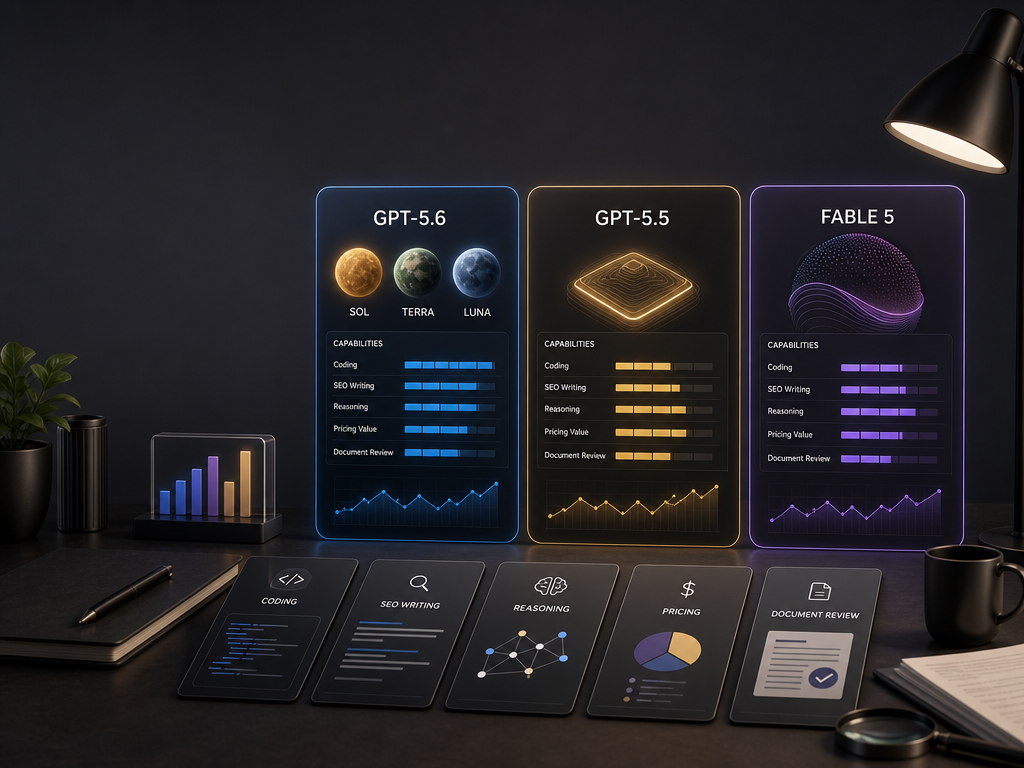
Updated July 11, 2026. GPT-5.6 pricing is not one simple number. The real cost depends on whether you use ChatGPT plans, OpenAI API token rates, Codex credits, prompt caching, or long-running coding tasks that generate many output tokens.
If your real decision is whether to pay for another standalone AI subscription, GlobalGPT’s all-in-one AI platform is the practical comparison point. It brings Perplexity access plus leading models such as GPT, Claude, and Gemini into one workspace, so you can compare daily writing, research, and planning workflows without managing every subscription separately. For GPT-5.6 specifically, check the model picker in the product you use before buying; availability can vary by product and plan.
In this guide
- Quick Answer: How GPT-5.6 Pricing Works
- GPT-5.6 ChatGPT Plan Access
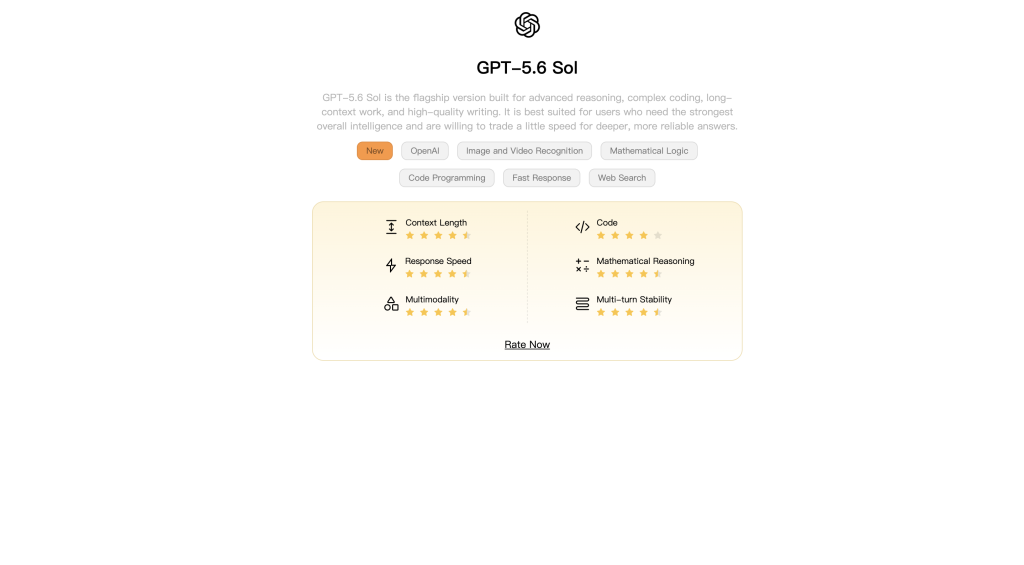
- GPT-5.6 API Pricing: Sol vs Terra vs Luna
- GPT-5.6 Codex Credits: How Codex Pricing Is Different
- The GPT-5.6 Cost Formula
- Our GPT-5.6 Token Usage Test
- Prompt Caching and GPT-5.6 Pricing
- GPT-5.6 Price vs GPT-5.5: Is the Upgrade Worth It?
- Which GPT-5.6 Model Should You Choose?
- FAQ: GPT-5.6 Pricing
- Official Sources
Quick Answer: How GPT-5.6 Pricing Works
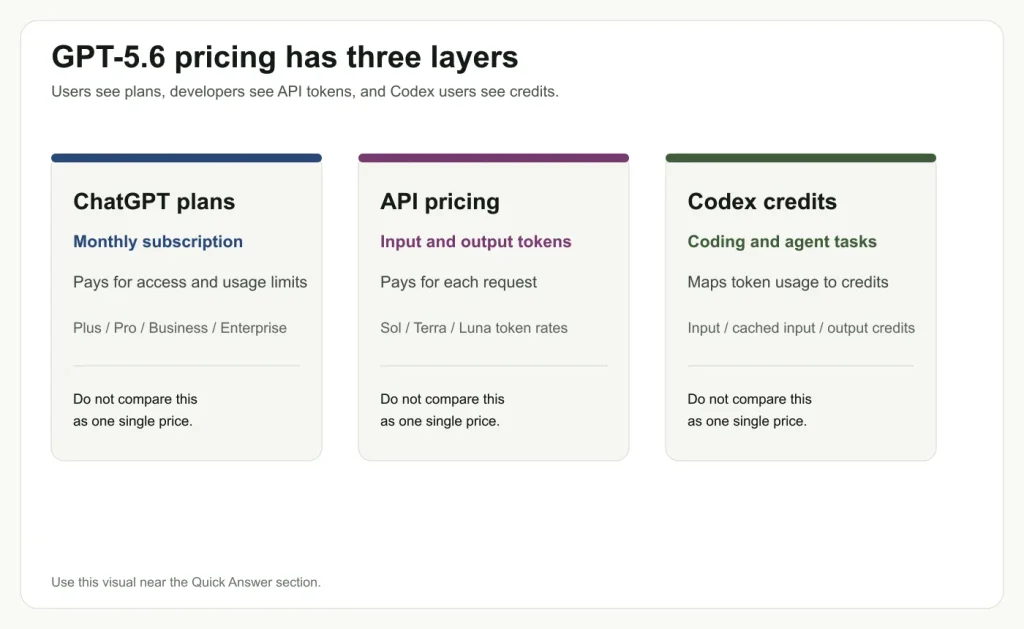
GPT-5.6 pricing has three layers: ChatGPT subscription plans, API token rates, and Codex credits. These are related, but they are not the same thing. ChatGPT plans are monthly subscriptions that unlock model access and usage limits. API pricing is billed by input and output tokens. Codex credits are a product-level credit system for coding and agent workflows.
The most important practical point is this: the cheapest GPT-5.6 price per token is not always the cheapest price per completed task. In our GPT-5.6 token usage test, Terra had cheaper output tokens than Sol, but it used more output tokens and had a lower pass rate on a long-horizon coding task. For that workload, Sol was more expensive per token but cheaper per passed task.
| Pricing type | What you pay for | Лучше всего подходит для |
|---|---|---|
| Планы ChatGPT | Monthly plan access and usage limits | Regular users who want GPT-5.6 in ChatGPT |
| API OpenAI | Input and output tokens | Developers who need direct model calls |
| Codex credits | Credits mapped to input, cached input, and output tokens | Coding agents and project-level work |
GPT-5.6 ChatGPT Plan Access
The first source of confusion in GPT-5.6 pricing is that some people are asking about monthly ChatGPT plans, while others are asking about API token rates. A ChatGPT subscription does not mean you are buying API tokens directly. It means your plan includes certain model access, usage limits, and product features. If you are comparing the broader subscription route, this ChatGPT subscription pricing guide is a useful next read before you compare GPT-5.6 with older plan choices.
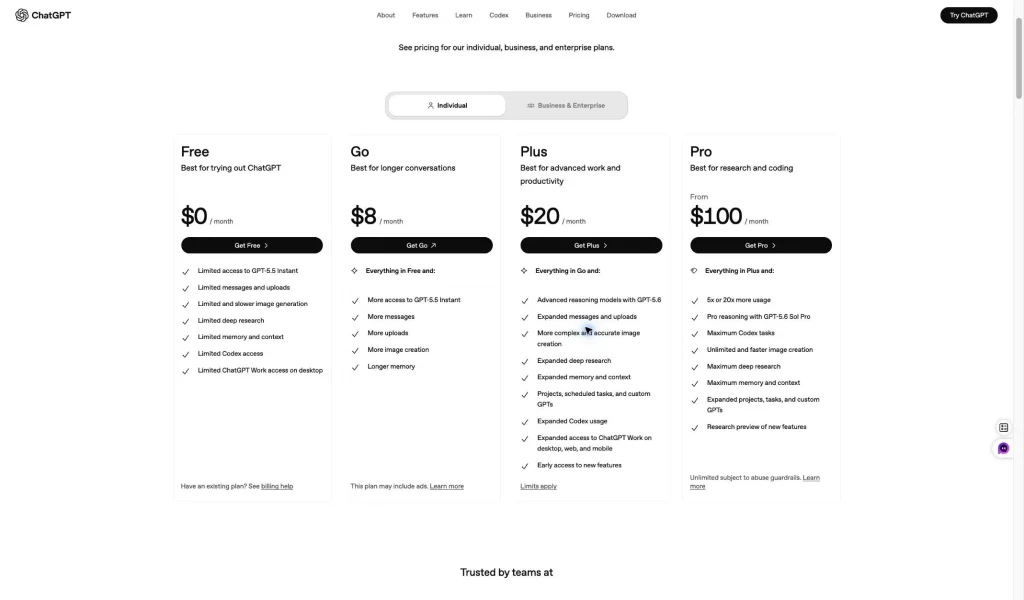
OpenAI’s current ChatGPT pricing page lists Free, Go, Plus, and Pro plans. The visible plan cards show Plus at $20 per month and Pro from $100 per month, while Plus includes advanced reasoning models with GPT-5.6 and Pro includes GPT-5.6 Sol Pro reasoning. For GPT-5.6 pricing, this is plan access, not a per-token bill.
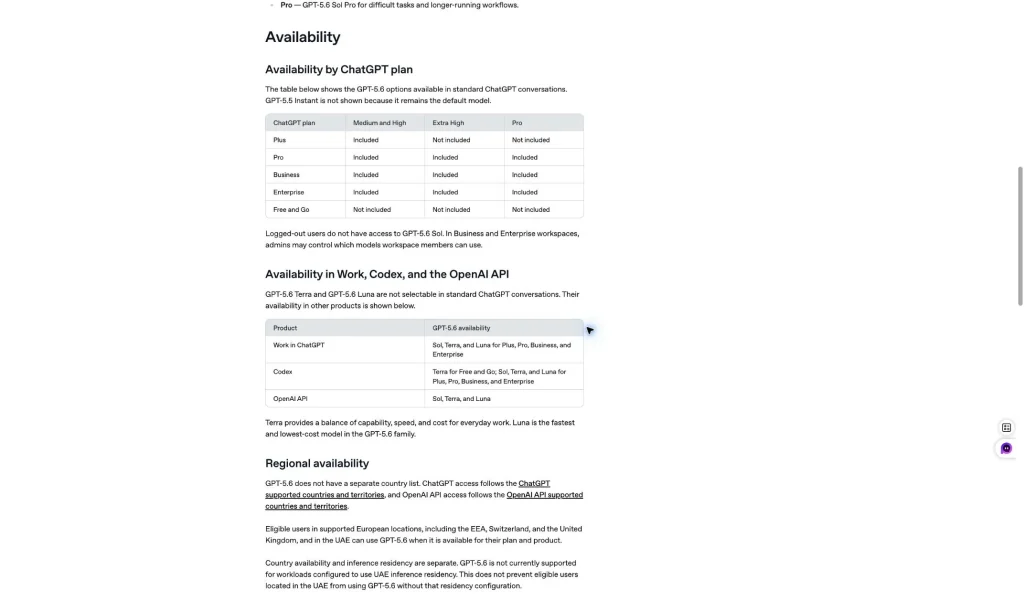
OpenAI’s help page also states that GPT-5.6 is gradually rolling out to eligible ChatGPT plans. If a user does not see GPT-5.6 Sol in the model picker, it may not be available for that account yet. That means GPT-5.6 pricing articles should not assume every account sees every model immediately.
The clean distinction: ChatGPT plan pricing answers “Can I use GPT-5.6 in the product?” API pricing answers “How much does each token cost?” Codex credits answer “How much does this coding task consume inside Codex?”
GPT-5.6 API Pricing: Sol vs Terra vs Luna
For developers, the most direct GPT-5.6 pricing table is the API rate card. OpenAI lists three GPT-5.6 tiers: Sol, Terra, and Luna. Each model has an input price and an output price per 1M tokens. If you are benchmarking model spend across labs, compare this section with GlobalGPT guides to Клод ИИ ценообразование и Цены на API Gemini 3.1 Pro.
| Модель | Входная цена | Цена выпуска | Наилучшее применение |
|---|---|---|---|
| GPT-5.6 Sol | $5 / 1M токенов | $30 / 1 млн токенов | Complex coding, long reasoning, difficult agent tasks |
| GPT-5.6 Terra | $2.50 / 1M tokens | $15 / 1M жетонов | Balanced everyday work, research, drafts, coding support |
| GPT-5.6 Luna | $1 / 1M токенов | $6 / 1M tokens | Simple, fast, low-cost, high-volume tasks |
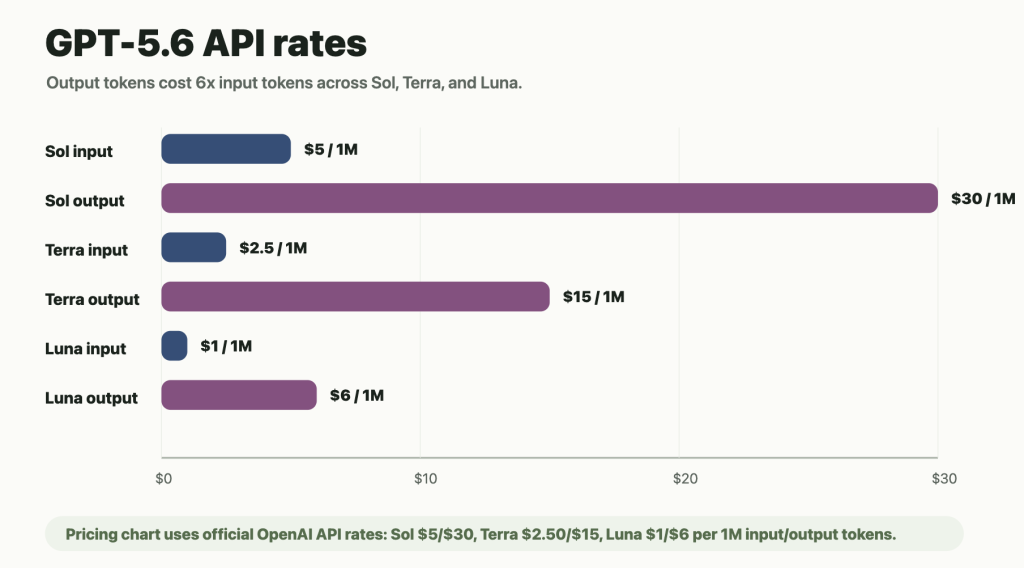
The key pattern is consistent: output tokens cost much more than input tokens. That matters because GPT-5.6 pricing for coding, agent workflows, and long reasoning is often dominated by output length, not just prompt size.
GPT-5.6 Codex Credits: How Codex Pricing Is Different
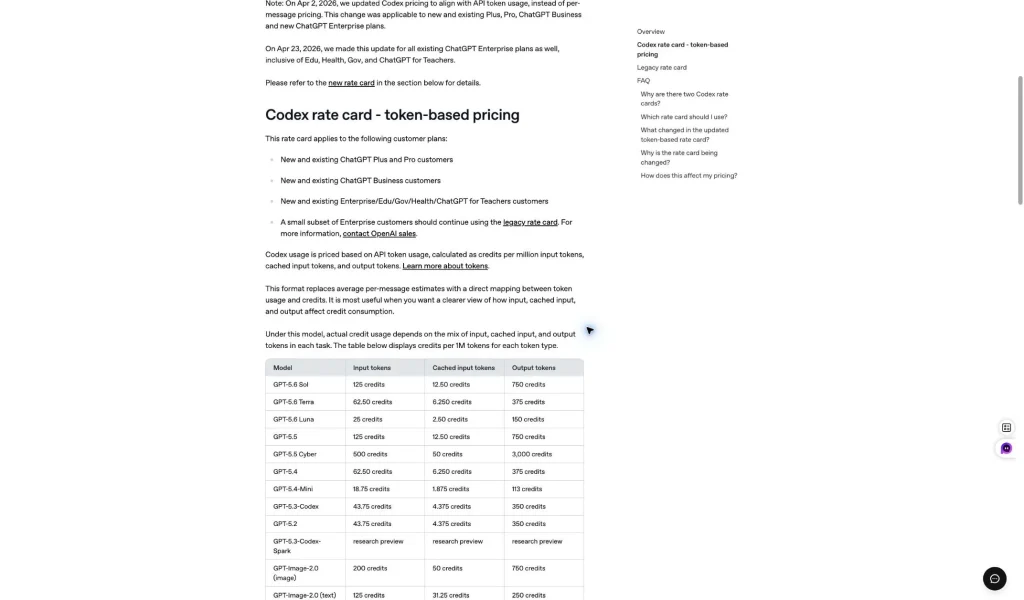
Codex pricing is not the same as API pricing. OpenAI’s Codex rate card says Codex usage is priced based on API token usage, but it is calculated as credits per million input tokens, cached input tokens, and output tokens. This means GPT-5.6 Codex credits are still token-aware, but users see them through a Codex credit system rather than a direct API invoice.
| Модель | Input credits / 1M tokens | Cached input credits / 1M tokens | Output credits / 1M tokens |
|---|---|---|---|
| GPT-5.6 Sol | 125 credits | 12.50 credits | 750 credits |
| GPT-5.6 Terra | 62.50 credits | 6.250 credits | 375 credits |
| GPT-5.6 Luna | 25 credits | 2.50 credits | 150 credits |
The practical lesson is simple: when GPT-5.6 pricing is discussed in Codex, do not compare it directly to a ChatGPT monthly plan. GPT-5.6 Codex credits are closer to task-level consumption. A project-level task may read files, reuse cached context, produce edits, retry, and generate long outputs.
The GPT-5.6 Cost Formula
For API usage, GPT-5.6 cost can be estimated with a straightforward formula. You multiply input tokens by the input rate, output tokens by the output rate, and add the two together.
Estimated API cost = (input tokens / 1,000,000 x input price) + (output tokens / 1,000,000 x output price)
For Codex, the same idea applies conceptually, but the output is credits instead of dollars. In both systems, output-heavy tasks are where GPT-5.6 pricing can rise quickly. This is the simplest GPT-5.6 pricing formula to keep beside any model comparison.
Вводные токены The text, code, files, and context sent into the model.
Выходные токены The answer, code changes, explanations, and generated content.
Кэшированный ввод Reused context that can lower repeated input cost.
Our GPT-5.6 Token Usage Test
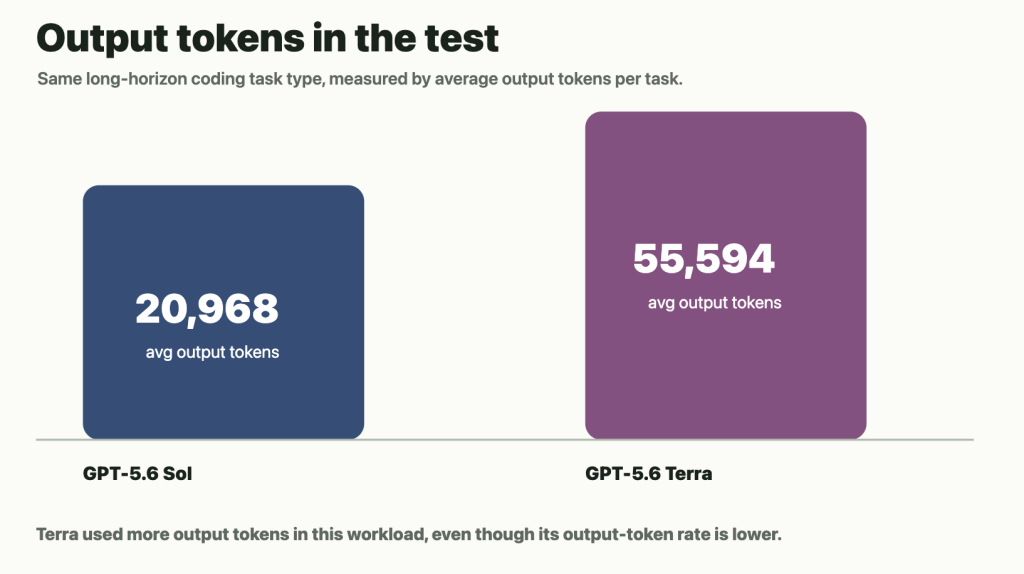
To make GPT-5.6 pricing less abstract, we measured token behavior on a long-horizon coding task. The GPT-5.6 token usage test compared GPT-5.6 Sol and GPT-5.6 Terra using the same task type and the same evaluation approach. We tracked pass rate, average output tokens per task, output-only cost per task, and output-only cost per passed task.
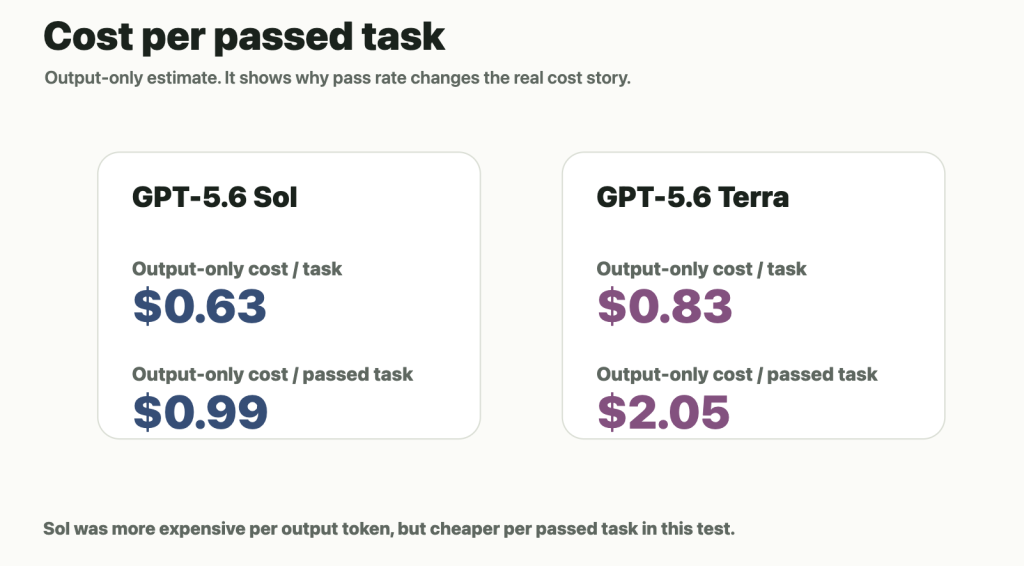
This is not a full invoice simulation. The table below is an output-only estimate, because a full bill would also include input tokens, cached input behavior, tool calls, and workflow-specific context. We use output-only cost here because output tokens are the expensive part of GPT-5.6 pricing and show the GPT-5.6 token usage pattern clearly.
| Модель | Pass rate | Avg output tokens / task | Output-only cost / task | Output-only cost / passed task |
|---|---|---|---|---|
| GPT-5.6 Sol | 63.7% | 20,968 | ~$0.63 | ~$0.99 |
| GPT-5.6 Terra | 40.7% | 55,594 | ~$0.83 | ~$2.05 |
What the test means
Terra has cheaper output tokens than Sol. But in this workload, Terra produced far more output tokens and passed less often. That changed the real GPT-5.6 pricing story. Sol was more expensive per output token, but cheaper per passed task in this test.
The broader lesson is that users should not evaluate GPT-5.6 pricing by token rate alone. For complex work, completion rate, output length, and retries can matter more than the headline price.
Prompt Caching and GPT-5.6 Pricing
OpenAI says GPT-5.6 introduces more predictable prompt caching, including explicit cache breakpoints and a 30-minute minimum cache life. For GPT-5.6 and later models, cache writes are billed at 1.25x the uncached input rate, while cache reads continue to receive a 90% cached-input discount. In practical GPT-5.6 pricing, GPT-5.6 prompt caching matters most when the same context is reused many times.
That matters most when the same long context is reused repeatedly. A coding agent working inside one project, a research workflow that reuses the same documents, or a long conversation with stable context can benefit from cached input. But caching does not make output tokens cheaper, so output-heavy work still needs careful model selection.
Practical reading: Caching can make repeated context cheaper. It does not remove the need to watch output length, retries, and task completion.
GPT-5.6 Price vs GPT-5.5: Is the Upgrade Worth It?
The right GPT-5.6 pricing question is not simply “Is GPT-5.6 cheaper than GPT-5.5?” The better question is “Does GPT-5.6 finish the job with fewer retries, less manual correction, and a better output?” For simple chat, lightweight writing, or routine brainstorming, a GPT-5.5 workspace or Luna may be enough. For difficult coding, security research, complex reasoning, and agent workflows, Sol or Terra may justify the higher model cost. The older GPT-5.4 pricing guide is also useful when you want a previous-generation cost baseline.
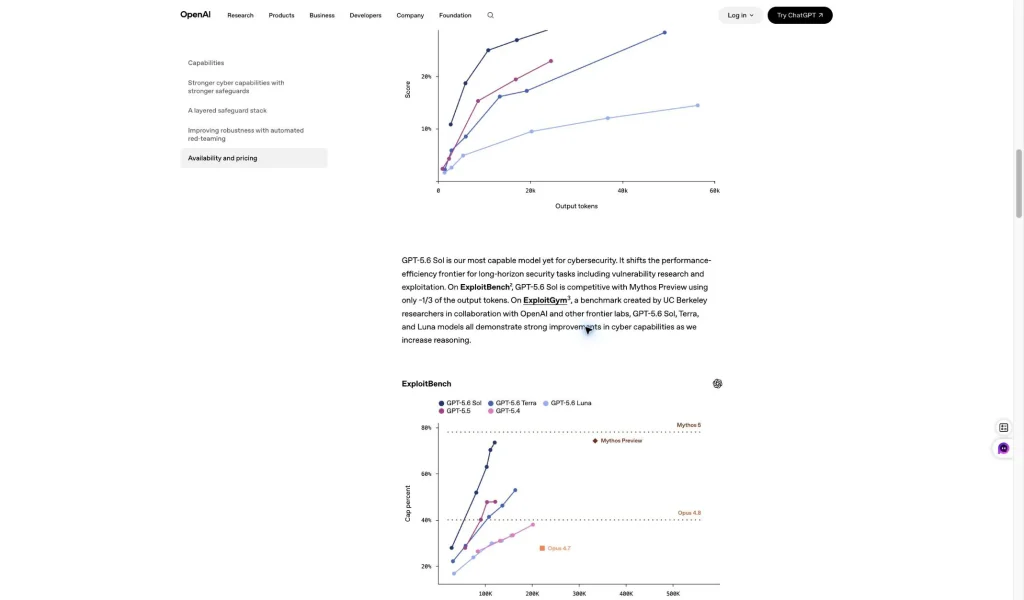
OpenAI’s GPT-5.6 page also frames model value in terms of performance efficiency. The official page notes that GPT-5.6 Sol is competitive with Mythos Preview on ExploitBench while using only about one third of the output tokens. That is exactly the type of evidence readers should look for: capability and token efficiency together.
Which GPT-5.6 Model Should You Choose?
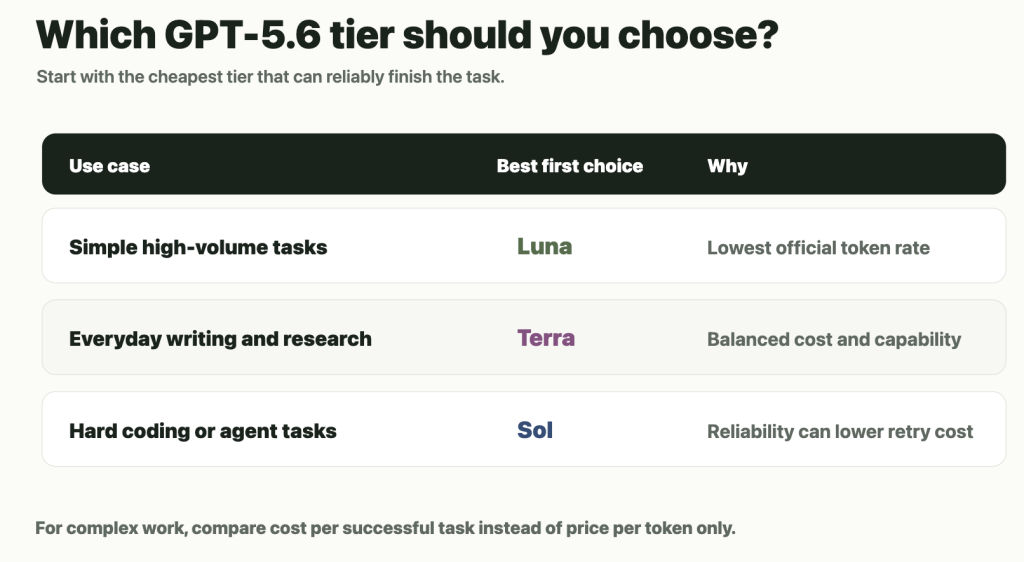
The best value depends on the job. For most everyday work, Terra is the safest starting point because it balances capability, speed, and cost. Luna is the cheapest GPT-5.6 model for simple, high-volume tasks. Sol is the premium choice when failure, retries, or lower-quality output would cost more than the model price difference. A good GPT-5.6 pricing decision starts with the cheapest tier that can finish the task reliably.
| Тип пользователя | Recommended choice | Причина |
|---|---|---|
| Casual ChatGPT user | Plus with GPT-5.6 Sol access | Fixed plan pricing is easier than token budgeting. |
| SEO or content writer | Terra first, Luna for simple drafts | Most writing tasks do not need the highest tier. |
| Developer using API | Terra first, Sol for hard cases | Start balanced, upgrade when retries become expensive. |
| Codex power user | Sol or Terra | Task completion can matter more than token rate. |
| High-volume simple workflow | Luna | Lowest input and output price. |
Subscription workflow note: If your goal is to control monthly AI-tool spend rather than build directly on the API, compare the official OpenAI plan/API route with GlobalGPT’s all-in-one AI platform и GlobalGPT pricing page. GlobalGPT is most useful when you want Perplexity plus leading models such as GPT, Claude, and Gemini in one workspace, while API and Codex pricing still matter for developer builds.
FAQ: GPT-5.6 Pricing
How much does GPT-5.6 cost?
Official GPT-5.6 API pricing is per 1M tokens. Sol is $5 input and $30 output, Terra is $2.50 input and $15 output, and Luna is $1 input and $6 output. ChatGPT plan access and Codex credits use different pricing systems.
Is GPT-5.6 included in ChatGPT Plus?
OpenAI’s Help Center says Plus includes GPT-5.6 Sol Medium and High in standard ChatGPT conversations. Extra High and Pro are not included in Plus.
Can Free users use GPT-5.6?
Free and Go users do not have GPT-5.6 Sol in standard ChatGPT conversations. OpenAI says Terra is available in Codex for Free and Go, while broader Sol, Terra, and Luna access is available for Plus, Pro, Business, and Enterprise in Codex.
Is Codex pricing the same as API pricing?
No. API pricing is billed in dollars per input and output token. Codex uses credits, with separate credit rates for input, cached input, and output tokens.
Why can Terra cost more than Sol in real tasks?
Terra has a lower output price than Sol, but real GPT-5.6 cost also depends on output length and pass rate. In our long-horizon coding test, Terra used more output tokens and passed less often, making its output-only cost per passed task higher than Sol.
Which GPT-5.6 model is cheapest?
Luna is the cheapest GPT-5.6 model by official API rate, at $1 input and $6 output per 1M tokens. It is best for simple, fast, high-volume tasks.
Which GPT-5.6 model is best value?
Terra is the best default value for many everyday workflows. Sol can be better value for complex coding or agent work when higher reliability lowers retries. Luna is best when the task is simple enough that quality risk is low.
Official Sources
- OpenAI: GPT-5.6 – official API pricing, prompt caching, and benchmark context.
- OpenAI Help Center: GPT-5.6 in ChatGPT – plan availability and product availability.
- OpenAI Help Center: Codex rate card – Codex credits for GPT-5.6 models.
- Ценообразование в ChatGPT – plan pricing and included product access.