How to Make Money with AI in 2026


Making money with AI in 2026 has transitioned from simple prompt-and-paste tasks to building high-ticket "Digital Products 2.0" and proprietary automated systems. However, professional creators now face a major profitability hurdle: extreme subscription fragmentation. Executing a high-end project today requires the advanced reasoning of a premier LLM, the visual fidelity of state-of-the-art image generators, and the cinematic power of native video models. Paying individual subscription fees to dozens of official sites—often totaling hundreds of dollars monthly—evaporates your profit margins before you even launch your business.
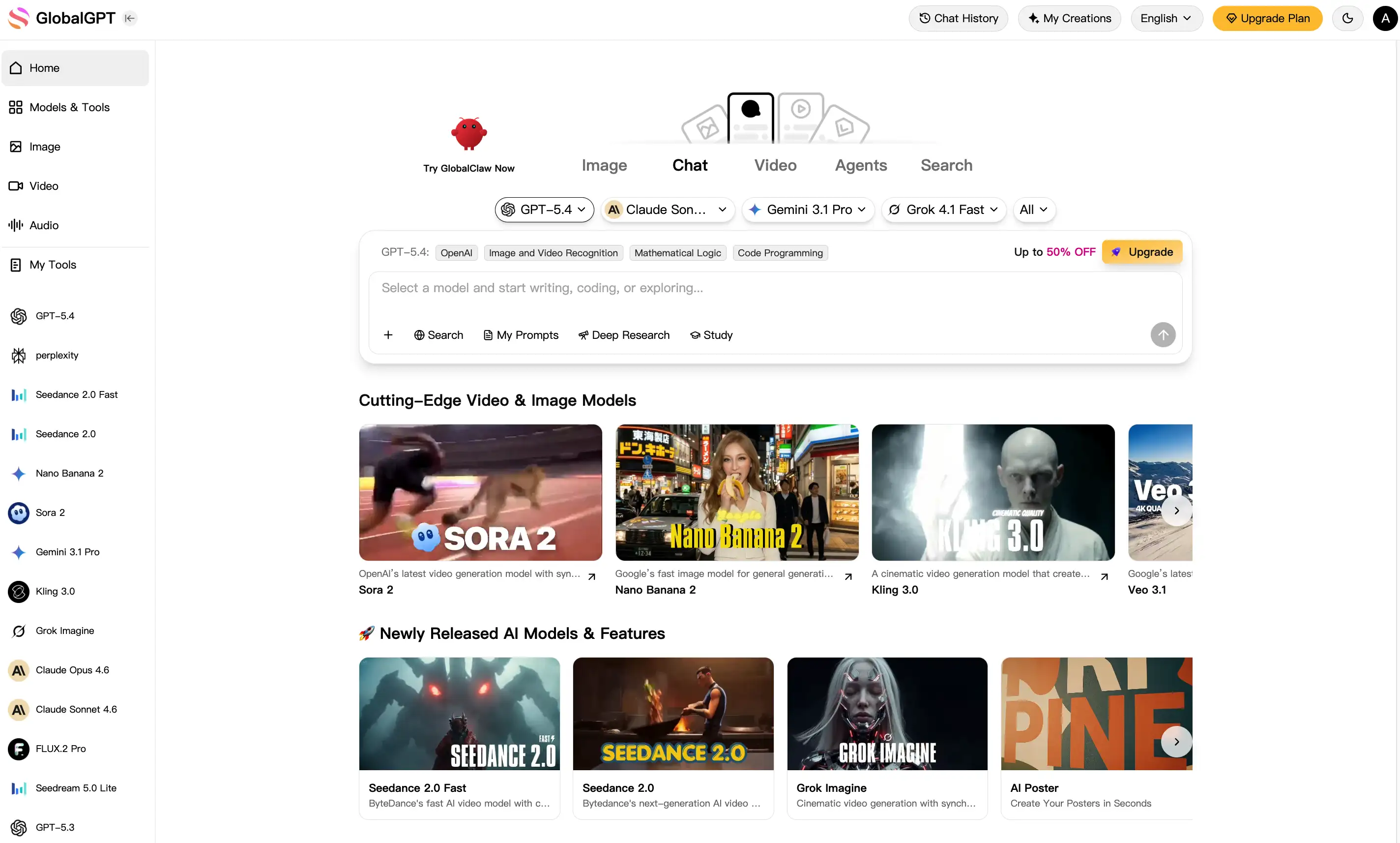
This financial and logistical barrier is exactly why GlobalGPT has become the central hub for AI-driven entrepreneurs. For a single $10.8 Pro Plan, users gain immediate, unrestricted access to a curated lineup of the world’s most powerful independent models—including GPT-5.4 for logic-heavy research, Claude 4.6 for autonomous coding, and the heavyweights of video AI like Sora 2 Flash and Kling video 3.0. Instead of managing separate accounts, international payment cards, and strict regional blocks, GlobalGPT provides a high-efficiency dashboard where the industry’s top reasoning and creative engines are always one click away.
While each model on the platform operates independently to ensure peak, unmodified performance, GlobalGPT allows you to manage your entire end-to-end production workflow within a single dashboard. You can finalize your market research and video scripts using Gemini 3.1, and then immediately open a parallel workspace to generate hyper-realistic commercial assets with Nano Banana 2 or Midjourney. By consolidating your AI toolstack into one cost-effective engine, you eliminate access barriers and unnecessary overhead, allowing you to focus entirely on scaling your automated income streams.
The Core Logic of Making Money with AI
If you want to understand how to actually generate revenue using AI, you must first accept a fundamental truth: AI is a lever, not the business model itself. Many beginners fall into the trap of thinking that the mere existence of AI will automatically print money. This is akin to being handed the keys to a Formula 1 race car and expecting to instantly win a championship without knowing how to drive. You cannot make money simply "because AI exists." Instead, you must identify a viable commercial vehicle and use AI to create a competitive advantage. The formula is straightforward: AI + A Valid Business Model = Efficient Monetization.
Furthermore, you do not need to be the absolute expert; you need to be the guide. AI systems possess vast amounts of information, capable of cross-referencing research papers, books, and websites in seconds—the AI is the expert. Your role is to act as the guide who translates this profound capability into specific, usable "solutions" that clients can understand and apply to their problems.
It is crucial to understand that clients buy "business results," not "AI tools." This is a cold reality. Business owners do not care whether you use AI or not; they only care if you can save them time or increase their revenue. If you offer generic "content writing," you are entering a race to the bottom because anyone can generate a basic article using a large language model today. What you must sell is an "automated system that they do not have to worry about."
Finally, the real bottleneck is "client acquisition," not "production." When the barrier to producing content drops to near zero because of AI, what becomes valuable are distribution channels, client trust, and industry insights. You must delegate the heavy lifting of production to AI, reserving your human energy for tasks that cannot be replicated: exercising judgment, applying industry background knowledge, and building interpersonal relationships.
Three Golden Rules for Execution
Niche Down to the "Third Layer": You must absolutely refuse to be a "general content writer." Instead, your focus should be hyper-specific, such as "optimizing email sequence conversion rates specifically for local dental clinics" or "writing LinkedIn stories for Direct-to-Consumer (D2C) brands." The more specific your niche, the higher the premium clients are willing to pay.
Sell Systems, Not Time: Freelancers who trade time for money have a hard ceiling on their earnings. You should leverage AI to build automated workflows. For example, rather than selling a one-off website design, secure clients on a monthly retainer for hosting and maintenance. Instead of selling a single article, sell a web-scraping system that automatically gathers competitor intelligence and analyzes trends. Once a business relies on your system, they are highly unlikely to cancel the contract.
Reject "Tool Fatigue": Beginners often fall into the trap of constantly switching tools—trying one model today and another platform tomorrow—believing the next tool will be the magic bullet. The problem is rarely the tool. Find a unified platform (like GlobalGPT, which allows you to access multiple top-tier models from a single dashboard, minimizing subscription costs) and immediately take your offering to the market. Sell the "finished product," not the "concept."
Understanding Client Psychology
Confusion and Overwhelm Regarding AI: Many business owners, particularly in traditional industries, only know AI as a buzzword. They are eager to reap the benefits of AI but have absolutely no time to learn about "prompt engineering" or how to configure automated workflows.
Willingness to Pay a Premium for "Speed" and "Peace of Mind": Clients strongly prefer a completed, polished product over a complex proposal that requires their own effort to implement. If you can present them with a beautifully designed website draft that already features their logo, the sales cycle shortens dramatically. The less friction there is for the client, the higher the conversion rate.
Your Immediate Action Plan
Understanding the underlying logic is useless without execution. Many people grasp the theory but fail because they try to build a perfect system before acquiring a single client. Since you understand that AI is a lever, that you must act as a guide selling systems, and that you must target a specific niche, your focus must shift entirely to implementation.
1. Lock In Your "Third Layer" Niche
Stop offering generalized services. You must solve a specific problem for a specific demographic.
Reject the Broad: Do not advertise "general content creation" or "AI copywriting." This guarantees you will face commoditized pricing. "Content writing" as a service without a defined industry focus is a dead end.
Dig Deeper: Find a highly specific entry point. Instead of "improving productivity," offer "helping solopreneurs reduce screen time." Instead of "copywriting," specialize in writing email sequences for D2C brands or ghostwriting LinkedIn posts for executive coaches.
2. Choose "One" Commercial Vehicle and Stick to It
Do not try to juggle five different monetization methods simultaneously. Pick one and master it. Here are proven starting points:
Freelancing/Outsourcing: This is the easiest entry point. Many start as freelance writers on Upwork or Fiverr, using AI to reduce a 3-hour task to 45 minutes.
Non-Expert Digital Products (Digital Products 2.0): Use AI’s information synthesis capabilities to package vast amounts of data into eBooks, templates, or workflows. Start with a simple eBook and secure a few sales to validate the market.
Building AI Systems and Websites for Businesses: Capitalize on the confusion business owners have regarding AI. You can build personalized GPT ecosystems for them (organizing workflows and writing prompts). Alternatively, use AI website builders (like Framer or Lovable) to rapidly generate modern websites for local businesses (like restaurants or gyms) that have outdated online presences.
3. Stop Over-Optimizing; Build the "Finished Product"
This is the most common pitfall for beginners.
Avoid the Tool Trap: If you don't have clients, do not spend weeks testing various AI tools or endlessly tweaking prompts. The issue is usually a lack of clients, not the tool. If you want to efficiently use multiple top models, a platform like GlobalGPT provides a seamless environment to invoke the latest models without the hassle of managing multiple accounts, allowing you to focus on the business.
Sell the "Result": Never pitch a "concept." If you are selling websites, use AI to quickly generate a draft featuring the client's logo and send it to them. If you are selling digital products, use AI to lower the development cost to near zero, generate the product quickly, and if it fails, move on to the next one until you find a winner.
4. Dedicate 80% of Your Effort to Client Acquisition
Acquiring clients is your core skill, not just writing prompts.
Find Existing Demand: Look where people are actively asking for help, such as business "Requests for Proposals (RFPs)." Monitor social media for real conversations and intervene when someone expresses a need.
Master Distribution Channels: If you are selling digital products, utilize "Influencer Arbitrage." Find micro-influencers with highly targeted audiences who don't know how to monetize, let them promote your product, and split the profits.
Persist with Cold Outreach: If you provide B2B services, treat outreach as a numbers game. Send 10 Direct Messages (DMs) every day to maintain a steady pipeline of early leads.
5. Survive the Initial "Valley of Death"
Manage Expectations: The vast majority of people will not make money in their first week. It typically takes 3 to 4 weeks to see traction, so do not quit early due to slow progress. Once your services receive positive reviews, raise your prices; do not remain in the cheap tier forever.
Four Recommended Fields for Immediate Execution
These four fields do not require you to write code or be an industry expert, but they possess clear demand and high profit margins.
Recommended Field 1: Building "Personalized GPT Ecosystems" for Business Owners
This model offers the highest profit margins and is ideal for engaging high-net-worth individuals.
Why it Works: CEOs want to use AI to improve efficiency, but concepts like "System Prompts" and "Custom GPTs" overwhelm them. They will pay a premium for "speed" and "peace of mind." You are selling a service that brings order to their chaotic workflows.
How to Execute:
Information Gathering: Design a comprehensive Intake Form to collect the client's daily workflows, business goals, communication tone, and preferences.
Build the Core System: Input this data into a powerful language model (like those available on GlobalGPT) to generate "Master Prompts" and "System Prompts" for various business scenarios.
Customize the Toolbox: Inside the client's account, use these prompts to establish several specific "Custom GPTs," organized neatly into project folders.
Generate a Delivery Manual (SOP): Have the AI automatically generate a Standard Operating Procedure (SOP) manual based on the system you built, teaching the client how to use their new tools.
Monetization Model: Charge a substantial one-time setup fee, plus a monthly retainer for maintenance and technical support as AI platforms update.
Recommended Field 2: "AI Website Renovation Studio" for Local Businesses
This approach relies on the speed of AI to present a finished product directly to the client.
Why it Works: Countless local businesses (dentists, gyms, restaurants) have outdated, slow websites that perform poorly on mobile devices. Pitching a concept leads to hesitation; presenting a beautiful, finished website drastically shortens the sales cycle.
How to Execute:
Identify Targets: Search Google Maps or local directories for businesses with poor websites.
Rapid AI Site Generation: Download their logo. Use AI website builders (like Framer or Lovable), input prompts detailing their brand and style preferences, and generate a responsive, code-free website draft in seconds.
Sell the Result: Email the owner: "Hello, your services are great, but your website is a bit outdated. I used your logo to create a new one, here is the link. If you like it, it's yours for $200."
Long-Tail Monetization: After the initial sale, convert them into a monthly subscriber for website hosting and basic AI-driven email automation maintenance.
Recommended Field 3: Infinite Splitting and Distribution of "Long-Form Content" (Content Multiplying)
This is a high-demand service for B2B companies and creators.
Why it Works: Many businesses possess excellent long-form content (podcasts, webinars), but they desperately lack short-form content optimized for platforms like TikTok, Instagram, and LinkedIn.
How to Execute:
Precision Targeting: Find clients with abundant long-form content who are inactive on short-video or social media platforms.
Transcription and Extraction: Select their best-performing long videos and use AI to transcribe them into text.
Restructure using the PSL Framework: Feed the transcript into an AI and instruct it to extract the most valuable insights, rewriting the content strictly following the PSL Framework (Point, Story, Lesson).
Multi-Format Output: Command the AI to instantly split this PSL-structured content into dozens of short video scripts, catchy headlines, LinkedIn Carousels, and tweets. You are selling "omnichannel visibility," not just writing.
Recommended Field 4: Non-Expert Digital Products (Digital Products 2.0)
This is perfect for introverted entrepreneurs. It requires testing initially, but the compounding returns are massive once successful.
Why it Works: You don't need to be an expert because AI cross-references all available research; it is the ultimate expert. The cost of trial and error is almost zero. You can test ideas infinitely until you find a hit, and selling to 10,000 people costs the same as selling to 10.
How to Execute:
Target a Third-Layer Need: Do not create a "Fitness Guide." Create a highly specific guide like "How to Relieve Knee Pain for Marathon Runners Over 50."
AI Information Synthesis: Once the pain point is identified, have the AI gather scientific research, case studies, and expert advice, organizing it systematically into an outline.
Productization: Use AI tools to generate an eBook or a PDF complete with actionable templates.
Distribution via Influencer Arbitrage: This is the key. Do not struggle to build your own audience from scratch. Find micro-influencers (with tens of thousands of followers) whose audience perfectly matches your product but who struggle with monetization. Partner with them to promote your eBook and split the revenue.
The Hidden Blocker: Why AI Subscriptions Are Killing Your Margins
While these high-ticket workflows are highly profitable, they expose a critical financial flaw for independent creators: extreme subscription fatigue. To properly execute the strategies outlined above, you need the absolute best models on the market. Relying on outdated or free models will result in hallucinated code, robotic text, and deformed videos that clients will immediately reject.
However, subscribing to the official platforms for each of these tools is financially crippling. A ChatGPT Pro subscription for access to GPT-5.4 costs $200 a month. A Claude Pro account is another $20. Accessing Sora 2 or Veo 3.1 often requires restrictive enterprise accounts or premium tiers. Add in Midjourney and specialized API access, and a freelance creator can easily spend $300 to $500 every single month just to maintain their basic toolkit. For someone just starting their automated income journey, this massive overhead destroys profit margins and creates an incredibly high barrier to entry. Furthermore, constantly jumping between five different official websites disrupts your creative flow and slows down production.
The GlobalGPT Solution: Your All-in-One AI Profit Engine
To successfully scale your AI business in 2026 without drowning in software fees, you need a centralized hub. GlobalGPT solves the subscription crisis by aggregating the industry's most powerful, independent models into a single, high-efficiency dashboard. It allows you to build your entire workflow—from research to final rendering—without the crippling overhead.
Access the Ultimate 2026 Lineup (GPT-5.4, Claude 4.6, Sora 2)
GlobalGPT guarantees access to the absolute frontier of AI technology. You are not forced to compromise on quality. If you are building a B2B lead generation system, you can leverage the unparalleled reasoning of GPT-5.4. If you are vibe-coding a utility app, switch to Claude 4.6. When you are ready to launch your faceless YouTube channel, you have direct access to Sora 2 Flash, Veo 3.1, and Kling VIDEO 3.0 Omni. While these models operate independently to ensure untampered performance, having them side-by-side in one platform accelerates your production speed exponentially.
Pricing Breakdown: Basic ($5.8) vs. Pro ($10.8)
The pricing strategy is designed specifically to protect creator margins. For heavy text and coding workflows, the Basic Plan at $5.8/month provides incredible value, granting access to the top-tier LLMs. However, for anyone executing the high-ticket visual workflows mentioned above, the Pro Plan at $10.8/month is absolutely mandatory. For just $10.8, creative professionals unlock the advanced Video AI suite (Sora 2, Veo, Kling) and premium Image Generation (Nano Banana 2, Midjourney). It is an essential investment that replaces thousands of dollars in annual official subscription costs.
Zero Geographical Barriers & High Usage Limits
Unlike official platforms that plague users with complex international credit card requirements, region locks, and aggressive hourly rate limits, GlobalGPT removes all access barriers. Whether you are operating out of Europe, Asia, or the Americas, you can instantly log in and start generating assets. The platform is built for heavy, professional use, ensuring that your automated workflows are never bottlenecked by arbitrary usage warnings.
Copyright & Legal Considerations for AI-Generated Assets
When building digital products or producing commercial assets for clients, understanding the 2026 legal landscape is crucial for protecting your intellectual property. The rules regarding AI and copyright have crystallized significantly over the past few years.
In March 2026, the U.S. Supreme Court declined to review the landmark Thaler v. Perlmutter case, cementing the legal bedrock that purely AI-generated works cannot be copyrighted. An AI system cannot be listed as an author. The U.S. Copyright Office has made it explicitly clear that merely typing a prompt into a generative AI tool—no matter how detailed or creative the prompt is—does not grant you ownership of the output.
However, this does not mean your business is unprotected. You can secure copyright for "AI-assisted works." To qualify, you must demonstrate a "significant human creative contribution." This means you must exercise meaningful control over the expressive elements of the final product. For example, if you use Midjourney to generate a raw image, but then heavily edit the composition, manipulate the colors in Photoshop, and arrange it into a complex UI design, that final composite work is protectable. When selling high-ticket services, always document your human iteration, editing, and strategic arrangement processes to ensure your clients are receiving legally defensible assets.
Conclusion: Start Scaling Your AI Income Today
GlobalGPT consolidates the world's most advanced AI models into a single, cost-effective platform, empowering you to execute high-ticket automated workflows without the crippling burden of multiple subscriptions. Stop wasting your margins on fragmented tools; transition to a unified workspace and begin building your scalable digital empire today.
Frequently Asked Questions (FAQ)
What is the most profitable way to make money with AI in 2026? The highest profit margins come from building B2B "Agentic Workflows" and "Digital Products 2.0." Instead of selling low-ticket freelance writing, successful creators use models like Claude 4.6 and Gemini 3.1 to build automated lead-generation systems or develop hyper-niche, faceless video courses.
Do I need coding skills to build and sell AI utility apps? No, traditional coding skills are no longer a barrier. Using the "vibe-coding" capabilities of advanced models like Claude 4.6, anyone can generate fully functional web applications (like currency converters or crypto trackers) using plain English prompts.
Why should I use GlobalGPT instead of subscribing directly to official AI sites? Subscribing individually to top-tier models like ChatGPT Pro, Claude Pro, Sora 2, and Midjourney can easily cost over $400 per month. GlobalGPT's $10.8 Pro Plan consolidates access to all these industry-leading engines into a single, unrestricted dashboard, saving you thousands of dollars annually.
Do the different models inside GlobalGPT share memory or context? No. To guarantee the highest level of data integrity and unmodified official performance, each model on GlobalGPT operates completely independently. There is no context sharing or API integration between them, meaning you have full, manual control over how you transfer your assets from one tool to the next within your browser.
Can I legally copyright the AI videos and images I sell to clients? Under 2026 U.S. copyright law, purely AI-generated content cannot be copyrighted. To legally protect and own the assets you sell, you must demonstrate a "significant human creative contribution," such as extensive editing, strategic compositing, or complex manual structuring after the initial AI generation.
