GLM-5.1 Explained: Performance, Pricing, and How to Access

On April 7, 2026, just over a month after the release of GLM-5, Z.ai launched GLM-5.1, its next-generation flagship model. According to public reports, this marks the first time a Chinese open-source model has reached the top of a global coding agent benchmark.
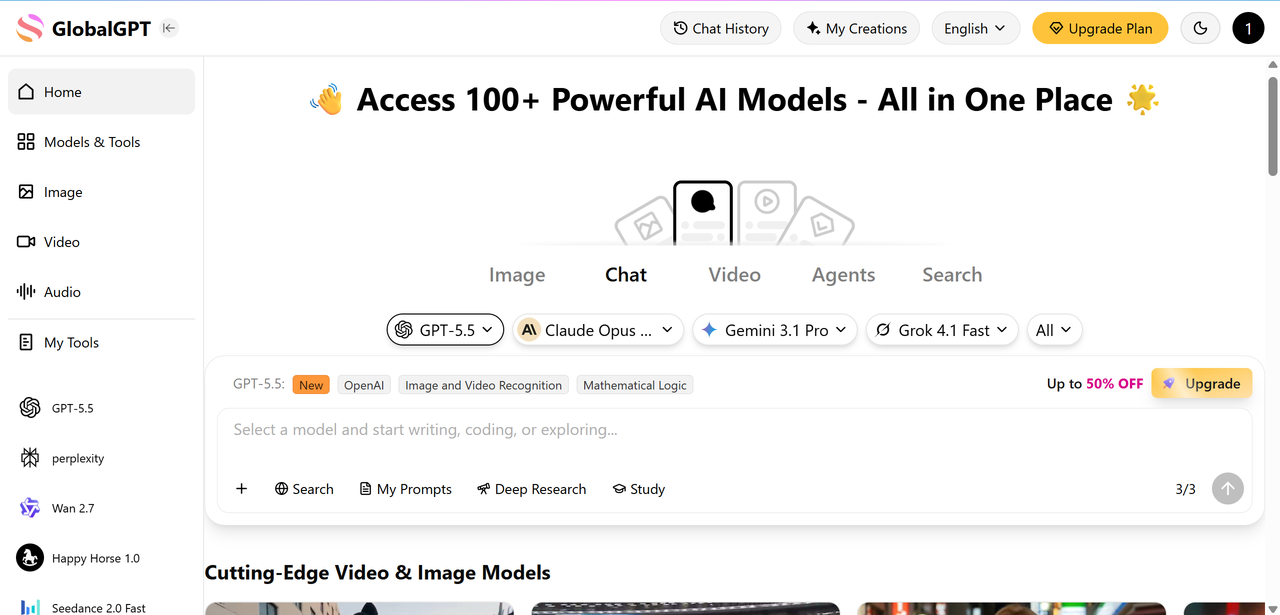
So, what is GLM-5.1? How strong is its performance? How much does it cost? This article gives you a clear and detailed overview. If you want to try it directly, GLM-5.1 is already available on GlobalGPT. At the end of the article, I will also list other access options for you to choose from.
What Is GLM-5.1?
GLM-5.1 is Z.ai’s next-generation flagship model for agentic engineering. It offers much stronger coding ability than previous GLM models and is designed for long-horizon, autonomous tasks, which can work continuously on a single task for up to 8 hours.
What Improved from GLM-5 to GLM-5.1?
GLM-5 is the fifth-generation large language model developed by Z.ai, one of China’s leading AI companies. It introduced a major upgrade in model architecture, using a Mixture-of-Experts model with around 745 billion total parameters. It was designed for agentic tasks, multi-step reasoning, coding, creative writing, and complex problem solving.

Compared with GLM-5, GLM-5.1 brings several important upgrades:
Larger and More Efficient Architecture
GLM-5.1 upgrades the model architecture from 355B total parameters with 32B active parameters to around 744B total parameters with 40B active parameters.
Stronger Training Data
The amount of pre-training data increases from 23T tokens to 28.5T tokens. This gives the model broader coverage, better knowledge, and stronger generalization ability.
Long-Context Support
GLM-5.1 integrates DeepSeek Sparse Attention, also known as DSA. This helps the model support a 202K context window while reducing deployment and inference costs.
Slime: An Asynchronous Reinforcement Learning Framework
Slime helps improve the model’s reasoning and coding abilities through more efficient RL training.
Who Built GLM?
GLM is developed by Z.ai, also known as Zhipu AI. The company was incubated from Tsinghua University in 2019 and has become an important player in open-source AI research.

According to public reports, Z.ai completed its Hong Kong IPO in January 2026, raising about HK$4.35 billion, or around US$558 million. The funding is expected to support the development of next-generation models such as GLM-5.
GLM-5 was reportedly trained on Huawei Ascend chips using the MindSpore framework. This makes it an important milestone for China’s domestic AI infrastructure and shows progress toward more independent AI model development.
Performance Overview of GLM-5.1
Overall, GLM-5.1 demonstrates outstanding performance in terms of coding ability, long-term working ability, and engineering delivery capability.
GLM-5.1: Frontier-Level Coding and General Intelligence
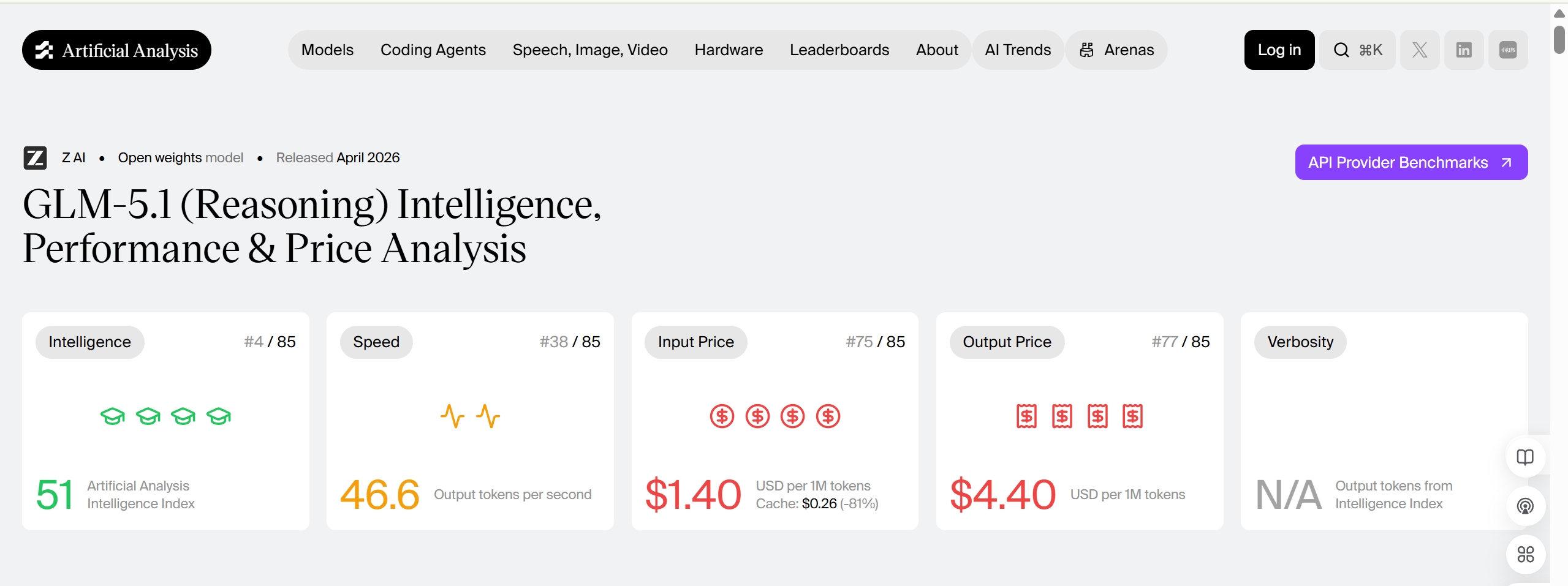
GLM-5.1 has reached the global top tier in both general intelligence and coding capability. Its overall performance is broadly comparable to Claude Opus 4.6, and it ranks highly across multiple important benchmarks.
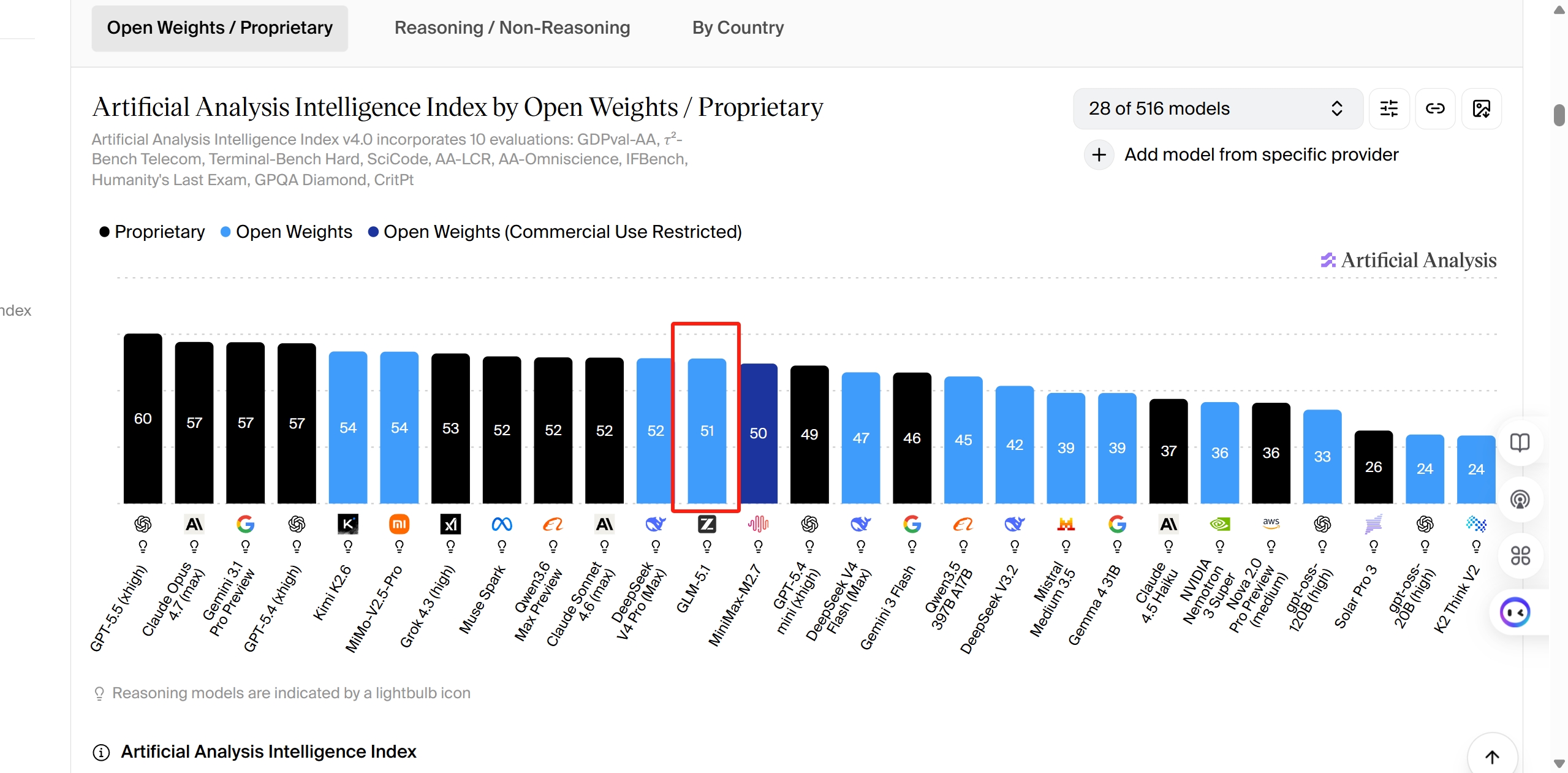
In terms of intelligence, based on the comparison of Artificial Analysis, the score of GLM-5.1 is 51 points, ranking twelfth, slightly behind DeepSeek V4 Pro (Max), but outperforming Gpt-5.4 mini.
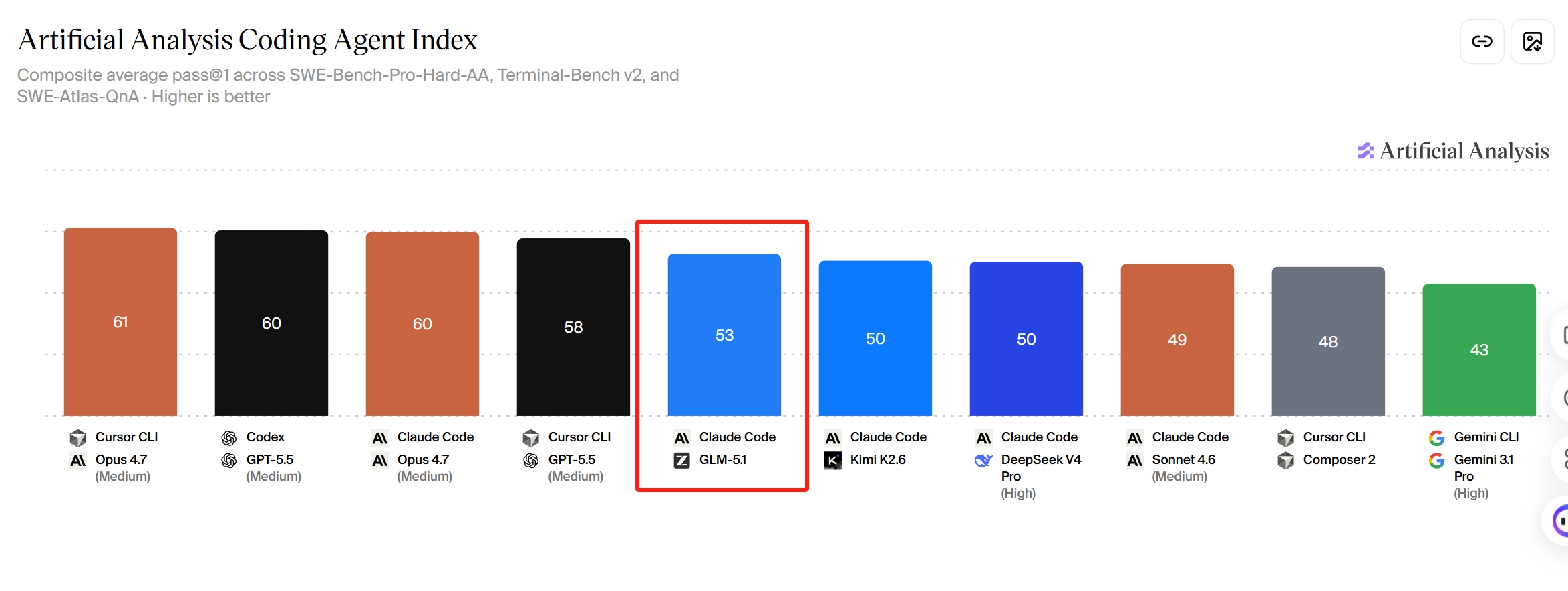
In terms of coding capability, it can be seen that the current coding agent index score of GLM-5.1 is 53, ranking fifth, just behind GPT-5.5 and Opus 4.7, and surpassing Kimi k2.6 and DeepSeek V4 Pro. It is the top model produced in China.
GLM-5.1 Long-Horizon Task Capability
One of the biggest highlights of GLM-5.1 is not just benchmark scores, but its long-horizon task capability.
GLM-5.1 supports a 200K context window using an efficient sparse attention architecture.
A 200K context window is roughly equivalent to processing over 150,000 Chinese characters at once — enough to fit an entire novella or a very large software repository. The model also supports up to 128K output tokens, reducing the risk of interruption during long and complex tasks.
GLM-5.1 can reportedly work autonomously on a single task for up to 8 hours.
This type of capability is not simply about having a larger context window. It requires the model to stay aligned with long-term goals, reduce error accumulation, avoid strategy drift, and continuously improve results over time.
GLM-5.1 Engineering and Autonomous Agent Capability
Another major breakthrough of GLM-5.1 is its ability to form a fully autonomous “Experiment → Analysis → Optimization” loop instead of stopping at one-shot code generation.
In official demonstrations, GLM-5.1 reportedly:
Built a complete Linux desktop system from scratch within 8 hours
Completed 655 autonomous optimization iterations on a vector database pipeline, improving query throughput by 6.9×
Performed thousands of optimization tool calls on KernelBench Level 3 workloads, achieving a 3.6× geometric mean speedup, significantly outperforming torch.compile max-autotune at 1.49×
These results suggest that GLM-5.1 is evolving beyond traditional code generation models toward a more autonomous engineering agent capable of long-term execution, system building, performance optimization, and continuous improvement in real-world development environments.
GLM-5.1 Pricing: API vs. Coding Plan Subscription
GLM-5.1 has two main ways to pay: the normal API price and the GLM Coding Plan subscription.
API Pricing
Z.AI’s official pricing page lists GLM-5.1 API prices in USD per 1 million tokens:
Item | Price |
|---|---|
Input tokens | $1.40 / 1M tokens |
Cached input tokens | $0.26 / 1M tokens |
Output tokens | $4.40 / 1M tokens |
Cached input storage | Limited-time free |
There may also be extra charges for tools. For example, Z.AI lists Web Search at $0.01 per use. That is separate from the model token price.
Model | Input Price (per 1M tokens) | Output Price (per 1M tokens) | Positioning |
|---|---|---|---|
Z.ai GLM-5.1 | $1.4 | $4.4 | Long-horizon coding and autonomous agent tasks |
OpenAI GPT-5.5 (xhigh) | $5.0 | $30.0 | Frontier reasoning and premium coding model |
Anthropic Claude Opus 4.7 | $6.25 | $25.0 | High-end reasoning and enterprise coding workflows |
By comparison, it can be seen that GLM-5.1 has a significant price advantage among the top AI players. It is more than four times cheaper than GPT and Claude, but their capabilities are similar.
Coding Plan Subscription
The GLM Coding Plan is different. It is a subscription package made for AI coding workflows.
The plan starts at $18 per month. It is designed for supported coding tools, not for general API resale or arbitrary app development.
The plan uses prompt quotas, not direct token billing.
The official usage estimates are:
These are estimates. Real usage depends on repository size, task complexity, tool calls, and whether the coding agent keeps running automatically.
Plan | 5-hour limit | Weekly limit |
|---|---|---|
Lite | about 80 prompts | about 400 prompts |
Pro | about 400 prompts | about 2,000 prompts |
Max | about 1,600 prompts | about 8,000 prompts |
How to Access GLM-5.1
There are five simple ways to access GLM-5.1: through the official Z.AI subscription,through your terminal, through API access, through open weights after release or try it on GlobalGPT.
Subscribe on Z.AI
Go to the official Z.AI subscription page
Create an account and choose a plan.
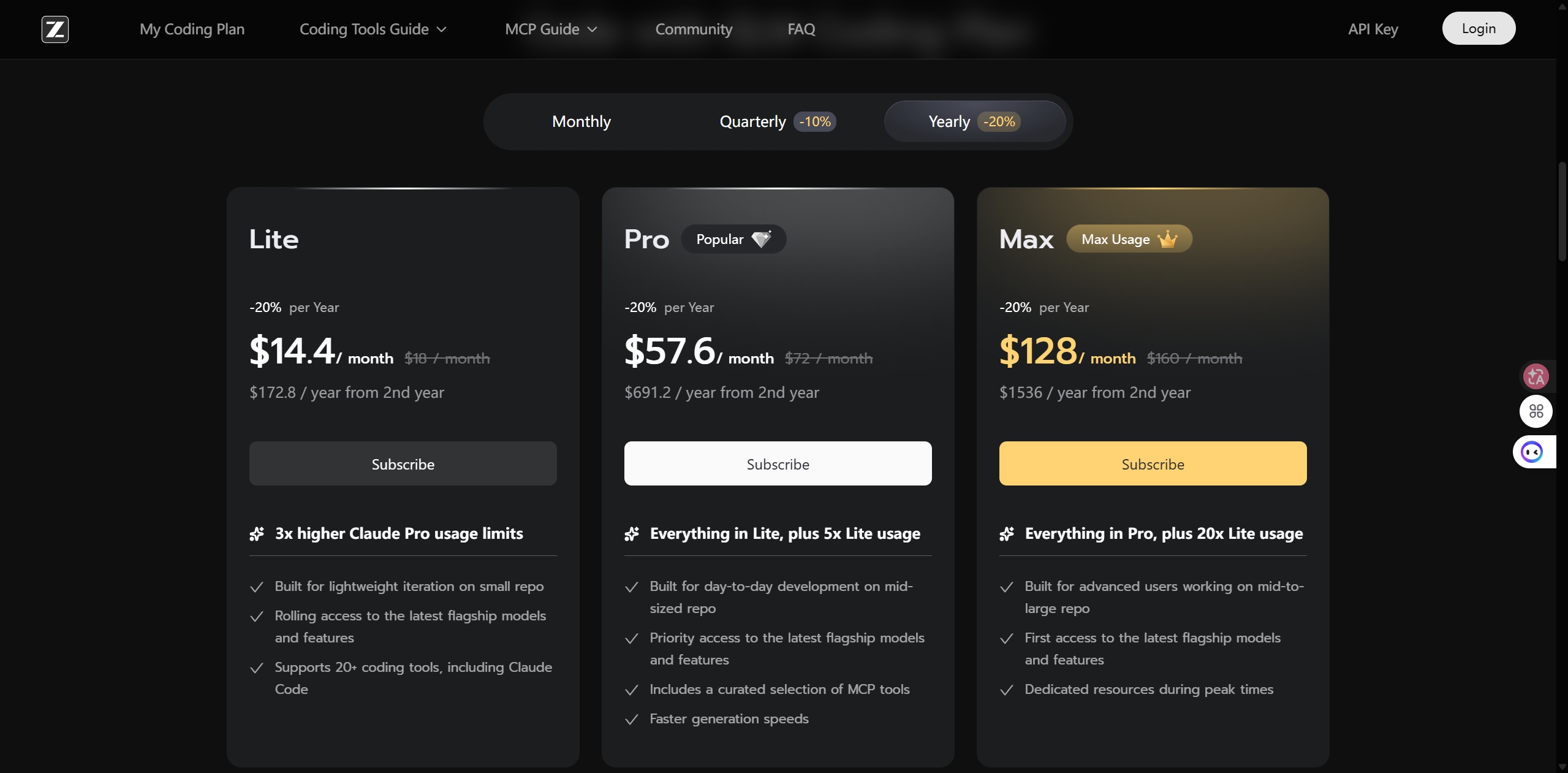
After payment, go to your account dashboard and open the API Key page. Create a new API key and save it safely. You will need this key to connect GLM-5.1 with coding tools.
Configure Your Coding Tool
Z.AI provides an official command-line helper called:
npx @z_ai/coding-helperOpen your terminal and run the command above.
Then follow the setup steps:
1. Select platform: [Global] GLM Coding Plan
2. Enter your Z.AI API key
3. Choose your coding tool, such as Claude Code, Cursor, Cline, or OpenCode
4. Select optional MCP tools if needed, such as web search or visual analysis
5. Finish the setup
The helper tool will automatically configure your selected coding tool. You do not need to manually edit complex config files.
Use GLM-5.1 Through API
If you are building an app, website, SaaS product, bot, or backend service, use the API instead of the coding subscription.
You can access GLM-5.1 through:
Z.AI official API platform
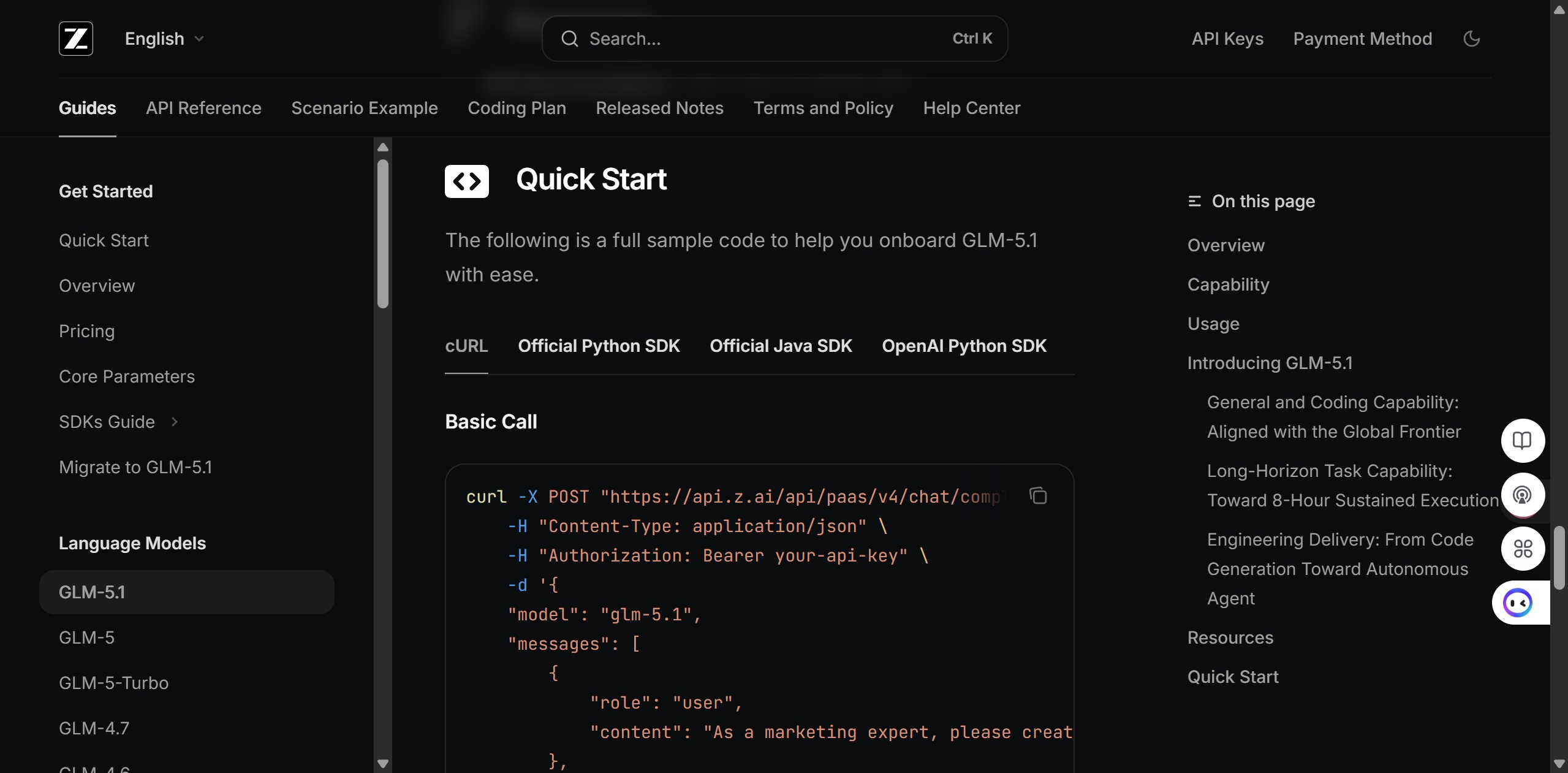
BigModel / Zhipu AI platform
Other supported API providers, such as WaveSpeed API, if available
This method is best for developers who want to integrate GLM-5.1 into their own products.
Use Open Weights
After the open-weight version is released, GLM-5.1 can be downloaded from platforms such as:
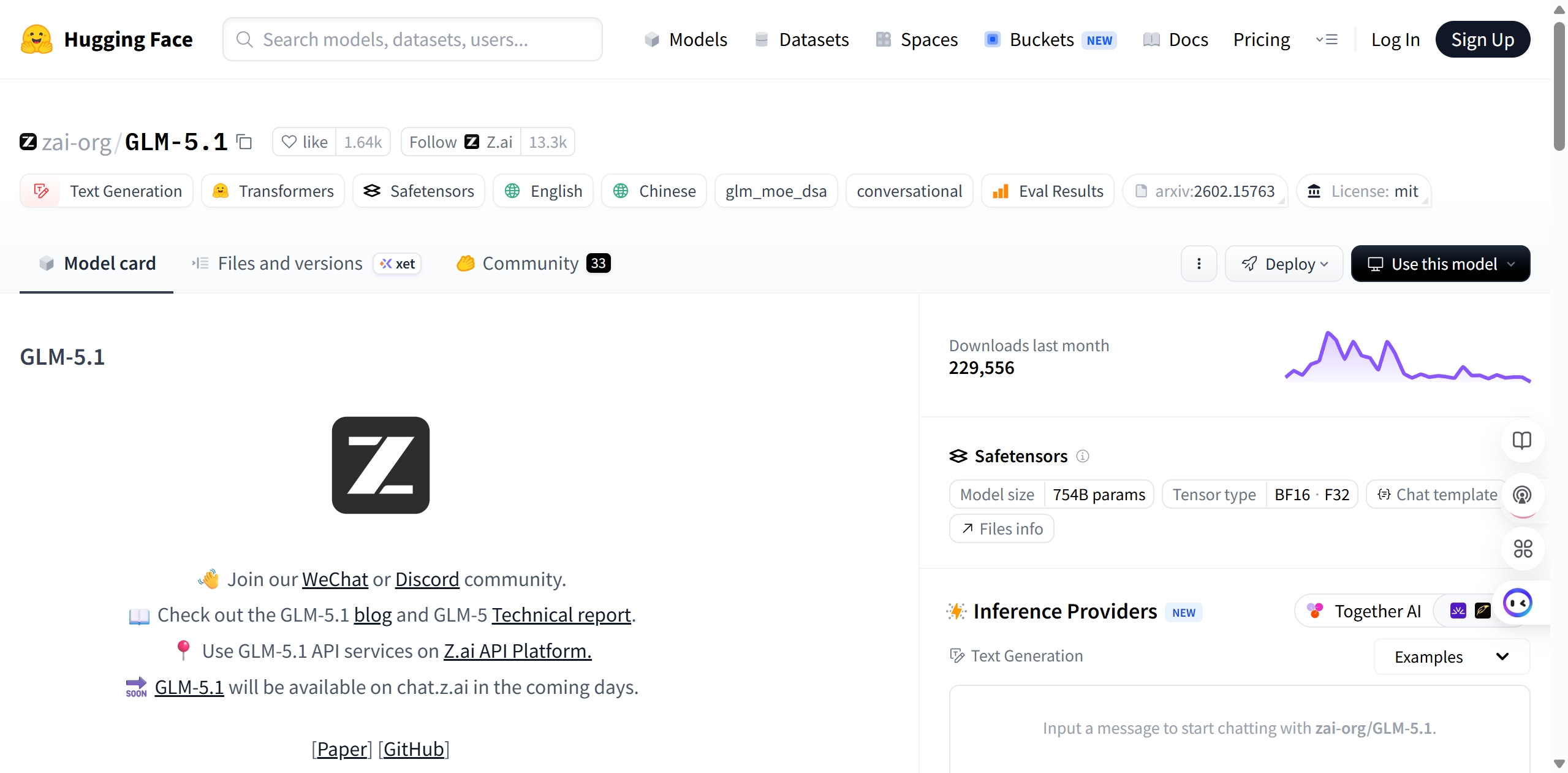
ModelScope
The model is expected to use the MIT license, which means developers can self-host it, fine-tune it, and build their own systems around it. This option is best for teams that have their own GPU resources and want full control.
Try It on GlobalGPT
If you do not want to set up anything, the easiest way is to try GLM-5.1 directly on the GlobalGPT platform.
This is the simplest option for quick testing before choosing API access, subscription access, or self-hosting.
Conclusion
GLM-5.1 is a strong new AI model built for coding, long-context tasks, and autonomous agent workflows. It offers competitive performance, a 200K context window, and a clear price advantage compared with many top models. For developers, it can be used through API, coding tools, or open weights after release. For regular users who want the simplest experience, GlobalGPT provides an easy way to try GLM-5.1 without complex setup.
FAQ
Is GLM-5.1 really better at coding than GPT-5.5?
According to Z.ai’s official reports, GLM-5.1 achieved a score of 58.4 on SWE-Bench Pro, outperforming GPT-5.4, Claude Opus 4.6, and Gemini 3.1 Pro. But this result has not yet appeared on the official SWE-Bench leaderboard.
According to the Artificial Analysis report, GLM-5.1 is not stronger than GPT-5.5 in coding performance. However, it performs better than GPT-5.4.
