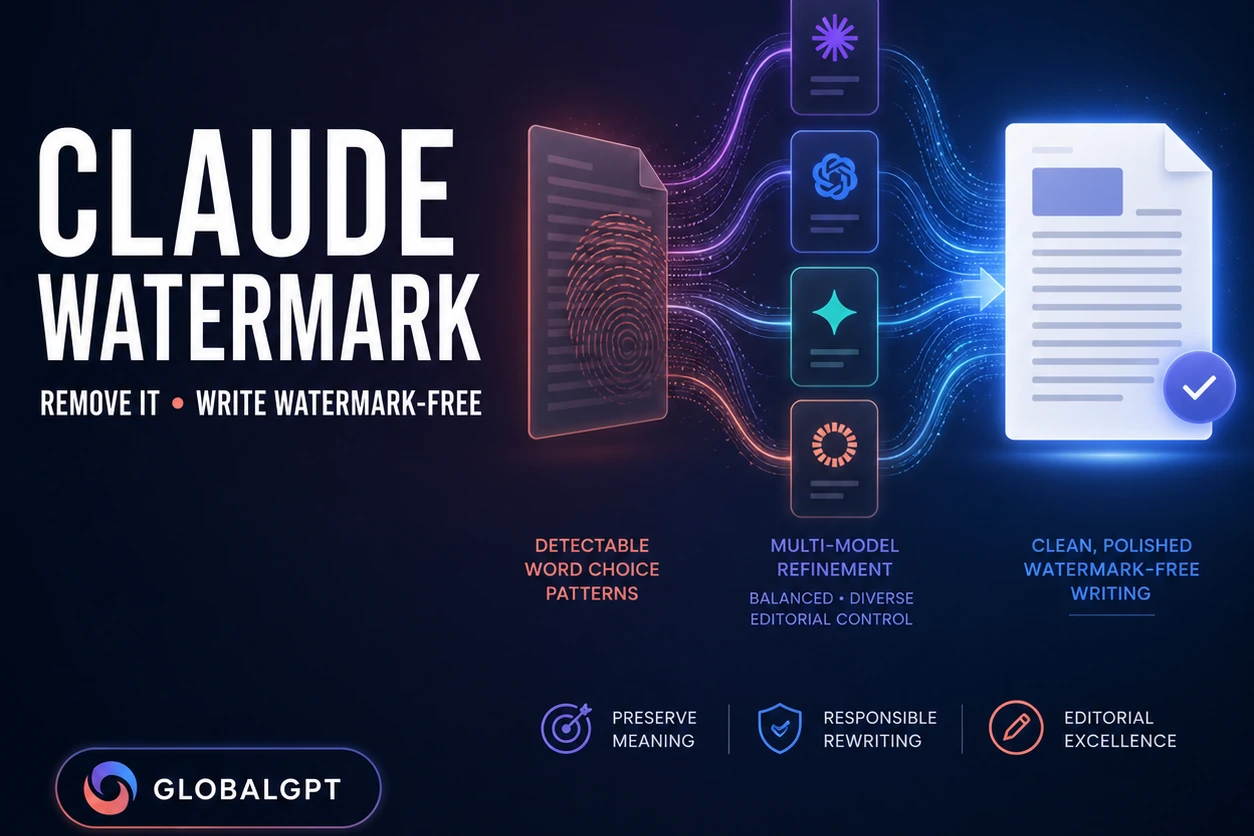
The practical fix depends on what you are trying to change. If an existing article was generated with a supported Claude route, a formatting cleanup is not the same thing as a rewrite. Start from the original brief and evidence, rebuild the structure, and let a person approve the final wording.
For future writing, GlobalGPT brings research, outlining, drafting, and model perspectives into one workspace. That makes it easier to compare approaches and keep a human editor in the loop without turning the article into a promise about detector results.
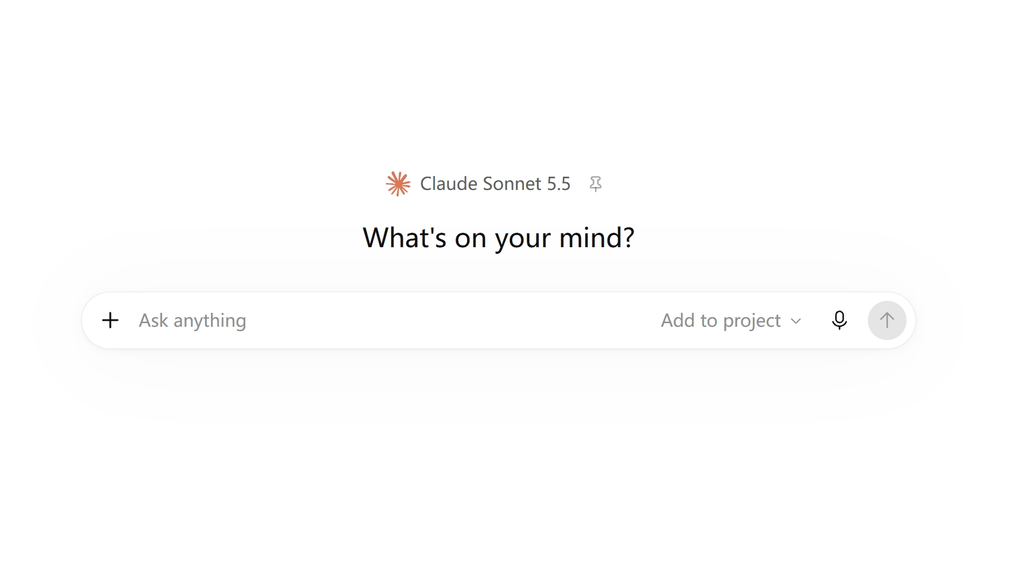
What Is the Claude Watermark and What Did Anthropic Announce?
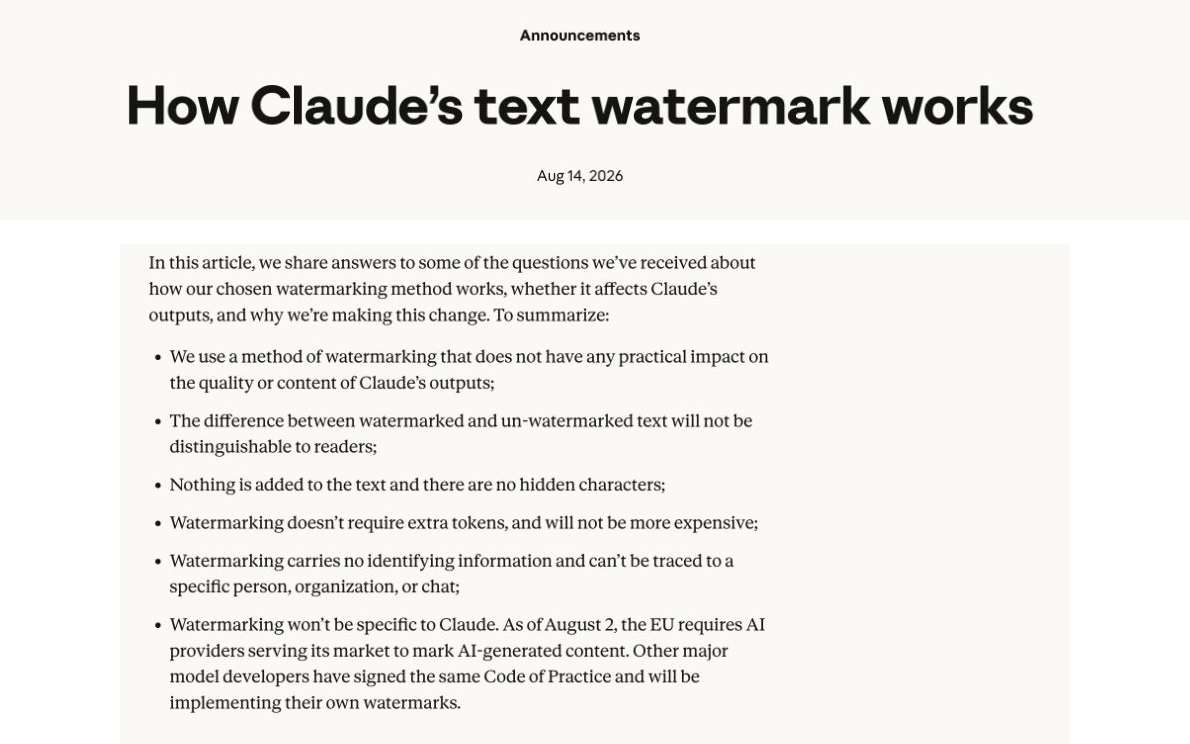
Anthropic’s August 14, 2026 announcement describes a text watermark as a statistical signal created through word choices. Nothing is appended to the text, there are no hidden characters, and the difference between marked and unmarked text is intended to be indistinguishable to readers.
Does Claude add the mark to every response?
The careful phrase is supported models. The Claude Help coverage page says models launched in the EU on or after August 2, 2026 support machine-readable marking at launch. Older models are being added on a rollout schedule, and routes or features may differ.
Why did Anthropic introduce text marking now?
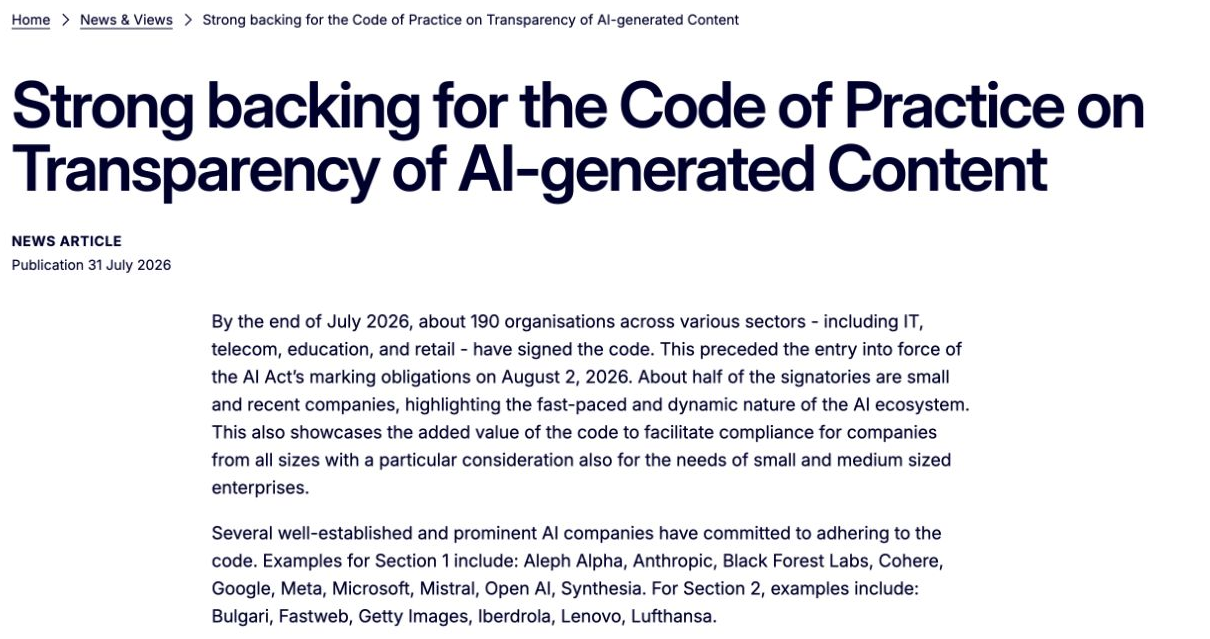
Anthropic connects the change to transparency obligations for AI-generated content. The European Commission’s policy page explains the Article 50 context and also makes clear that voluntary code participation and legal obligations are separate ideas.
What the announcement does not say
- A positive signal does not identify a person, organization, account, or chat.
- The signal is not a visible quality grade or a claim that the text is false.
- The announcement does not provide a universal public checker or a detector accuracy table.
How Does Claude’s Invisible Text Watermark Work?
Large language models often have several plausible next words. A watermark can use a keyed source of randomness to make those low-stakes choices in a repeatable statistical way. Across enough tokens, the sequence can be tested by someone who has the right key; the pattern is in the choices, not in an extra character.
Is it hidden Unicode or a zero-width character?
No. Anthropic explicitly says nothing is added and there are no hidden characters. A formatting cleaner can change presentation, but it cannot undo a pattern expressed through ordinary word choices.
How is this different from a generic AI detector?
A generic classifier learns surface patterns from example text and returns a model-specific score. A keyed watermark detector asks a different question: whether a passage is statistically consistent with a particular generation scheme. A classifier score is not a keyed Claude result.
Four different things people call a watermark
Choose the evidence that matches the question
A text signal, a classifier score, signed file metadata, and a visible overlay answer different questions. They should not be merged into one “AI detector” result.
A keyed pattern across token choices. An authorized keyed detector may estimate whether the sequence is consistent with the mark.
A post-hoc score based on surface patterns. It does not automatically have Anthropic’s key.
Signed provenance metadata attached to a supported file. It is separate from a text watermark.
Text, a logo, or a mark that can be seen in the pixels. It is a different production feature from Claude’s text signal.
Decision rule: identify the medium first—text, classifier output, file metadata, or pixels—then choose the matching evidence. None of these alone proves who authored the work or whether a policy was broken.
The Nature paper on SynthID-Text is useful for the general mechanism and its limits, including the way edits can weaken a generative watermark. It does not independently prove that Claude uses every method described in that paper.
Can You See or Detect a Claude Text Watermark?
You cannot inspect the Claude text mark by looking at the prose. Detection needs enough suitable text and the detector’s key. That is why a visible overlay, a generic AI score, and an official keyed result should never be reported as if they were the same thing.
Is there an official Claude watermark detector today?
Anthropic’s current announcement says its detection API is in private preview. The access description covers eligible organizations required under EU law—such as regulators, law enforcement, media, fact-checkers, independent researchers, educational organizations, and EU civil society groups—and enterprises with a similar compliance obligation. That is materially different from a free public checker anyone can paste text into.
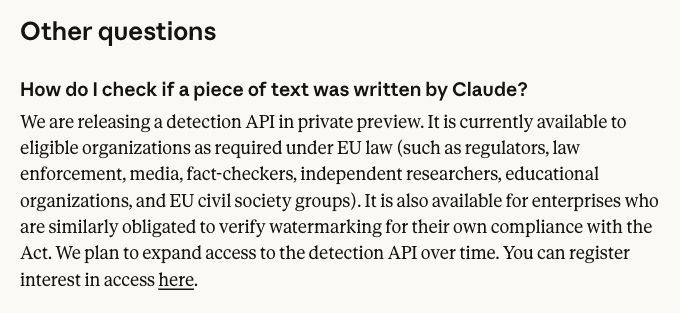
The Anthropic news post is dated August 14, 2026, and its detection API information is marked as updated September 1, 2026. Treat those as the source’s publication and update dates, not as a claim that access is universal or permanent.
What can a generic detector prove?
It can report that text resembles patterns its own classifier associates with AI writing. It cannot show that Anthropic’s key was used, identify a writer, or prove that a rule was broken. If a school, publisher, or employer needs a defensible decision, the workflow record matters more than a single score.
Coverage and detection decision map
What should you check first?
Check the supported model, route, date, and whether an authorized keyed detector is available. A generic classifier is a separate signal.
Look for Content Credentials (C2PA) where the route supports file processing. Metadata can be absent or stripped.
Inspect the pixels and the product’s export settings. A visible overlay is not Anthropic’s statistical text mark.
Use drafts, source notes, version history, interviews, and policy records. No mark or classifier score supplies that context by itself.
Source scope: Anthropic’s announcement and Claude Help page checked 2026-09-30; C2PA is described as a separate file-provenance layer. This map contains no detector accuracy or rewrite pass-rate claim.
Why “detector-negative” is the wrong promise
A rewrite changes the text and may weaken one signal, but different systems look for different things. A negative generic-classifier score would not prove that no model was used; an unavailable keyed check would not prove the opposite. Keep the language about better writing, traceable sources, and accountable editing.
How to Responsibly Rewrite an Existing Article
Anthropic says light editing probably will not remove the watermark completely, while a complete rewrite that replaces every word will. Read that as a statement about changing the marked text—not as a promise to pass a detector, establish authorship, or satisfy a policy.
What does not solve the problem?
- Changing fonts, spacing, or document format changes presentation rather than the word-choice sequence.
- Deleting zero-width characters targets a different mechanism because Anthropic says no hidden characters are appended.
- Copying the article into a new document preserves the wording and therefore does not create a new editorial work.
- Running the result through several generic checkers does not turn those scores into an official Claude verdict.
A complete rewrite has a higher standard
Use the original brief and source set, then make a new structure and new prose. Preserve facts that survive verification, remove unsupported claims, and record what a human editor changed. If disclosure applies in your setting, make that decision explicitly rather than treating a watermark question as a shortcut around it.
Responsible rewrite
A source-led rewrite that has a clear audit trail
The goal is a better, accountable article. A changed text may no longer match the original statistical pattern, but that is different from a guarantee about any downstream checker.
Keep the brief, sources, facts, and claims worth saving.
Change the structure and write fresh sentences from the evidence.
Recheck dates, names, links, product claims, and quotations.
Follow the relevant school, client, publisher, or workplace rule.
Put a named human editor behind the final claims and wording.
How should the final text be checked?
- Read it against the primary sources, not against the old draft.
- Check every date, model name, product route, quote, and link.
- Ask whether the article answers the reader’s question without a detector-evasion guarantee.
- Keep a version history and name the person responsible for final publication.
How Can You Keep Future Articles Watermark-Aware and Accountable?
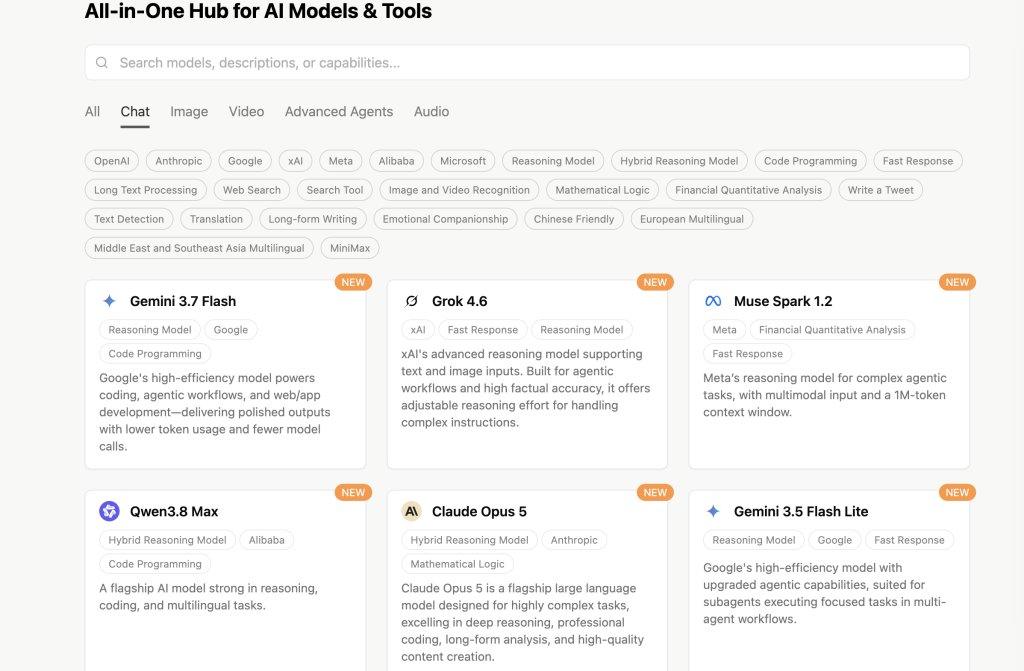
For a new brief, GlobalGPT can keep research, outlining, drafting, and comparison in one multi-model workspace. The useful value here is workflow control: start with sources, ask for more than one structure, and let a human choose what survives. That is a writing process, not a promise that every downstream checker will return a particular result.

Use the workspace for a concrete sequence
The AI writing tools guide is a relevant next read when you are choosing a tool for long-form, SEO, or editorial work. Within the workflow itself, keep the steps simple:
- Define the reader, search intent, angle, and claims that need support.
- Collect primary sources before asking for polished prose.
- Use more than one model perspective to expose missing questions or weak structure.
- Choose one outline and draft against the evidence rather than copying the longest output.
- Verify dates, quotations, product statements, and links.
- Apply a human voice, disclosure decision, and final approval.
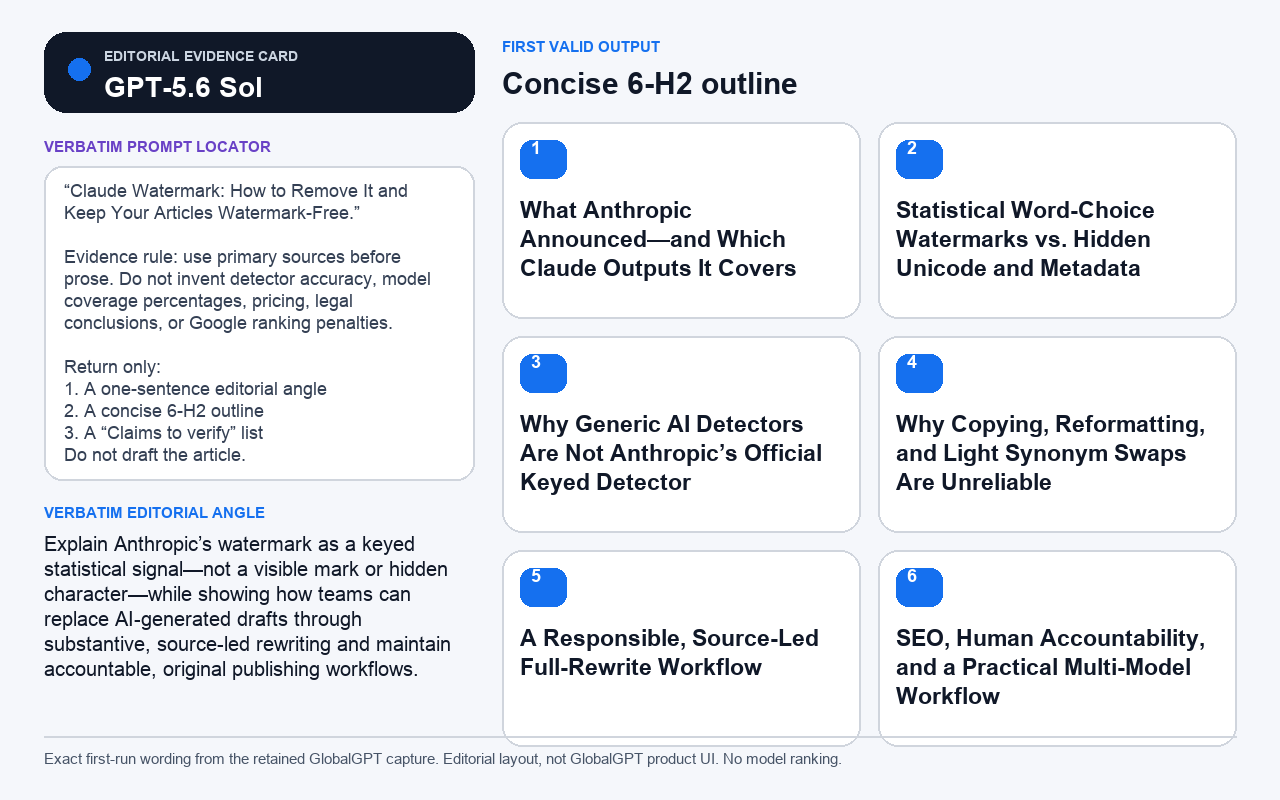
Keep more than one perspective, but keep one editorial owner
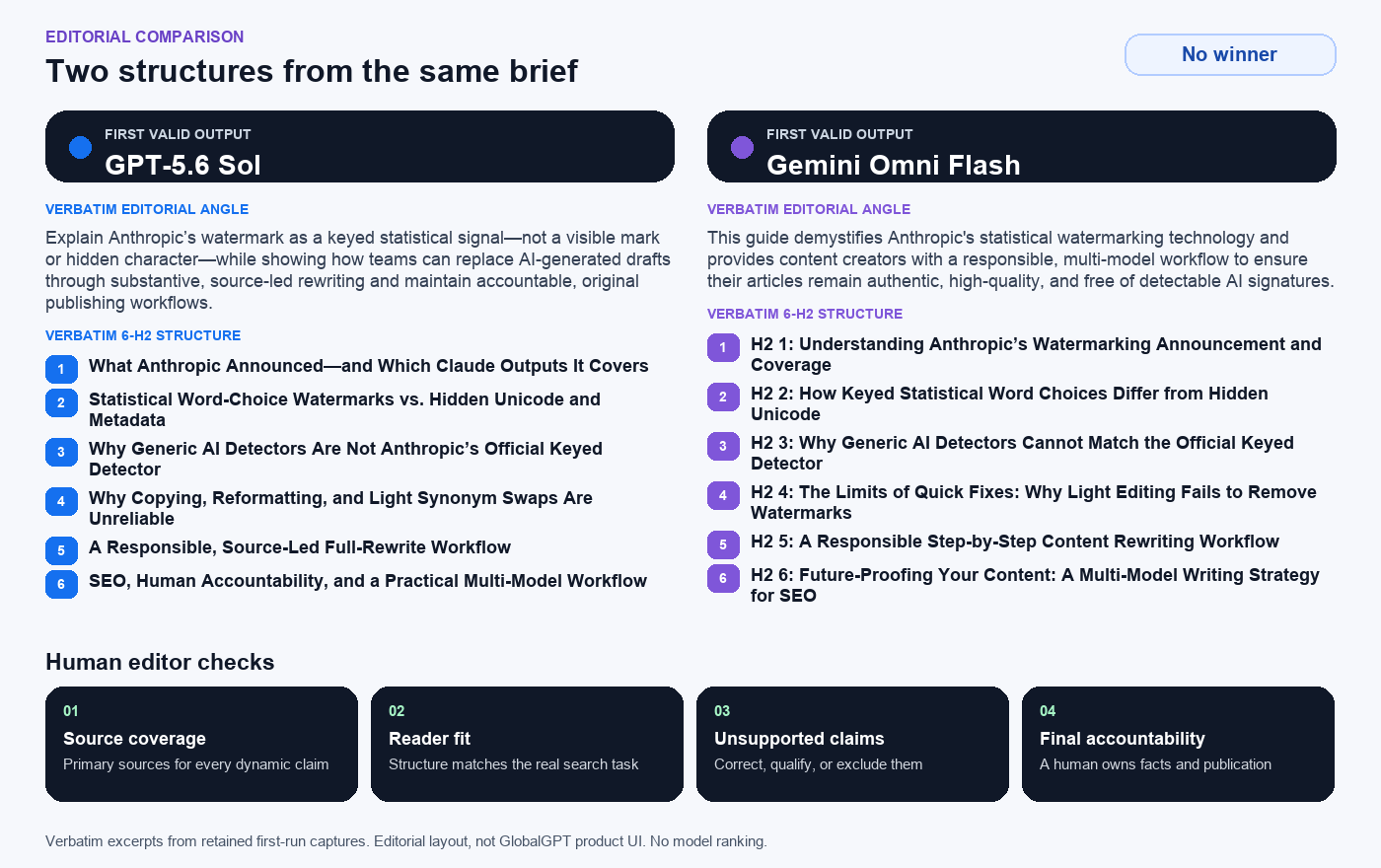
A second outline can expose a missing section or a clearer order. It does not become a model leaderboard. The editor still decides which claims belong in the article and which need to be removed.
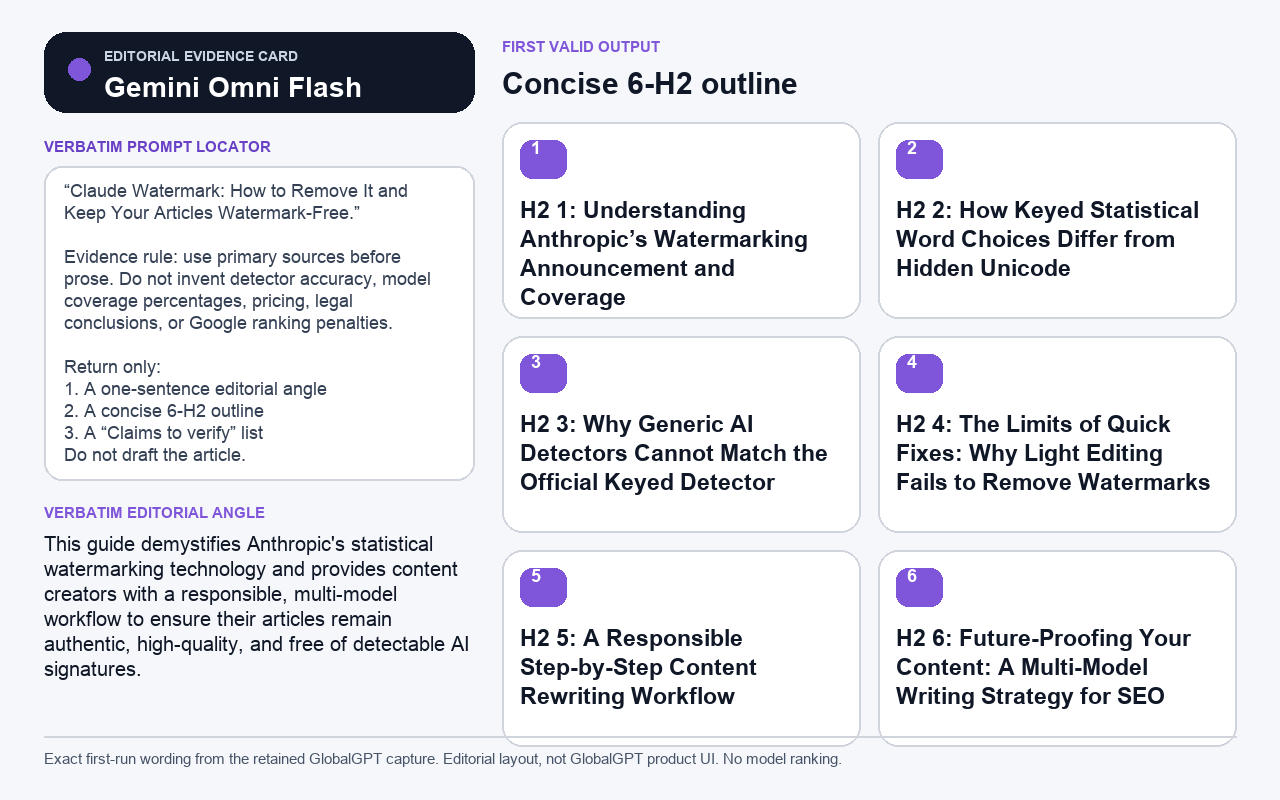
If you are comparing broader tools, the Claude alternatives guide can help frame the choice around the work you need to finish. Availability and access are separate questions from the writing method, so keep the final recommendation tied to the route you actually use.
Review the sources before you share
A multi-model workspace can make source review and drafting easier. It does not transfer responsibility for facts, permissions, disclosures, or publication to the tool.
What Does AI Text Watermarking Mean for SEO, Writers, Schools, and Businesses?
A text watermark is provenance context, not a visible quality grade. The practical question is what evidence the decision-maker needs alongside it.
Will Google penalize a watermarked article?
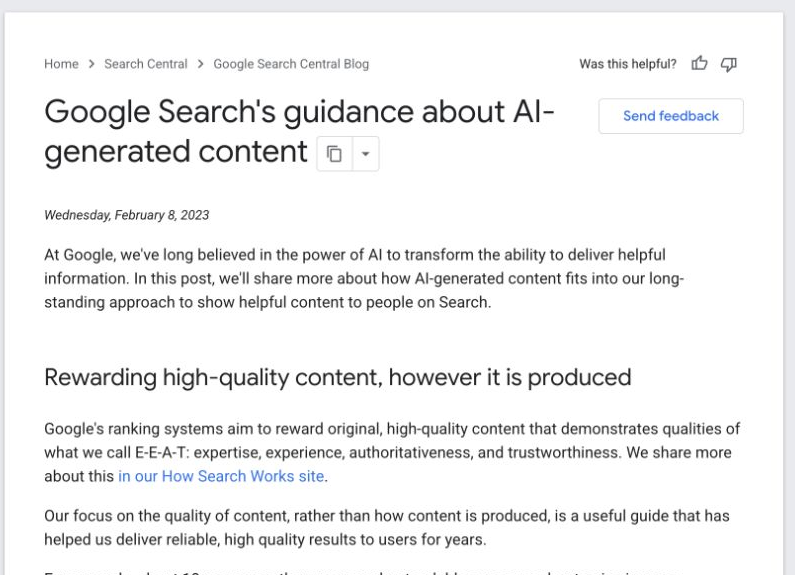
Google Search’s guidance says its systems aim to reward helpful, high-quality content regardless of how it was produced, while automation used mainly to manipulate rankings can violate spam policies. That supports a quality-and-intent discussion; it does not establish an automatic penalty for a Claude mark.
Use the signal as context, not a verdict
The right next step depends on the decision you are making.
| Audience | Use the signal for | Do not infer |
|---|---|---|
| Writers and editors | Review sources, version history, disclosures, and final human approval. | That the wording is false, plagiarized, or ownerless. |
| SEO teams | Evaluate helpfulness, originality, factual support, and scaled-content risk. | An automatic ranking penalty from the mark alone. |
| Schools | Combine process evidence with a clear AI-use policy. | That one result proves misconduct or intent. |
| Enterprise and API teams | Log model, route, version, policy, sources, and approvals. | That every legacy model or platform has identical coverage. |
What should teams keep?
Keep source notes, major revisions, version history, and the person who approved the final claims. Those records answer questions a statistical text signal cannot, including who commissioned the work, which sources were used, and why the final wording was chosen.
Which Claude Models, Products, and Outputs Are Covered?
Claude Help describes coverage as broad but conditional. The page says models launched in the EU on or after August 2, 2026 support machine-readable marking at launch, while support is being added to earlier models with all covered models targeted by December 2, 2026. Recheck the page before using that rollout as a current model-by-model list.
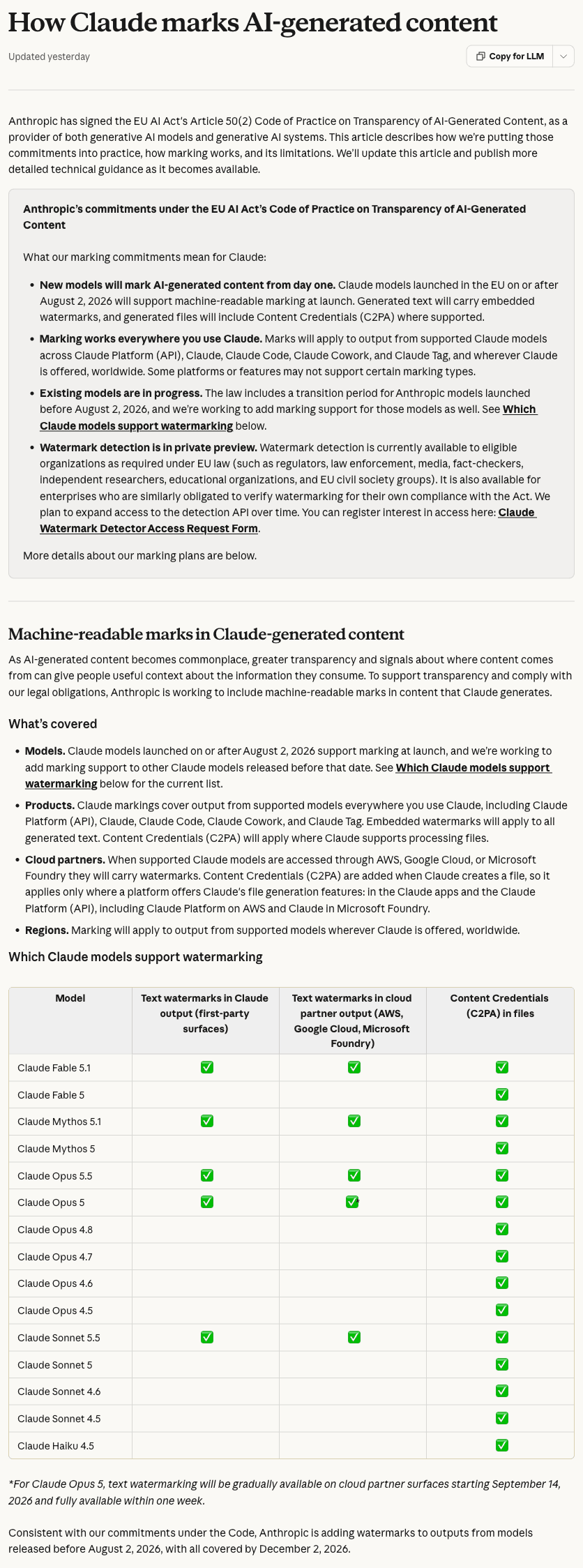
The captured Help page separates model support from product, cloud-partner, regional, and file scope. Blank cells in its model table are not proof of a permanent exemption; the Opus 5 cloud-partner note describes a gradual transition from September 14, 2026, and December 2, 2026 is a future coverage target in this capture. The page header says “Updated yesterday,” so no exact update date is inferred.
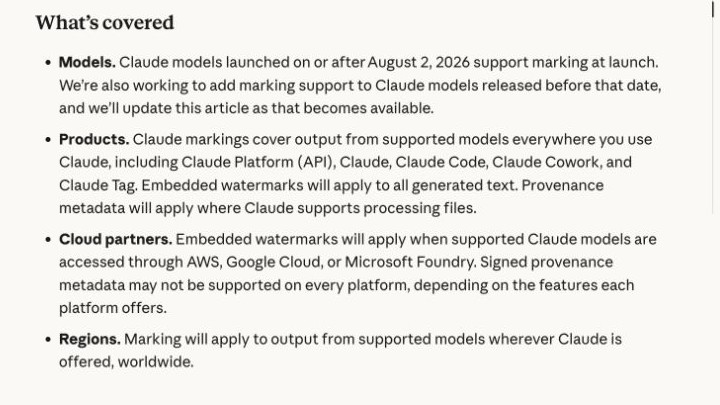
Products, routes, and cloud partners
- Claude products named by the Help page include Claude Platform/API, Claude, Claude Code, Claude Cowork, and Claude Tag, subject to supported models and features.
- Supported Claude models accessed through AWS, Google Cloud, or Microsoft Foundry can carry embedded text marks; platform features may differ.
- The Help page says marking applies worldwide where supported Claude models are offered.
- Generated files may use C2PA Content Credentials where Claude supports file processing. That file layer is separate from the text signal.
What “covered” still leaves open
Coverage does not mean every historic response, every feature, or every file type has the same marking behavior. It also does not tell you who authored a passage or whether a particular generic detector will agree. For a high-stakes decision, record the exact model, route, date, file/text medium, and policy that applied.
Claude Watermark FAQ
Does Claude add watermarks to text?
Supported Claude models add machine-readable text marking. Claude Help says models launched in the EU on or after August 2, 2026 support marking at launch, while older-model support is still being added. Coverage depends on the model, route, feature, and content type.
Does copy-paste remove the watermark?
No. Copying and formatting changes do not reverse a statistical word-choice pattern. Light editing may preserve it; a complete rewrite changes the text itself, but that is not a guarantee about every detector or provenance system.
Can GPTZero detect Claude’s actual watermark?
GPTZero and similar services are generic classifiers. They do not automatically have Anthropic’s keyed detector, so their scores should not be presented as an official Claude watermark result.
Is there an official Claude watermark checker?
Anthropic says its detection API is in private preview for eligible organizations and enterprises with relevant compliance needs. Access is not a universal public checker, and the official pages should be rechecked before a high-stakes decision.
Does the watermark prove Claude wrote the article?
No. Anthropic says the mark carries no identifying information and does not establish ownership, authorship, the user, the organization, the chat, or a policy violation.
Will Google penalize a watermarked article?
Google’s guidance emphasizes helpful, high-quality content and the intent behind scaled automation. It does not state an automatic penalty for an Anthropic text mark. Quality, originality, factual support, and spam-policy compliance still matter.
Are C2PA credentials the same as a Claude text watermark?
No. C2PA is signed provenance metadata attached to supported files. A Claude text watermark is a statistical pattern in generated text. They answer different questions and can be absent for different reasons.
Can GlobalGPT guarantee a watermark-free article?
No tool should promise a detector-negative or policy outcome. GlobalGPT gives writers one workspace for research, outlining, model perspectives, drafting, and human review; the editor still owns the sources, disclosures, and final claims.
For the next article, try a source-led brief in GlobalGPT and keep the final checks with a human editor. The useful outcome is a better, traceable article—not a claim that one tool can guarantee a detector result.