

A complete email in one draft
Create a clear subject line, a brief absence notice, and a professional closing, ready for your final check.
Choose your situation and add your absence dates, preferred tone, and expected return or next update. Get a subject line and email body you can review, copy, and send. You can also paste an existing message to make it clearer or shorter.
Prompt Guide
Model
Say you are unable to work, give your absence dates, and let your manager know when to expect your return or an update. Copy a template below or create a message that fits your situation—without sharing more health detail than you want to.
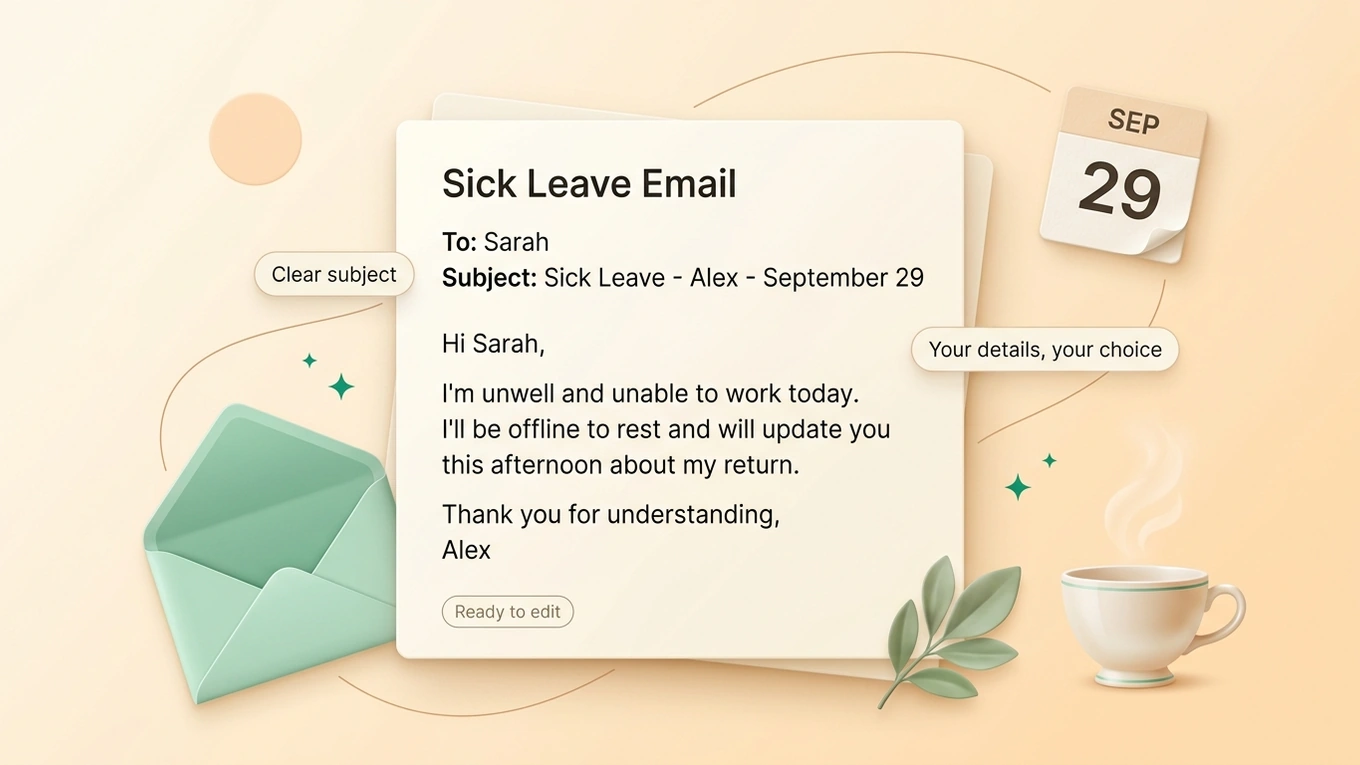
Keep it short. Your manager mainly needs to know when you will be away and when they will hear from you again.
Use a subject such as “Sick leave — [Your name] — [Date]”. Address your manager and say that you are unwell and unable to work on the relevant date or dates.
If you expect to return on a particular day, say so. If you are unsure, state when you can provide an update. Mention an urgent task or handover only if it needs attention.
Replace the bracketed details, check the dates, and send the message as soon as reasonably possible. Follow your employer's reporting process, including a call or HR notification if required.
Create a clear subject line, a brief absence notice, and a professional closing, ready for your final check.
Find wording for a single sick day, several days away, leaving work early, or extending leave already in progress.
Tell your manager when you will provide another update if you do not yet know when you can return.
Use a simple statement such as “I'm unwell and unable to work”. Include more detail only when it is relevant and you choose to share it.
Point to a deadline, file, or agreed contact so your manager knows what needs attention while you rest.
Choose formal, friendly, or very brief wording. Refine a message you have already written while keeping your names, dates, and meaning.
Include a clear subject line, the date of your absence, and your expected return or next-update time. For example: “Hi [Manager], I'm unwell and unable to work today, [date]. I'll update you by [time] about my return. Thank you, [Your name].” Add an urgent handover only if it is needed.
Use “Sick leave — [Your name] — [Date]” for a one-day absence, “Sick leave — [Your name] — [Start date–end date]” for several days, or “Sick leave update — [Your name]” for a follow-up. Follow your employer's preferred format if it has one.
Notify your manager as soon as reasonably possible, ideally before your shift starts. Follow your employer's process: you may also need to call, record the absence in an HR system, or notify a designated contact. If an emergency prevents early notice, get in touch as soon as you can.
Keep the initial message brief; a statement such as “I'm unwell and unable to work” often communicates what your manager needs to know. Requirements for medical information or a doctor's note vary by workplace, location, and circumstances. Check the applicable process and provide required documents through the appropriate channel.
Say that you are still unable to work and give a realistic time for your next update. For example: “I'm still unwell and won't be able to return on [date]. I'll update you by [day/time].” If you have a tentative return date, describe it as expected rather than certain.